
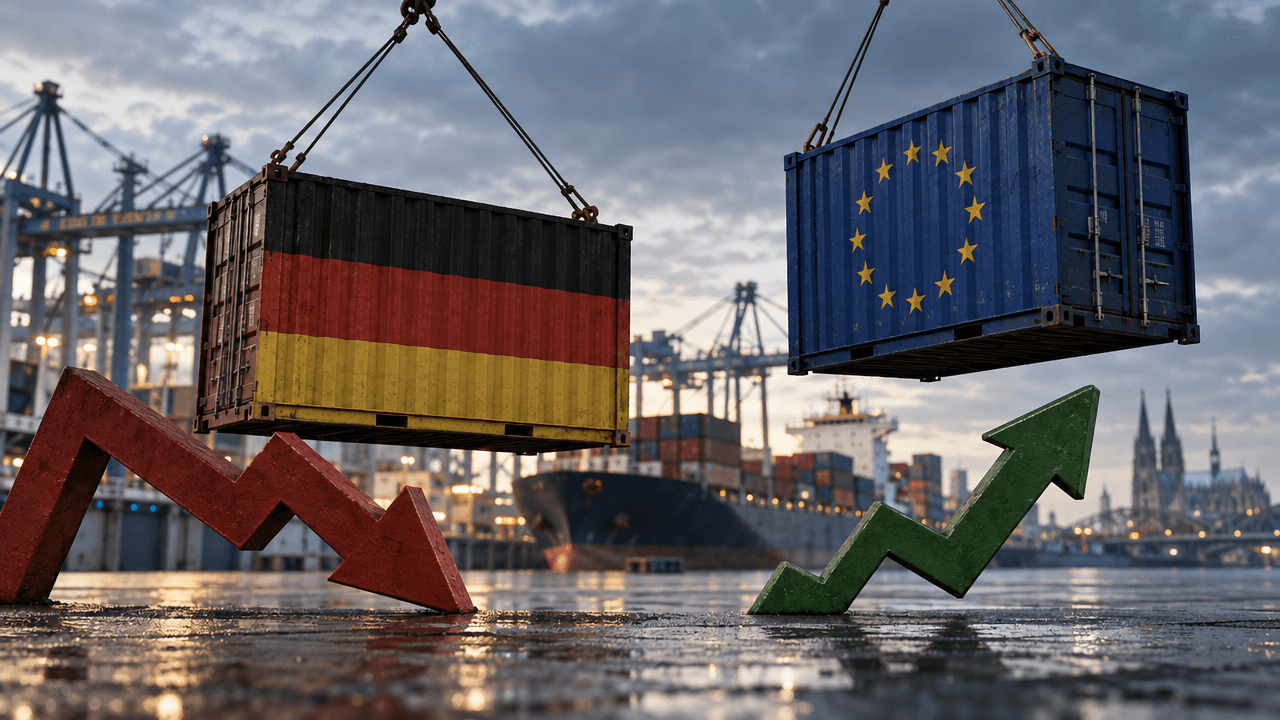
The latest German trade release has added another layer of uncertainty to the euro’s near-term outlook. August exports fell by 0.8% month-on-month, defying expectations for a rebound, while imports rose 0.9%, a combination that points to weakening external demand and softening momentum in Europe’s largest economy.[2][8][12] The trade surplus narrowed to around €19.5 billion from €21.6 billion in July, yet still came in slightly above market forecasts, underscoring a picture of resilience but fading strength.[2][8][9] For currency traders, this mix of weaker growth signals and only modestly better headline balances is likely to weigh on euro sentiment as markets reassess the region’s growth story.
Current Data: Weaker Trade Momentum
August’s figures mark the second consecutive month of declining exports, following a 0.5% drop in July.[12] Consensus had expected exports to rise by roughly 0.8%, making the negative surprise particularly noteworthy for markets attuned to Germany’s role as the euro area’s export engine.[12] Imports, by contrast, staged a moderate recovery, rising 0.9% after a sharp 5.5% decline the month before.[2][12] The result is a trade surplus that remains large by international standards but is moving lower at the margin, suggesting that the cushion Germany typically provides to euro area demand is becoming less generous.[2][3]
Drilling into the regional picture, recent data have indicated softer exports to key partners, including the United States and parts of the European Union, even as some demand from China and other markets shows signs of stabilisation.[2][5][9] Earlier in the summer, exports to euro area partners had already been under pressure, while shipments to non-euro countries offered only limited offset.[5] This gradual cooling of foreign demand matters because Germany’s export-oriented model amplifies global cycles into the euro area, especially when domestic demand is constrained by high energy costs and cautious business investment.[11]
Why German Trade Matters For The Euro
Germany remains one of the most open and trade-dependent economies among the major advanced markets, with exports accounting for a very large share of GDP.[11] As a result, changes in its trade performance are often read as a proxy for broader euro area growth prospects, particularly in manufacturing and capital goods. When export growth disappoints, it raises questions about corporate earnings, employment in export-heavy regions, and the strength of the euro bloc’s cyclical recovery.
For the euro, the signal is twofold. First, weaker German trade data tends to reinforce concerns that the euro area is unable to fully leverage global demand, which can dampen expectations for future interest rate increases and reduce foreign capital inflows. Second, if weaker trade translates into slower growth, markets may perceive the euro as less attractive relative to currencies backed by stronger cyclical stories, such as the US dollar during periods of robust US demand. This dynamic is especially relevant when the euro has already been under pressure from other sources, including political uncertainty and patchy industrial data.[14]
Growth Risks Versus Persistent Inflation
The challenge for policymakers and traders is that weaker trade comes at a time when inflation pressures, particularly those linked to energy, have been slow to fully recede. Even if headline energy prices have stabilised, the cost shock of previous years continues to filter through industrial contracts, transport costs, and utility bills, keeping input prices elevated for German manufacturers. That combination—softer demand abroad and lingering cost pressures at home—squeezes margins and can discourage new investment and hiring.
From a market perspective, this is a classic “stagflation-lite” concern: growth indicators disappoint while inflation remains uncomfortably sticky. In such a backdrop, central banks face a difficult balancing act. If the European Central Bank is seen as constrained in its ability to cut rates aggressively because inflation has not fully normalised, yet growth data like trade and factory orders keep weakening, investors may price in a less supportive environment for euro-denominated assets.[14] This tension tends to cap euro rallies and make the currency more sensitive to negative surprises in data releases, including trade reports that previously might have been dismissed as second-tier.
How Fx And Rates Markets May React
In the short term, the direct impact of a single trade release on the euro is usually modest, but surprises relative to expectations can matter. Here, the unexpected drop in exports and the upside surprise in imports increase the probability that analysts will revise down growth forecasts for Germany and, by extension, the euro area.[2][12] For FX traders, that can translate into a bias to sell the euro on rallies, especially against currencies supported by stronger data or higher real yields.
Bond markets may also react by nudging German yields lower at intermediate maturities, reflecting softer growth expectations and a potential for more cautious ECB rhetoric, even if immediate rate cuts remain off the table. Equity markets, particularly export-heavy sectors like machinery, autos, and chemicals, could see increased volatility as investors reassess earnings sensitivity to slower global trade. While the headline surplus still looks healthy, the direction of travel—narrowing surplus, weaker exports, recovering imports—is more important for pricing than the absolute level.[2][3]
Practical Takeaways For Traders
For traders on simulated finance platforms such as E8 Markets, this type of data release offers a valuable case study in macro-driven market dynamics. First, attention should focus on how the trade data compares to forecasts, not just the headline numbers. In August, the key story is the negative export surprise versus expectations for a rebound.[12] Second, note the composition: exports to major partners softening while imports recover can hint at both weaker external demand and relatively resilient domestic consumption or restocking demand.[2][5][9]
Third, traders can build scenarios around how upcoming indicators—such as industrial production, PMI surveys, and inflation prints—might confirm or contradict the picture painted by trade data. If subsequent releases echo the same message of softening momentum, the euro is more likely to remain under pressure, and strategies that favor selling euro rallies or expressing relative weakness via crosses (for example, EUR versus USD or CHF) may gain traction. Conversely, if future data show a rebound in orders and exports, the current trade setback could be viewed as noise rather than the start of a new downtrend.
Finally, simulated trading offers a controlled environment to test macro-informed strategies without capital at risk. Traders can design playbooks that specify entries and exits around key data releases, using historical reactions to German trade and other indicators as guides. Over time, this helps build discipline in integrating macro signals into trading decisions, which is essential in a market where currency moves increasingly hinge on the interplay between growth and inflation narratives.
Conclusion: Navigating A Data-driven Euro Outlook
Weak German trade data is not a crisis event, but it is a meaningful signal for the euro at a time when the currency already faces headwinds from uneven growth and lingering inflation pressures. The negative surprise in exports, coupled with a narrower yet still sizeable trade surplus, reinforces the sense that Europe’s growth engine is running below potential.[2][3][12] For traders, the main takeaway is that the euro’s path will be shaped less by any single data point and more by the emerging pattern across trade, production, and prices. Using simulated environments to interpret and act on these signals can turn routine data releases into opportunities to refine strategy, build macro intuition, and prepare for the moments when ordinary numbers tip market sentiment in a decisive way.