
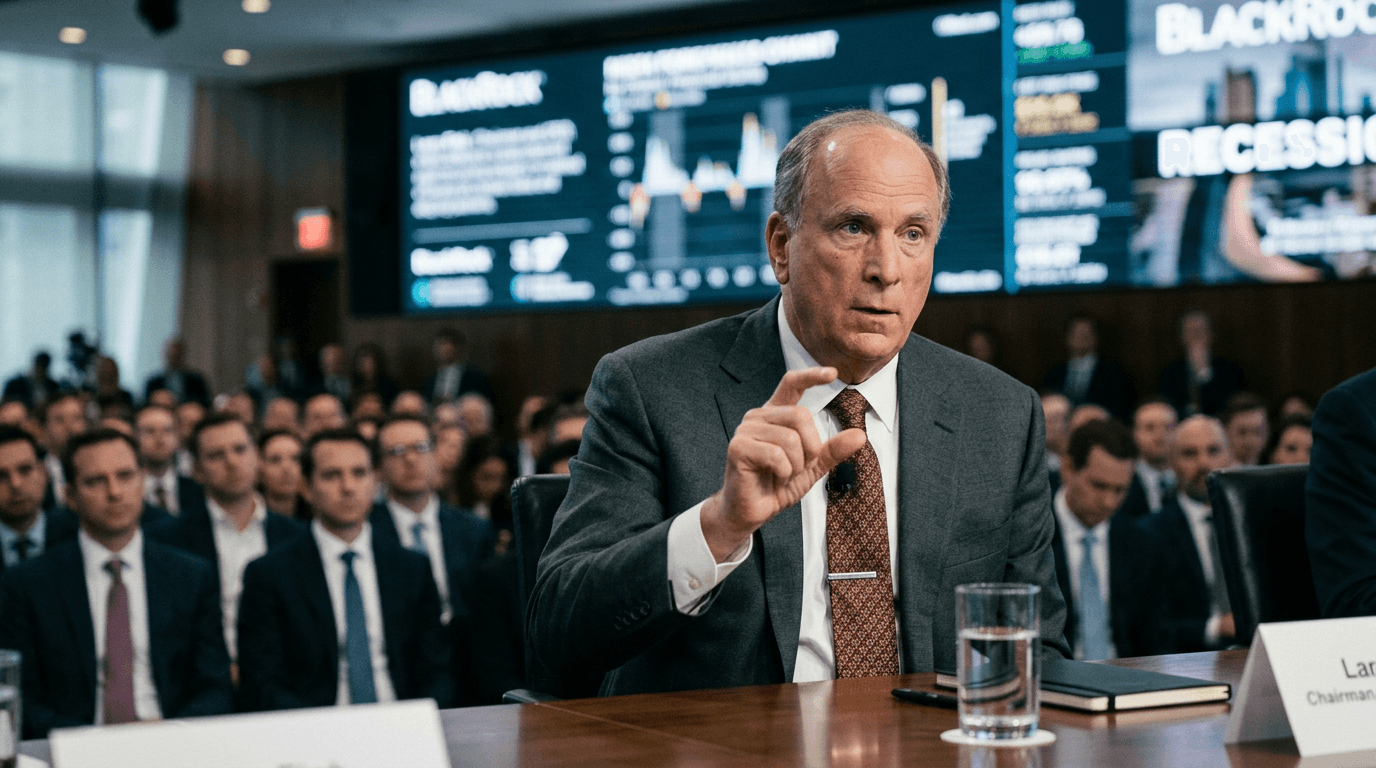
When the CEO of BlackRock, the world’s largest asset manager, says the US economy is “very close to, if not in, a recession,” markets pay attention.[1] Larry Fink’s warning taps into growing unease about slowing growth, shifting Fed expectations, and the durability of the current market cycle.[1] For traders, this is not just a headline – it is a signal to reassess risk, positioning, and scenario plans.
WHY LARRY FINK’S RECESSION WARNING MATTERS
Larry Fink sits at the center of global capital flows, with a direct line to corporate leaders, policymakers, and institutional investors.[1] When he says many CEOs are reporting softer demand and growing caution, he is effectively amplifying real‑economy signals that may not yet be fully visible in headline data.[1]
His comment that the US is “very close to, if not in, a recession” adds weight to the view that growth is losing momentum faster than many official forecasts suggest.[1] It reflects a combination of cooling consumer spending, more cautious business investment, and tighter financial conditions that have followed an extended period of high interest rates.
Markets reacted in line with a classic “recession scare” pattern: equity futures softened, demand for safe‑haven government bonds increased, and risk‑sensitive currencies and credit instruments came under pressure.[1] At the same time, expectations for future Federal Reserve easing strengthened as traders priced in a higher probability that the Fed will need to cut rates to cushion the slowdown.[1]
For traders, the key point is not whether a recession has already started down to the exact month – it is that the balance of risks is shifting from “soft landing” toward “harder landing,” and portfolios that were built for a strong‑growth, higher‑for‑longer environment may need to evolve.
Implications For Equities, Bonds, Credit And Fx
Fink’s warning effectively nudges the market narrative in favor of defensiveness and quality, and that has different implications across asset classes.[1]
In equities, recession risk usually means greater dispersion beneath the index level.[1] Historically, cyclical sectors tied to discretionary spending, housing, or heavy industry tend to underperform, while more defensive areas like utilities, healthcare, and consumer staples can hold up better. Profit margins become a central focus: markets will scrutinize which companies can maintain pricing power and control costs as demand cools.
In bonds, rising recession risk is often supportive for high‑quality sovereign debt. US Treasuries tend to benefit as investors seek safety and bet on future rate cuts.[1] However, the impact along the yield curve can be nuanced: longer‑dated yields may fall on growth concerns, while shorter‑dated yields move in line with changing Fed expectations.
Credit markets sit at the intersection of growth and liquidity risk. If recession fears deepen, spreads on high‑yield and lower‑quality corporate bonds can widen sharply as investors reprice default risk. Even investment‑grade credit can experience bouts of illiquidity, particularly in stressed environments.
In FX, Fink’s comments contributed to a more cautious tone toward risk‑sensitive currencies and tempered some of the US dollar’s recent strength.[1] When markets price in more aggressive Fed easing, the dollar can soften against currencies backed by central banks perceived as less dovish, though this is constantly interacting with global risk sentiment and local growth dynamics.
THE FED, INFLATION, AND THE POLICY TRADE‑OFF
Recession risk cannot be separated from the Federal Reserve’s inflation fight. If growth slows materially while inflation continues to ease, the Fed gains room to pivot toward a more supportive stance. That is part of why markets moved to price in additional rate cuts after Fink’s comments.[1]
However, if inflation proves sticky even as activity slows, the policy trade‑off becomes much harder. The Fed may be forced to hold rates higher for longer to prevent inflation from re‑accelerating, accepting weaker growth in the process. In that scenario, both risk assets and rate‑sensitive sectors could face prolonged pressure.
Traders should think in terms of scenarios, not predictions. A “mild recession with rapid Fed easing” will produce a very different market path from a “stagflation‑lite” outcome where growth falters but inflation remains uncomfortably high. Fink’s warning is a reminder to map these possibilities explicitly rather than assuming a linear glide path back to trend growth.
How Traders Can Adapt: Practical Risk Management Steps
For both live and simulated traders, this is a moment to elevate risk management from an afterthought to a core strategy component.[1]
First, stress‑test your portfolio or trading strategy under different recession scenarios. Ask how your positions would behave if earnings fell 10–20%, credit spreads widened significantly, or equities experienced a sharp drawdown. In a SimFi environment, you can run these ideas without capital at risk, refining your response plan in advance.
Second, review concentration risk. Positions heavily tilted toward the most cyclical sectors, highly leveraged companies, or illiquid assets may be especially vulnerable in a downturn.[1] Consider whether your exposure is intentional and sized appropriately, or simply a by‑product of chasing recent performance.
Third, pay close attention to liquidity. In prior risk‑off episodes, bid‑ask spreads widened and market depth evaporated fastest in smaller‑cap equities, lower‑quality credit, and niche instruments. Build the habit of considering not just “Can I enter this trade?” but “Can I exit it under stress?”
Finally, be clear about your time horizon. Short‑term traders can benefit from volatility and shifting expectations, focusing on intraday or multi‑day setups around data releases and central bank communication. Longer‑term traders may prioritize capital preservation, drawdown control, and gradual rotation toward higher‑quality exposures.
Key Data To Watch Next
Fink’s comments amplify a theme that will be tested in the data over the coming weeks and months.[1] Traders should tighten their focus on a few key areas.
Growth indicators are front and center. Employment reports, retail sales, and business surveys such as ISM or PMI will help confirm whether the slowdown is broadening beyond a few sectors.[1] Weakening hiring or rising unemployment would strongly reinforce the recession narrative.
Inflation and wage data remain critical. If price pressures continue to moderate while wage growth cools, the Fed’s path to easing becomes smoother.[1] Conversely, any re‑acceleration in core inflation would complicate the picture and potentially cap how quickly policy can turn supportive.
Corporate earnings and guidance will provide a real‑time cross‑check on Fink’s CEO‑level insights.[1] Listen not just to headline earnings beats or misses, but to commentary on demand trends, pricing power, and capital expenditure plans. When multiple management teams signal caution, it often precedes official macro data.
Finally, watch financial conditions – especially credit spreads, bank lending surveys, and funding markets.[1] These channels transmit monetary policy and sentiment into the real economy. Tightening credit and more restrictive lending standards are classic hallmarks of an approaching or unfolding recession.
Putting It All Together
Larry Fink’s warning that the US is very close to, or already in, a recession does not guarantee a deep downturn, but it does mark a meaningful shift in the conversation about where we are in the cycle.[1] For traders, the message is to respect the risk, not fear it blindly.
By combining disciplined risk management, scenario planning, and a sharper focus on leading data, traders can navigate this environment more confidently. Simulated trading offers a powerful way to rehearse those decisions, test how strategies perform under stress, and refine playbooks before markets are under maximum pressure.
The next phase of this cycle will be shaped by the interplay between growth, inflation, and Fed policy. Fink’s comments are a catalyst to prepare – and preparation, more than prediction, is what separates reactive trading from resilient, professional decision‑making.