
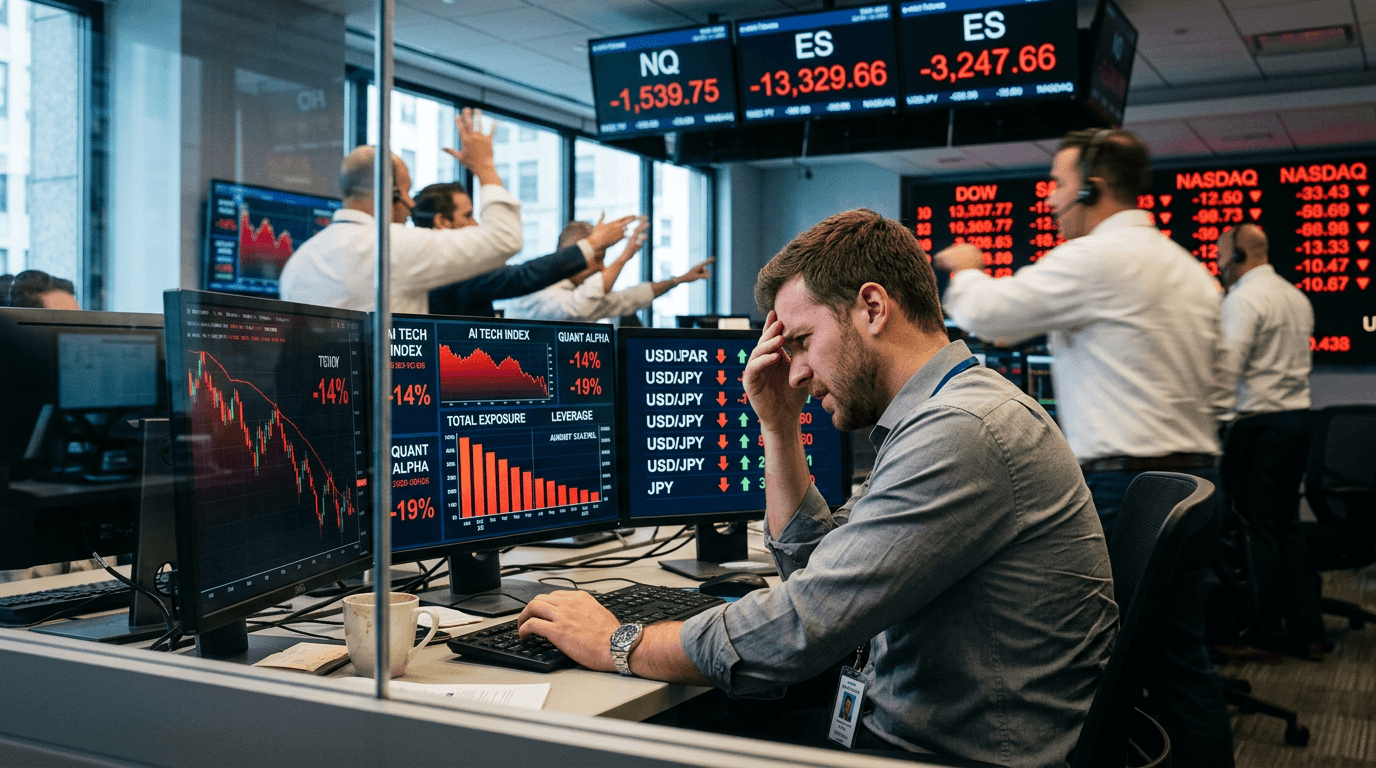
A sudden, sharp selloff in artificial‑intelligence‑linked stocks has just delivered the worst performance stretch for major quant funds since last August, and the pain hasn’t stayed in equities.[1][2] Systematic managers have been forced to slash risk in equity index futures and pivot toward safer currencies, turning what began as an AI equity shakeout into a broader cross‑asset risk‑off episode.[1][2]
What Just Happened In Ai Stocks
For most of the year, AI‑themed trades were among the market’s most crowded winners, with chipmakers, data‑center plays, and software names powering momentum and growth portfolios.[1][2][3] As long as the narrative of unbounded AI demand held, these positions attracted more capital, more leverage, and more confidence.
That changed abruptly when investors began reassessing valuations, earnings expectations, and how much future AI revenue was already priced in.[1][3] A cluster of high‑beta AI and semiconductor stocks reversed sharply, erasing weeks of gains and delivering outsized losses to funds that had become heavily concentrated in the theme.[1][3]
According to recent analysis, systematic managers—quant funds that use algorithms to trade trends—have given back roughly a quarter of their year‑to‑date returns as the AI trade rolled over.[1][2][3] Their aggregate performance dropped from about 14.4% in late June to around 10.8%, still positive but representing the worst stretch since last August.[1][2][3]
Importantly, this was not just a single day of bad luck. The move unfolded over several sessions, with selling pressure feeding on itself as stop‑loss levels were hit, volatility rose, and risk systems compelled further reductions in exposure.[1][2][6] Crowded winners turned into crowded exits.
Why Quant Funds Got Hit So Hard
Quant funds are designed to systematically capture patterns such as momentum, value, quality, and volatility across thousands of securities, often with tight risk controls and diversification.[1][2] Yet when a single narrative like AI dominates market leadership, even diversified models can end up heavily exposed to the same cluster of stocks.
Momentum and growth factors were particularly overweight AI chipmakers and related technology names, so any strategy leaning on recent winners was effectively long the same theme.[2][3] As these stocks sold off together, correlations spiked, and what looked diversified on paper behaved like a single large bet.
Leverage amplified the impact. Many systematic strategies scale position sizes based on recent volatility and drawdowns, which had been relatively subdued in AI leaders before the reversal.[2][5] When volatility suddenly jumped, risk‑weighted positions that were sized for calm conditions became too large, forcing rapid deleveraging.
This dynamic is not new. During previous corrections, AI‑driven hedge funds and commodity‑trading advisers were forced to de‑risk after large, unexpected losses, contributing to broader market moves.[5] The latest episode follows a similar pattern: trend‑following and factor‑driven models extended into a dominant theme, then had to retreat quickly when that theme stumbled.
How The Rout Spilled Into Futures And Fx
Once losses in AI equities crossed certain thresholds, risk management rules triggered reductions not only in single‑stock positions but also in equity index futures.[1][2] Index futures are the fastest way for quant funds to adjust overall market exposure, so they tend to bear the brunt of deleveraging during stress.
As systematic managers cut futures longs in major indices, index levels faced additional pressure beyond the original AI names.[1][2] That extended the drawdown from a sector‑specific correction into a broader equity risk‑off, even though the fundamental shock was concentrated in AI valuations.
The ripple continued into currencies. Many quant and macro strategies express pro‑growth, pro‑risk views through FX by being long cyclically sensitive currencies—such as those tied to commodities or global trade—and short traditional safe havens like the U.S. dollar, Japanese yen, or Swiss franc.[2][5] When AI equities cracked and equity risk was cut, these FX positions were often unwound in parallel.
The result: increased demand for defensive currencies and selling pressure in growth‑linked FX pairs, reinforcing a cross‑asset shift toward safety.[2] This kind of alignment—equity selling, futures deleveraging, and FX repositioning—is a hallmark of systematic risk‑off episodes, where models are responding to volatility and drawdown triggers rather than discretionary macro calls.
Lessons For Traders And Simfi Participants
Whether you trade live markets or practice on a simulated finance platform, the AI‑stock selloff offers several practical lessons for risk management and strategy design.[2]
First, stress‑test your portfolio against theme reversals. If much of your performance is coming from a single narrative—AI, clean energy, biotech—ask how your equity and futures positions would behave if that theme dropped 15–20% in a short period.[2] Running scenarios in a SimFi environment can reveal concentration and liquidity risks before the market does.
Second, watch crowding indicators. When the same names dominate top holdings across funds, factor indices, and retail flows, the risk of a crowded unwind rises.[2] Track which sectors and stocks sit at the intersection of multiple strategies; those are the ones most vulnerable when sentiment turns.
Third, treat volatility spikes as information, not just noise. A sudden jump in cross‑asset volatility—equities, futures, FX—is often a sign that leverage and conviction are highest in a particular theme.[2][5] Observing how AI‑linked stocks, index futures, and key currency pairs react can help you map where systematic risk is concentrated.
Finally, use simulated environments to practice deleveraging. On a SimFi platform, you can rehearse how to cut exposure systematically when losses or volatility breach predefined levels, without the emotional pressure of real capital at risk. This prepares you for making disciplined decisions when similar conditions arise in live markets.
What To Watch Next
The key question now is whether the AI‑stock selloff marks the end of the theme’s leadership or a painful but ultimately healthy shakeout. Quant funds, despite the drawdown, remain up for the year, suggesting that the broader systematic trend‑capturing engine is still intact.[1][2] What has changed is the degree of confidence in ultra‑crowded AI trades.
Traders should monitor three things. First, breadth: does market leadership broaden beyond AI and megacap tech into other sectors, or does performance remain narrowly concentrated?[2] Broader breadth would signal a more sustainable risk environment.
Second, positioning: data on hedge‑fund and quant‑fund exposure to technology and AI names, as well as index futures, will indicate whether deleveraging has largely run its course or still has room to go.[1][2] Persistent reductions could keep volatility elevated.
Third, cross‑asset behavior: if equities, futures, and FX continue to move in a tightly linked risk‑off pattern, it suggests systematic de‑risking is still underway.[2][5] If those correlations relax, the market may be transitioning from mechanical unwinds to more discriminating, stock‑specific pricing.
For traders and SimFi participants alike, the AI‑stock selloff is a reminder that powerful themes can drive impressive returns—but also rapid reversals when everyone is leaning the same way. Building strategies that respect crowding, leverage, and cross‑asset linkages is no longer optional; it is central to navigating an increasingly algorithm‑driven market.