
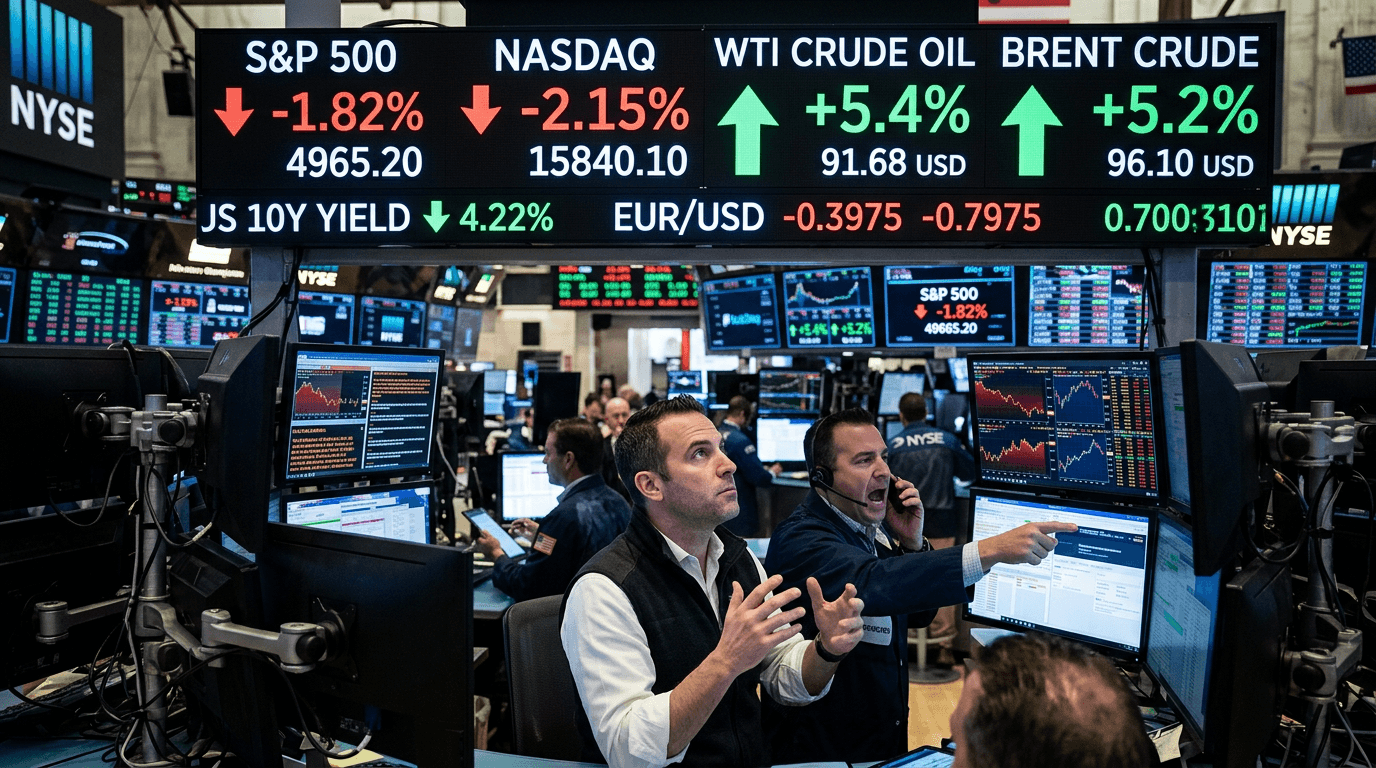
U.S. stocks pulled back as oil prices spiked on renewed tensions between the U.S., its allies, and Iran, reminding traders how quickly geopolitics can shift the market narrative. After weeks of record highs driven by tech leadership and optimism around monetary easing, risk appetite cooled as crude surged and investors reassessed both inflation and interest-rate expectations.
WHAT’S DRIVING THE MOVE: GEOPOLITICS AND OIL SUPPLY FEARS
The latest leg higher in oil prices has been fueled by a renewed flare-up in the Iran conflict and fresh worries about the security of energy flows through the Strait of Hormuz, a critical chokepoint for global crude shipments.
When markets sense even a partial threat to supply, crude futures can reprice aggressively. Brent and WTI both jumped as traders rushed to hedge against potential disruptions, with front-month contracts reacting more violently than longer-dated futures. That pattern reflects near-term supply anxiety rather than a confident, long-term demand story.
At the same time, hawkish political rhetoric and stalled diplomatic efforts have undercut hopes for a quick de-escalation. For equities, this creates a classic “bad news mix”: higher input costs, higher macro uncertainty, and a higher probability that the conflict drags on longer than markets had been pricing.
WHY HIGHER OIL IS A PROBLEM FOR EQUITIES AND THE FED PATH
Oil shocks matter because they filter into almost every macro channel that equity traders care about: inflation, growth, and central bank policy.
First, energy is a major input cost for transportation, manufacturing, and agriculture. A sustained jump in crude tends to lift gasoline and diesel prices, pass through to freight and logistics costs, and eventually show up in consumer prices. That keeps inflation “sticky,” especially in headline CPI, even if core components are cooling.
Second, higher fuel costs act like a tax on consumers. When households spend more at the pump, they have less disposable income for discretionary spending. That is negative for retailers, travel and leisure, and many cyclical sectors that depend on strong consumer demand.
Third, and most important for markets right now, rising oil undermines the case for aggressive rate cuts. The recent rally in stocks was partly built on the expectation that the Federal Reserve could ease policy as inflation cooled. A renewed energy shock complicates that story. If inflation expectations tick up and real yields remain elevated, the Fed may be slower and more cautious in cutting rates.
That repricing is visible in rates markets: Fed funds futures typically reduce the implied number or size of cuts, Treasury yields drift higher on the front end, and the curve can flatten as growth risks counterbalance inflation fears. Equities, especially long-duration growth names, tend to dislike that combination.
Sector Winners And Losers: How Equities Are Repricing
Even when the indices look weak, the impact is not uniform across sectors. A renewed Iran conflict with an oil spike typically creates sharp intra-market rotations:
- Energy and defense stocks: These are usually the first beneficiaries. Higher crude supports integrated oil majors, exploration and production firms, and oilfield services companies as their revenue and cash flow expectations improve. Defense contractors can see inflows as investors position for rising geopolitical risk and potential increases in defense spending.
- Travel, airlines, and consumer cyclicals: These areas often come under pressure. Airlines face higher jet fuel costs and potential route disruptions if airspace is restricted. Travel and tourism names can suffer from both higher costs and weaker demand as consumers and businesses cut back on discretionary trips.
- Interest‑sensitive sectors: Real estate, small caps, and highly leveraged companies can lag if rising yields and reduced rate‑cut hopes reset discount rates higher. The combination of higher funding costs and macro uncertainty weighs on these names.
- Mega-cap tech and quality growth: In recent episodes, investors have often bought dips in large-cap technology and high-quality growth companies, treating them as “new defensives.” However, if the move in yields is strong enough, even these leaders can see volatility as valuations get stress‑tested.
For index traders and SimFi participants, understanding these cross‑currents is critical. A headline “equities slip” can hide significant opportunity beneath the surface for long–short, sector-rotation, or pairs-trading strategies.
Implications Across Asset Classes: Fx, Rates, And Commodities
The market impact of an oil-driven geopolitical shock is rarely confined to stocks.
In FX, higher oil prices often support commodity-linked currencies such as the Canadian dollar and Norwegian krone, while pressuring major oil importers like Japan and parts of emerging Asia. At the same time, safe-haven flows can bid up the U.S. dollar and the Swiss franc if risk-off sentiment deepens.
In rates, as noted, front-end yields can move higher as markets price fewer or later Fed cuts. Longer-dated yields may not rise as much if growth fears intensify, leading to a flatter or even inverted curve. That configuration is typically a warning sign about future economic momentum.
In commodities, crude becomes both a macro barometer and a volatility engine. Front-month contracts see the sharpest moves, while time spreads (the difference between near and far futures) can widen, reflecting concerns about immediate supply. Volatility in energy can spill over into metals and agricultural commodities as systematic strategies adjust risk across the entire complex.
For multi-asset and macro-focused traders, this creates a rich but complex environment: correlations can change rapidly, and what worked during a calm, tech-led equity rally may behave very differently in a geopolitically driven risk-off phase.
How Traders Can Navigate Heightened Geopolitical Risk
Periods like this can be both dangerous and highly rewarding for active traders, especially in a simulated environment where you can test playbooks without real capital at risk.
A few practical approaches
1. Reassess correlations and regimes Do not assume that the correlations of the past month will hold. Re-check how your key instruments (indices, FX pairs, crude, yields) are moving relative to each other during this shock. You may find, for example, that equities are now trading more off rates and oil than off earnings or tech narratives.
2. Respect gap risk and headline risk Geopolitical news can hit at any hour, leading to gaps at the next open or sudden spikes in volatility. Position sizing, wider but controlled stops, and avoiding over-leverage become even more important. Backtesting strategies on prior geopolitical episodes can help you calibrate realistic risk limits.
3. Focus on relative value, not just direction Instead of trying to call every headline, consider spreads and relative trades that reflect the underlying narrative: energy vs. airlines, defense vs. broad industrials, oil exporters vs. importers in FX, or value vs. growth depending on the rate path. These can sometimes be more robust than outright directional bets in a headline-driven tape.
4. Have clear scenarios and “if–then” plans Map out at least three scenarios: rapid de-escalation, prolonged standoff, and severe escalation affecting actual oil flows. For each scenario, outline how you expect equities, crude, rates, and FX to react. Then, as new information arrives, update probabilities and adjust your positioning rather than reacting emotionally to each headline.
Conclusion: Short-term Shock, Long-term Lessons
The latest slide in U.S. equities and surge in oil is a timely reminder that macro and geopolitics can quickly overpower micro stories, even in a strong earnings and tech-led environment. Whether this proves to be a short-lived scare or the start of a more persistent risk regime will depend on how the Iran conflict evolves and how much of the oil spike feeds into inflation and the Fed’s reaction function.
For traders, the key is not predicting every twist in the news cycle, but building robust frameworks that link geopolitics, commodities, inflation expectations, and central bank policy back to price action. Simulated trading environments are ideal for stress-testing those frameworks, honing discipline, and preparing for the next time markets are jolted by events far from the trading screen.