
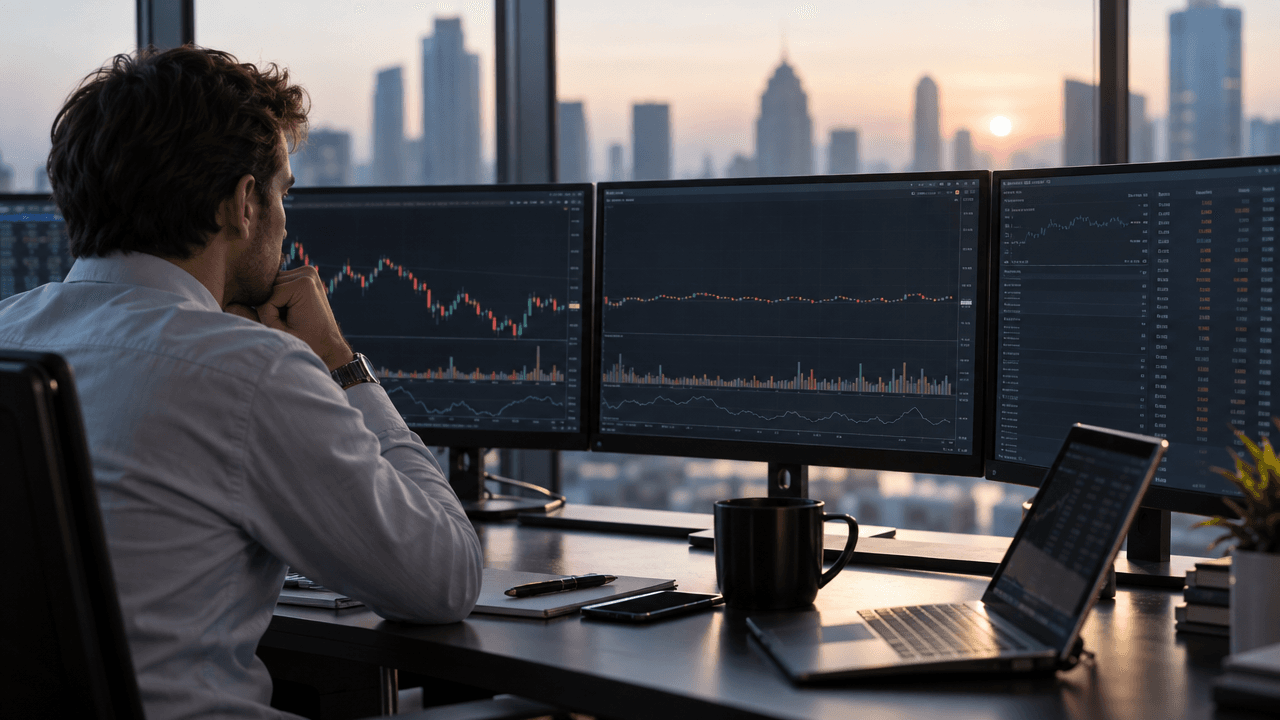
When the news feed goes quiet and no adequately verified six-hour-old forex or futures headlines are available, many traders feel uneasy. Silence can be just as informative as a screaming headline. It often signals a market in “wait-and-see” mode, where large players are cautious, volatility is muted, and the edge shifts from reacting to news to managing risk and expectations.
QUIET HEADLINES, QUIET MARKETS?
A lack of fresh, timestamped headlines about major moves in currency pairs or futures contracts usually points to a low-volatility environment rather than a hidden crisis. In these periods, prices tend to oscillate within tight ranges instead of making strong, directional moves[2][7]. Spreads can be relatively narrow and intraday swings smaller, which lowers short-term risk but also compresses profit potential[2].
Importantly, “no news” does not mean “no trade.” It simply changes the type of opportunities available. Instead of chasing trend extensions driven by macro shocks, traders are working with more measured, mean-reverting price action and must be prepared for longer stretches of consolidation[3][7]. Patience and discipline become as valuable as any indicator.
What Low-news Environments Mean For Traders
When no recent major headlines can be confirmed, markets are often quiet because there are no new catalysts to reprice currencies or futures aggressively[3]. Central bank policies may be well telegraphed, key data releases are either already baked in, or still ahead, and positioning is comparatively balanced[2][3]. That backdrop favors strategies that assume stability rather than sudden dislocation.
Traders who are used to pursuing large, news-driven moves need to recalibrate. Multi-hundred pip trends or explosive breakout days in futures become less frequent[9][10]. Expectations around daily profit targets, trade frequency, and holding times should adjust accordingly. Trying to force “big trade” behavior out of a small, quiet market is one of the fastest ways to overtrade and bleed capital.
At the same time, low volatility does not eliminate risk; it changes its form. Quiet ranges can lure traders into oversized positions because moves look small, yet a surprise headline or scheduled announcement can still trigger sharp breaks from established levels[1][4]. Risk management must remain robust even when the tape looks calm.
Trading Strategies For Low Volatility
In a market defined more by absence of fresh headlines than by new information, range trading naturally comes to the fore. Price often oscillates between clear support and resistance, making “buy near support, sell near resistance” a logical framework[3][7][9]. Mean-reversion tools and horizontal levels typically outperform trend-following systems in these conditions[10][14].
Several practical adjustments help traders adapt
1. Focus on ranges and mean reversion Range trading strategies that target modest moves between well-defined boundaries tend to perform better than momentum setups in low-volatility markets[5][8][14]. Traders watch how price behaves at repeated levels and look for signs of rejection, like slowing momentum or reversal patterns, before entering[7].
2. Aim for smaller, more frequent wins Rather than hunting for large, extended moves, scalping or short-term mean-reversion trades with tight targets can be effective[1][4]. Positions are held for shorter windows, with profit objectives and stop losses reduced proportionally to maintain a consistent risk–reward balance[3][7]. The emphasis shifts from size of individual trades to consistency over a series of trades.
3. Consider carry and longer-term views Quiet periods can favor carry trades, which rely on interest rate differentials rather than short-term price swings[1]. In forex, using a lower-yield currency to fund a higher-yield one allows capital to grow through overnight financing rather than intraday volatility[1]. Alternatively, some traders step back from intraday activity and hold positions over several days to capture the slower, cumulative moves that still occur in calm markets[3][7].
4. Know when to look elsewhere If a market has stayed quiet for weeks and upcoming data or policy events look unlikely to change the condition, rotating to more active instruments can be sensible[3]. Cross-currency pairs, exotics, or other asset classes may offer better volatility, provided liquidity and risk are understood[9][10]. The goal is not constant trading, but finding environments that match the trader’s edge.
Using Simulated Finance To Practice The Quiet
Simulated Finance platforms like E8 Markets’ SimFi environment are particularly useful when real-world headlines offer little direction. A quiet market is ideal for practicing range identification, order placement, and discipline without the emotional pressure of large swings. Traders can experiment with different parameters for stops and targets, refine position sizing, and test how their strategies behave when volatility is compressed[3][7][15].
Low-news periods are also a good time to step back and review performance. Building or updating a trading journal, analyzing past trades, and backtesting new setups helps traders sharpen their process so they are ready when volatility returns[3][15]. Because quiet markets often precede more active phases around scheduled events, there is value in using SimFi to rehearse scenarios for potential breakouts from the current range.
Finally, simulated trading encourages healthy behavior during dull stretches: reducing the urge to “manufacture” trades, taking planned breaks, and respecting that not every session needs to be active[3][4]. Preserving psychological capital is just as important as preserving account equity.
Practical Takeaways For Traders
A news feed that reports “no adequately verified six-hour-old forex or futures headlines” is itself a signal. It tells traders that, for now, markets are driven more by existing narratives than by fresh surprises. The edge shifts toward:
- Reading ranges instead of chasing headlines.
- Targeting smaller, more frequent profits instead of outsized moves[1][4][9].
- Keeping risk parameters tight and consistent, even when conditions look benign[3][7].
- Using quiet time to refine strategy, journal, and backtest[3][15].
- Leveraging simulation to explore new ideas without live capital risk.
Rather than a reason for frustration, a lack of fresh major headlines can be an invitation to slow down, improve craft, and prepare for the next volatility cycle. Markets eventually move; the traders who use quiet periods wisely are usually the ones ready to capitalize when the headlines finally return.