
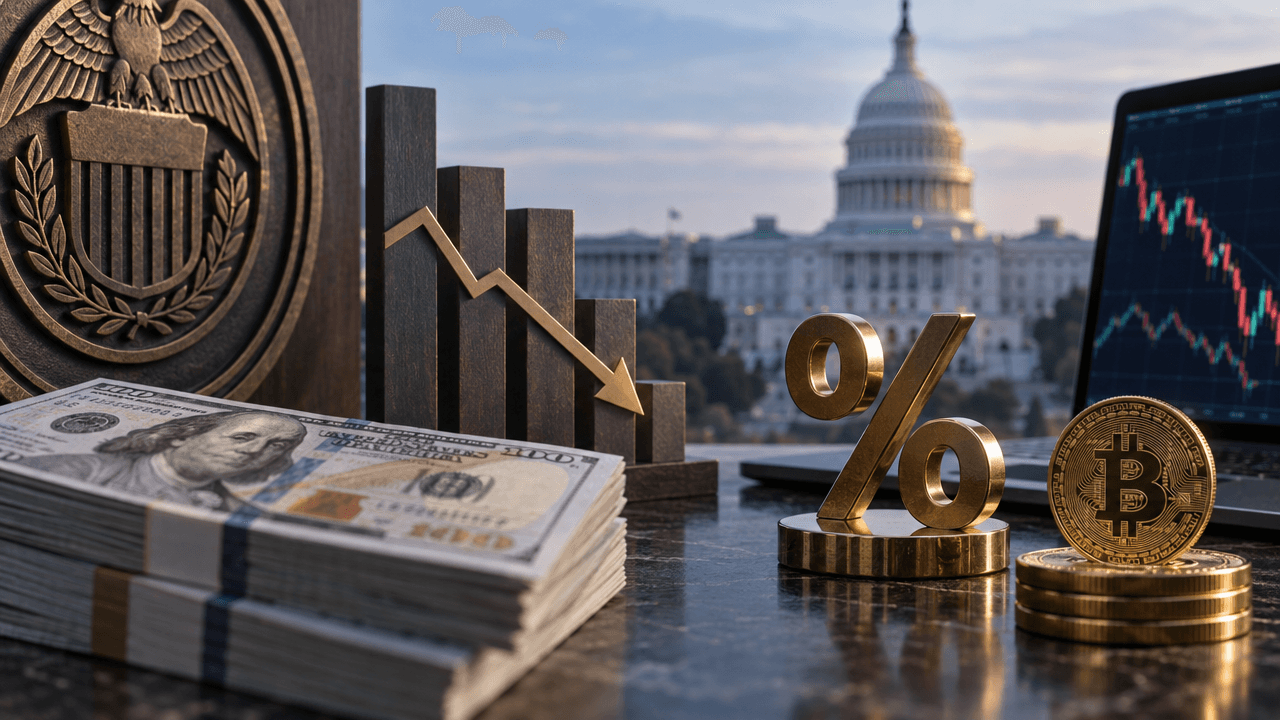
U.S. short‑term rates may look unremarkable at first glance, but an effective federal‑funds rate holding near 3.88% is still firmly in restrictive territory for the real economy.[1][6][11] With four‑week Treasury bills trading just below that at roughly 3.82%, cash and near‑cash instruments continue to offer meaningful yield, shaping everything from dollar strength to rate futures pricing and crypto risk appetite.[1][6] For traders on SimFi platforms, this backdrop is a powerful macro driver that needs to be built into every strategy.
WHY 3.88% STILL COUNTS AS RESTRICTIVE
The effective federal‑funds rate is the weighted average rate at which banks lend reserve balances to one another overnight, and it has held steadily around 3.88% in recent sessions.[1][6][11] That stability reflects a policy stance that is deliberately tight, designed to keep financial conditions from becoming too accommodative while inflation risks linger.[8][13] Even though the current rate is below levels seen earlier in the hiking cycle, it remains well above estimates of the “neutral” rate that would be neither stimulative nor restrictive.[8][10]
Federal Reserve projections released in mid‑September show policymakers expecting the funds rate to hover around 4.1% in the near term before gradually declining toward the mid‑3% range over the next couple of years.[8] Independent forecasts such as those from the Congressional Budget Office also anticipate a path where the funds rate drifts down but stays elevated relative to pre‑pandemic norms, reinforcing the message that “higher for longer” is still the base case.[10] For households and corporates, that means borrowing costs remain elevated; for traders, it means the discount rate applied to future cash flows and risk assets is still relatively high.
With four‑week Treasury‑bill yields around 3.8–3.9%, investors can lock in a government‑backed return that competes directly with riskier assets.[1][6][14] This anchors the entire short end of the curve and makes it harder for equities, speculative credit, and crypto to justify aggressive valuations without clear growth or earnings catalysts.[14] In practice, that is what “restrictive” means for markets: the hurdle rate for taking risk is high, and the tolerance for disappointment is low.
Implications For The Dollar And Global Fx
Short‑term U.S. rates are a key driver of the dollar’s carry appeal, and a 3.88% effective funds rate keeps the policy stance more hawkish than that of many major central banks.[1][6][11] When investors can earn a relatively attractive yield simply by holding dollar cash or short‑dated Treasuries, global capital tends to gravitate toward USD assets, supporting the currency on a trade‑weighted basis. Rate differentials versus currencies tied to looser policy regimes can widen, reinforcing existing trends in popular FX pairs.
Fed communications have signaled a willingness to keep rates steady and restrictive while data evolve, with policymakers projecting only limited additional tightening and a slow normalization in the coming years.[8][13][15] This “patient but vigilant” stance encourages markets to price in a plateau rather than a quick pivot, which often translates into range‑bound but firm dollar performance. For FX traders on platforms like E8 Markets, this environment favors strategies that exploit carry and relative momentum rather than assuming an imminent, broad‑based dollar reversal.
Tactically, a restrictive rate backdrop tends to:
1) Support USD on dips as long as U.S. growth holds up and inflation does not collapse. 2) Pressure lower‑yielding currencies where central banks are reluctant to follow the Fed. 3) Make funding shorts in the dollar more expensive, raising the bar for mean‑reversion trades.
For simulated FX portfolios, incorporating these dynamics into scenario analysis—such as stress‑testing a stronger dollar versus key crosses—is essential when rates are pinned at elevated levels.
WHAT SHORT‑TERM RATES MEAN FOR RATE FUTURES
The effective funds rate is not just a snapshot; it is a reference point for the entire strip of fed‑funds and Eurodollar‑style futures pricing.[1][6][11] With the spot rate stuck at 3.88%, futures markets must reconcile current restrictive settings with forward‑looking expectations implied by Fed projections and macro data.[8][10][15] As long as the spot rate remains steady, small changes in expectations about the timing and size of future cuts can cause outsized moves further out the curve.
Fed officials’ forecasts of one more potential hike this year, followed by a period of steady policy and gradual easing, have already been absorbed into futures pricing.[8][13][15] However, every new inflation print, employment report, or growth surprise can nudge the implied path higher or lower, creating trading opportunities in calendar spreads and curve steepeners. A flat, restrictive front end combined with more uncertainty further out tends to favor relative value trading over outright directional bets.
For SimFi traders, rate futures in a stable‑but‑restrictive regime are ideal for:
1) Practicing scenario‑based trading—how does the curve react to a surprise inflation uptick? 2) Exploring term‑structure trades—steepening vs. flattening between specific maturities. 3) Learning how implied probabilities of cuts or hikes are extracted from futures prices.
This kind of environment rewards disciplined macro analysis and an understanding of how policy communications interact with market expectations.
How The Rate Backdrop Shapes Crypto Risk Appetite
Crypto markets are highly sensitive to global liquidity conditions, and a 3.88% effective funds rate signals that liquidity is still being rationed rather than generously supplied.[1][4][6] When risk‑free yields near 4% are available in cash‑like instruments, some investors rotate out of high‑beta assets such as altcoins and speculative tokens, especially those without clear cash flows or adoption stories. That rotation can cap upside and increase the volatility of sentiment‑driven rallies.
Historically, periods of tight monetary policy have coincided with more cautious positioning in crypto, while sustained easing tends to unlock aggressive risk‑taking and leverage.[4][10][14] With the Fed currently in “hold and watch” mode, crypto markets may oscillate between narratives—sometimes trading like a high‑beta tech proxy, other times as a macro hedge—but rarely enjoying the kind of liquidity wave seen in ultra‑low‑rate environments.[13][15] For traders, this means emphasizing risk management, shorter holding periods, and clear catalysts.
On a SimFi platform, this backdrop is perfect for testing:
1) How crypto portfolios behave under different rate regimes. 2) The impact of funding costs and collateral yields on leverage decisions. 3) Diversification strategies that combine crypto with FX and rates exposures.
By simulating trades across multiple asset classes, traders can see how a single macro variable—the policy rate—ripples through their entire risk book.
Practical Playbook For Simfi Traders
With U.S. rates remaining restrictive, traders can adapt in several concrete ways:
1) Build macro context into every trade thesis. Map how a 3.88% funds rate affects the asset’s cash flows, funding costs, and valuation multiples.[1][6][11] 2) Favor strategies that respect the yield on cash. Compare expected returns from risk trades against the “risk‑free” short‑term yield and demand a convincing premium.[1][4] 3) Use simulations to stress‑test both rate shocks (unexpected hikes or cuts) and volatility shocks (rapid repricing of risk assets). 4) Diversify across FX, rates, and crypto to capture how different assets react to the same policy backdrop. 5) Focus on risk budgeting. In a restrictive environment, sizing and stop discipline matter more than ever, because the market’s tolerance for bad news is limited.
Looking Ahead: Path Of Policy And Market Adjustment
Official projections and independent forecasts point to a gradual glide path lower for the funds rate over the next few years, but not a return to the ultra‑low regime that defined the previous decade.[8][10][15] As long as the effective rate holds near 3.88%, markets are likely to experience alternating phases of optimism and caution, with the balance of power shifting between income‑generating assets and high‑beta growth or speculative plays.[1][4][6] That tug‑of‑war will define opportunities in FX, rates, and crypto.
For traders using E8 Markets and other SimFi platforms, the current moment is an ideal training ground. A clearly restrictive yet stable policy rate creates a controlled environment to learn how macro drivers shape pricing across asset classes, refine risk frameworks, and test strategies before committing real capital. By treating the 3.88% funds rate not just as a number but as a narrative anchor, traders can turn a complex macro backdrop into actionable and repeatable trading insights.