
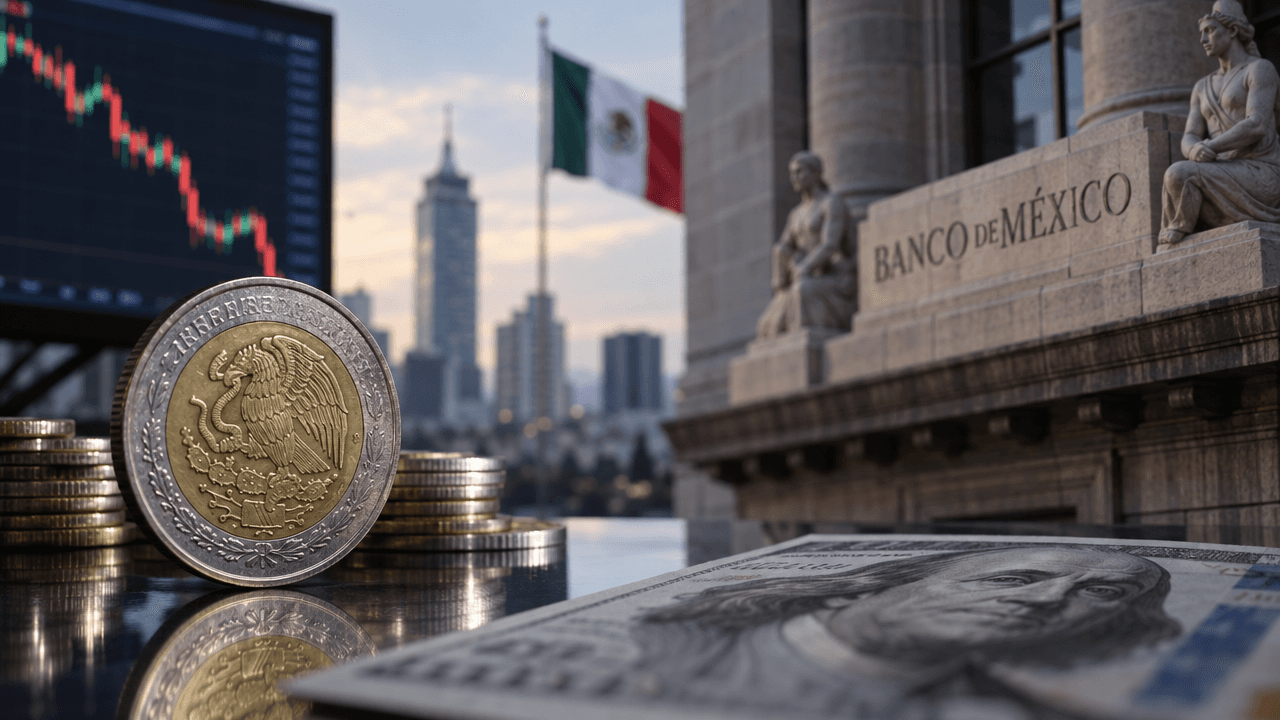
The Mexican peso weakened toward 18.8 per U.S. dollar after Banco de México, commonly known as Banxico, unexpectedly reduced its benchmark interest rate by 25 basis points to 6.25%. Markets had broadly expected policymakers to leave rates unchanged, making the decision more significant than the size of the cut alone. [6][7]
For traders, the reaction illustrates how currencies respond not only to economic data, but also to the gap between expectations and reality. A quarter-point adjustment may appear modest, yet an unexpected shift in monetary policy can quickly change interest-rate differentials, carry-trade incentives, and investor confidence.
The Surprise Rate Cut
Banxico’s five-member Governing Board voted 3-2 to lower the overnight interbank rate. Two officials, Deputy Governors Galia Borja and Jonathan Heath, preferred to keep the benchmark at 6.50%. The central bank described the move as a “one-time adjustment” and indicated that it expected to hold the new rate for an extended period. [1][3]
That wording matters. The decision was not presented as the beginning of an aggressive easing cycle. Instead, Banxico argued that the reduction was consistent with continued disinflation, economic slack, and limited exchange-rate pass-through to consumer prices. In other words, policymakers believe the weaker peso will not immediately translate into a large increase in inflation.
However, markets often trade the initial signal before fully weighing the details. The surprise cut suggested that the balance of risks had shifted enough for a majority of officials to accept a smaller interest-rate cushion, even as the peso had already experienced pressure against the dollar.
Why The Peso Fell
Interest rates are one of the main forces influencing currency values. When a country offers relatively high yields, international investors may buy its assets and convert capital into the local currency. This can support the exchange rate, particularly when investors use the currency in a carry trade.
A lower Banxico rate reduces the return available from Mexican assets, at least relative to what investors expected before the announcement. The move also narrowed the Mexico-U.S. interest-rate differential. The Federal Reserve’s policy rate was reported at 3.75% to 4.00% after its September decision, while Banxico’s previous rate stood at 6.50%. The spread was already historically narrow at roughly 250 basis points before the Mexican cut. [5]
The peso has also faced broader pressure. Reports indicate that it had depreciated by more than 9% since the beginning of September, while a stronger U.S. dollar, elevated risk aversion, and an unwinding of carry trades weighed on the currency. [5] Against that backdrop, an unexpected easing decision reinforced concerns that the peso could remain vulnerable.
For USD/MXN traders, a move toward 18.8 means that more pesos are required to buy one dollar. Rising USD/MXN generally represents peso weakness, while falling USD/MXN indicates peso strength.
Inflation And Policy Credibility
The most important question is whether Banxico can support economic activity without allowing inflation expectations to become unanchored. Inflation reportedly rose to 3.62% in mid-October from 3.42% a month earlier, even as third-quarter economic growth reached 3.2%, the strongest pace in three years. [2]
Those figures create a complicated policy environment. Slower or uneven domestic conditions can justify lower borrowing costs, but rising inflation and a weaker currency can argue for caution. Imported goods, energy, and other dollar-priced inputs can become more expensive when the peso loses value.
Banxico’s defense is that prevailing economic slack should limit demand-driven inflation and that exchange-rate movements will have a limited pass-through into consumer prices. The central bank also emphasized that maintaining the new 6.25% rate for an extended period should help inflation converge toward its target. [1][11]
The split vote provides an additional layer of information. It shows that policymakers were not unanimous about the timing of the cut, which may reduce expectations for rapid follow-up reductions. The market’s next focus will be whether inflation continues to moderate, whether the peso stabilizes, and whether external conditions become more supportive.
Practical Lessons For Simfi Traders
This event offers several useful lessons for simulated finance traders. First, do not trade only the headline number. A rate cut can weaken a currency, but the accompanying statement may signal a pause, a prolonged hold, or further easing. The policy guidance often determines whether the initial move continues.
Second, compare the decision with consensus expectations. The surprise element helped make this announcement market-moving. A widely anticipated cut might have produced little reaction because traders had already priced it in.
Third, monitor the interest-rate differential. USD/MXN is influenced by both Mexican policy and Federal Reserve expectations. If Banxico eases while U.S. rates remain elevated, the peso may lose support. If the Federal Reserve turns more dovish, however, the dollar could weaken and offset some of the pressure.
Finally, manage risk around central bank announcements. Currency markets can move sharply in seconds, spreads can widen, and the first move may reverse as traders interpret the statement. In a SimFi environment, use predefined risk limits, avoid oversized positions, and test whether your strategy performs across both expected and unexpected outcomes.
What Comes Next
Banxico’s decision is best understood as a cautious but meaningful policy shift. The central bank cut rates by 25 basis points, yet its “one-time adjustment” language points toward a period of observation rather than an immediate sequence of reductions. [4]
The peso’s next direction will depend on the interaction between domestic inflation, Mexico’s growth outlook, U.S. monetary policy, and global risk appetite. A sustained move above recent levels could signal continued concern about the currency and the carry trade. Conversely, evidence that inflation is moderating and that Banxico’s pause is credible could help stabilize the peso.
For traders, the central lesson is simple: central bank decisions are about expectations, credibility, and relative returns—not just the headline rate. The unexpected cut has made USD/MXN more sensitive to every inflation release, policy speech, and Federal Reserve signal that follows.