
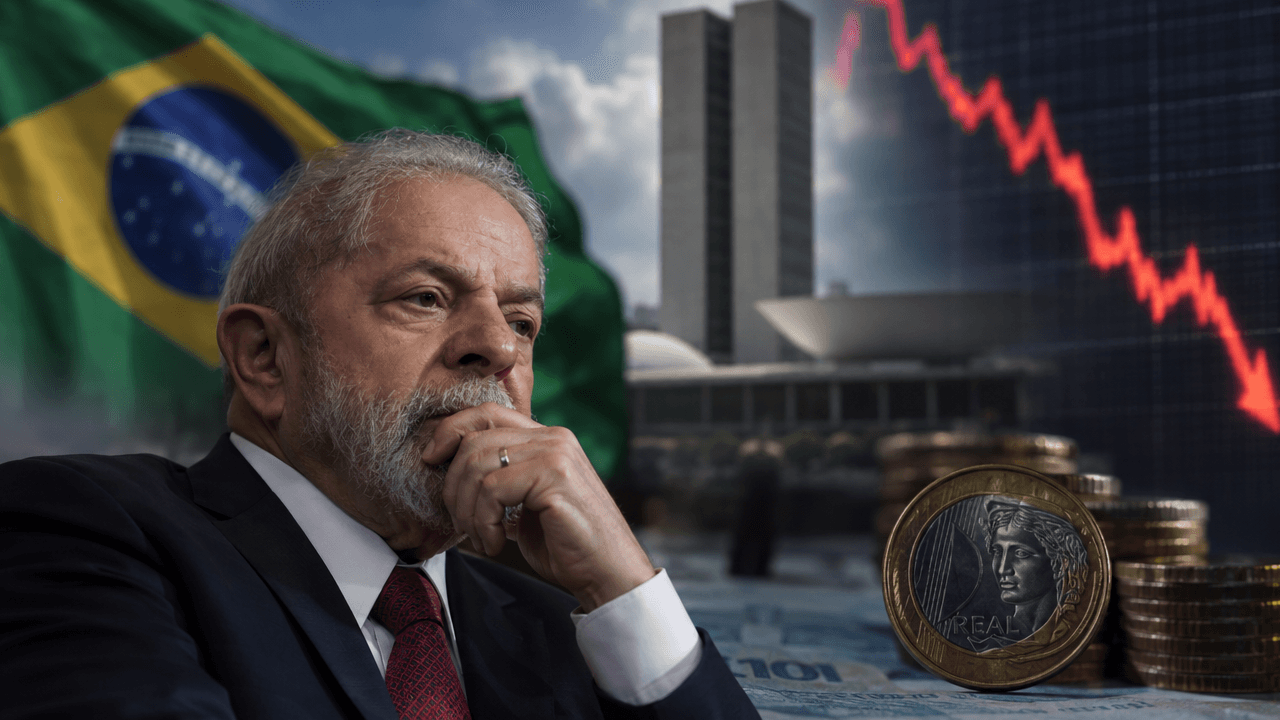
Brazilian real futures plunged by more than 10% in Asian trading after Luiz Inácio Lula da Silva won an unprecedented fourth presidential term, delivering a sharp reversal for investors who had positioned for an opposition victory. The move was not simply a reaction to the election result itself. It reflected a rapid repricing of fiscal policy, political stability, interest rates, and the outlook for Brazil’s broader emerging-market assets. [6][15]
For traders, the sell-off offers a clear lesson: political events can transform market expectations within minutes, especially when positioning is crowded and the election outcome differs from what investors had priced in.
What Happened In The Real Futures Market
November Brazilian real futures fell roughly 10% during Asian trading, with the contract implying an exchange rate near 5.5 to 5.6 reais per U.S. dollar, compared with approximately 5.01 before the result. Because the contract is quoted in reais per dollar, a rising number indicates a weaker real. [9][15]
The move was accompanied by heavy losses across Brazilian assets. The Bovespa benchmark dropped nearly 14% in one session, while Brazilian equity exchange-traded funds also suffered steep declines. Brazil’s 10-year government bond yield rose sharply, reaching its highest level in more than a decade according to market reports. [2]
This simultaneous decline in the currency, stocks, and bonds is often called a “triple sell-off.” It suggests that investors were not merely rotating between Brazilian assets. Instead, many were reducing exposure to the country altogether.
Why Investors Reacted So Sharply
Markets had rallied after the first round of voting, when opposition candidate Flávio Bolsonaro received strong support and appeared to improve the possibility of a government associated with spending restraint and privatization. Lula’s comeback victory forced investors to unwind those trades quickly. [5][9]
The central concern is fiscal policy. Investors are assessing whether the new administration will prioritize expanded social programs and public spending, or whether it will maintain credible limits on government debt and the budget deficit. If markets expect fiscal deterioration, they may demand higher yields to hold Brazilian bonds. Higher yields can increase government financing costs and make local assets less attractive.
Currency markets also respond to expected interest-rate policy. Brazil’s central bank may face pressure to keep interest rates elevated if fiscal concerns weaken the real and raise inflation expectations. Higher rates can support a currency by attracting yield-seeking capital, but they can also slow economic growth and increase debt-service costs. This creates a difficult policy balance for the incoming administration.
Political Uncertainty Adds To The Risk Premium
The election result was followed by challenges from the opposition, which increased uncertainty surrounding the transition and the government’s ability to govern effectively. Reports indicated that Bolsonaro disputed the result and called for the vote to be annulled, while Brazil’s Congress remained strongly opposed to many of Lula’s policies. [5][11]
Political uncertainty matters because financial markets price not only the leader but also the ability to pass legislation. A president facing a hostile Congress may struggle to approve tax, spending, or structural reforms. That can create two opposing outcomes: legislative gridlock may limit unpopular policies, but it can also prevent measures needed to restore investor confidence.
For international investors, the uncertainty adds a risk premium to Brazilian assets. The greater the perceived chance of protests, legal disputes, coalition instability, or policy reversals, the higher the return investors may require before committing capital.
What Traders Should Watch Next
The initial market reaction is only the first stage of the repricing process. Traders should monitor several indicators as the political picture develops.
First, watch the government’s fiscal announcements and cabinet appointments. A finance minister viewed as disciplined and market-oriented could help stabilize the real. Conversely, proposals for large unfunded spending increases could extend pressure on bonds and the currency.
Second, follow Brazil’s inflation expectations and central-bank communication. If policymakers signal that currency weakness is becoming a threat to price stability, interest-rate expectations could rise. That may temporarily support the real but weigh on Brazilian equities.
Third, monitor positioning and liquidity. A 10% futures move can be amplified when investors are concentrated on one political outcome. Once forced selling ends, the real may experience sharp rebounds even if the longer-term outlook remains uncertain.
Finally, traders should compare Brazil with other emerging markets. A political shock in one major Latin American economy can affect regional currencies, commodities, and risk appetite. However, each country has different fiscal accounts, central-bank credibility, and political conditions. Correlation can rise during panic, but it should not replace individual market analysis.
Practical Takeaways For Simfi Traders
This event provides a useful scenario for simulated finance practice. Rather than immediately buying after a large decline, traders can build a structured plan around different outcomes.
One approach is to define a base case in which the real remains under pressure as investors wait for fiscal details. A bullish alternative could involve a credible economic team, opposition acceptance of the result, and reduced political tension. A bearish scenario might include prolonged legal challenges, aggressive spending proposals, or renewed inflation concerns.
For each scenario, traders should identify an entry level, a stop-loss point, a profit target, and the event that would invalidate the trade. Position size should reflect volatility. A market moving 10% in a single session can quickly overwhelm a strategy that uses normal risk assumptions.
The key lesson is to separate direction from timing. Correctly anticipating a weaker currency does not guarantee a profitable trade if the position is entered too late or sized too aggressively.
Conclusion
The plunge in Brazilian real futures shows how elections can rapidly reshape expectations for currencies, bonds, and equities. Lula’s fourth-term victory overturned crowded market positions, while fiscal concerns and opposition challenges magnified the reaction. [6][11]
For traders, the most important takeaway is not whether the real must continue falling or recover immediately. It is that political risk should be treated as a measurable market variable. By tracking fiscal signals, central-bank policy, positioning, and volatility, traders can respond to uncertainty with a plan instead of reacting emotionally to the next headline.