
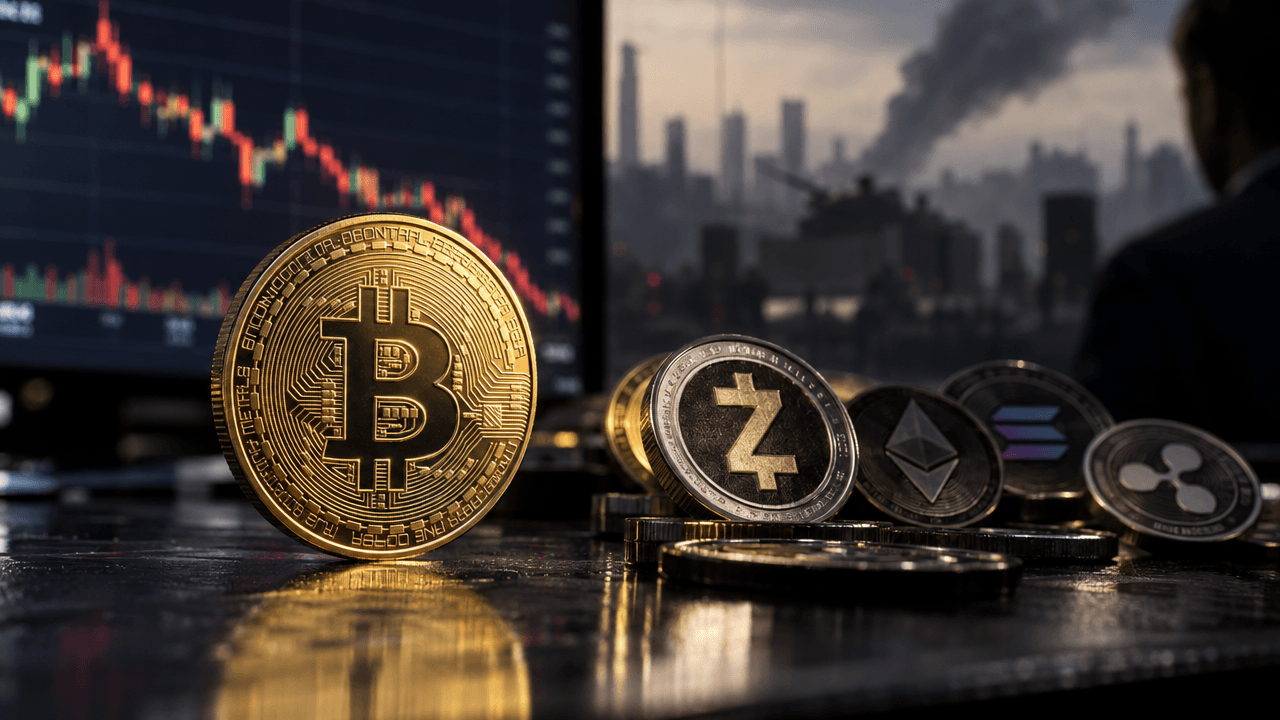
Crypto markets are weakening as investors reassess growth prospects, interest-rate expectations, and geopolitical risk. Bitcoin was little changed near $80,529, but that relative stability masks a more defensive tone beneath the surface. Zcash fell sharply, while broader crypto weakness reflected declining appetite for volatile assets rather than a rush toward digital currencies as a safe haven. Recent market coverage has linked the pressure to escalating US-Iran tensions, higher energy prices, and concerns that inflation could keep monetary policy restrictive. [2]
This combination matters because crypto remains highly sensitive to liquidity. When investors expect interest rates to stay elevated, capital often moves away from speculative assets and toward cash, short-term government securities, or defensive parts of the equity market. The latest price action shows that digital assets are still trading within that wider macroeconomic framework.
Risk Aversion Reaches Crypto
The immediate question is why Bitcoin has held relatively steady while other cryptocurrencies have suffered larger losses. The answer is partly market structure. Bitcoin has the deepest liquidity, the broadest institutional participation, and the strongest recognition among digital assets. Smaller tokens generally have thinner order books and higher concentrations of leveraged traders, making them more vulnerable when positions are unwound.
Zcash provides a useful example. Its decline appears to have occurred alongside a broad market selloff rather than as an isolated reaction to a single protocol event. Privacy-focused assets can be particularly sensitive to changes in liquidity, regulation, and speculative positioning. Recent reports also identified heavier derivatives exposure as a factor that amplified Zcash’s downside. [4]
When markets turn defensive, investors often sell what they can sell most quickly. That process can create a feedback loop: falling prices trigger stop-loss orders, leveraged positions are liquidated, and the resulting selling pushes prices lower. The move can become disproportionate to the original catalyst.
BITCOIN’S LIMITED SAFE-HAVEN RESPONSE
Geopolitical stress does not automatically produce demand for Bitcoin. Although some investors view the asset as an alternative monetary network, its behavior during periods of acute uncertainty has frequently resembled that of a high-beta risk asset. In the latest episode, Bitcoin’s subdued reaction suggests that markets have not yet developed a broad crypto safe-haven bid.
That distinction is important. A safe haven is expected to attract capital when investors reduce exposure to risk elsewhere. Bitcoin may eventually benefit from concerns about currency debasement, financial restrictions, or sovereign debt, but those themes typically develop over a longer time horizon. In the short term, traders tend to focus on liquidity, volatility, and the cost of leverage.
Higher Treasury yields and a stronger dollar can also challenge non-yielding assets such as Bitcoin. When investors can earn more from relatively low-risk instruments, the opportunity cost of holding volatile digital assets increases. Previous market analysis has similarly highlighted the connection between Bitcoin, Treasury yields, and the broader liquidity environment. [6]
What Traders Should Watch Next
Economic data will be central to the next phase of the market. Flash purchasing managers’ indexes are particularly important because they provide an early signal about business activity and growth. Weak data could intensify fears of an economic slowdown, while strong data might support risk assets initially but also reinforce expectations that central banks will keep policy tight if inflation remains persistent. [3]
Energy prices are another key variable. A sustained rise in oil prices can increase inflation pressure, reduce household purchasing power, and make policymakers less willing to cut interest rates. It can also weaken investor confidence across stocks, bonds, and crypto simultaneously.
Traders should also monitor derivatives funding rates, open interest, liquidation activity, stablecoin flows, and Bitcoin exchange balances. Rising open interest while prices decline can indicate that leverage is building into a weakening trend. Large liquidation spikes may mark short-term exhaustion, but they do not automatically signal a durable bottom.
For SimFi participants, this is a valuable environment for practicing risk management without confusing volatility with opportunity. Useful exercises include reducing position size during high-impact events, setting invalidation levels before entering a trade, and comparing Bitcoin’s performance with major altcoins. A trader who understands correlation and liquidity can often avoid mistakes that result from treating every token as an independent market.
How To Approach The Weakness
The current decline should not be interpreted as proof that crypto’s long-term investment case has disappeared. It is better understood as a stress test of market structure and investor conviction. Bitcoin’s relative resilience is constructive, but it becomes more meaningful only if the asset can hold important levels while volatility in altcoins continues to rise.
Patience is especially important when the market is responding to several uncertain variables at once. Traders should avoid increasing leverage simply because prices have fallen. Instead, they can define a maximum acceptable loss, wait for confirmation through price and volume, and maintain enough cash or simulated buying power to respond to new information.
The crypto market’s latest weakness reinforces a familiar lesson: digital assets do not trade in isolation. Growth expectations, monetary policy, energy costs, geopolitical developments, and derivatives positioning can all shape prices within hours. Bitcoin’s limited response near $80,529 shows that geopolitical anxiety alone has not created a broad safe-haven demand, while Zcash’s sharper decline demonstrates how quickly risk aversion can spread through less liquid assets.
For now, the most useful signal is not a single daily price move but the market’s reaction to incoming data. If growth fears ease and liquidity improves, crypto could stage a relief rally. If inflation, energy prices, or geopolitical tensions worsen, defensive pressure may continue. In either case, disciplined sizing and clearly defined risk remain more valuable than trying to predict the exact market bottom.