
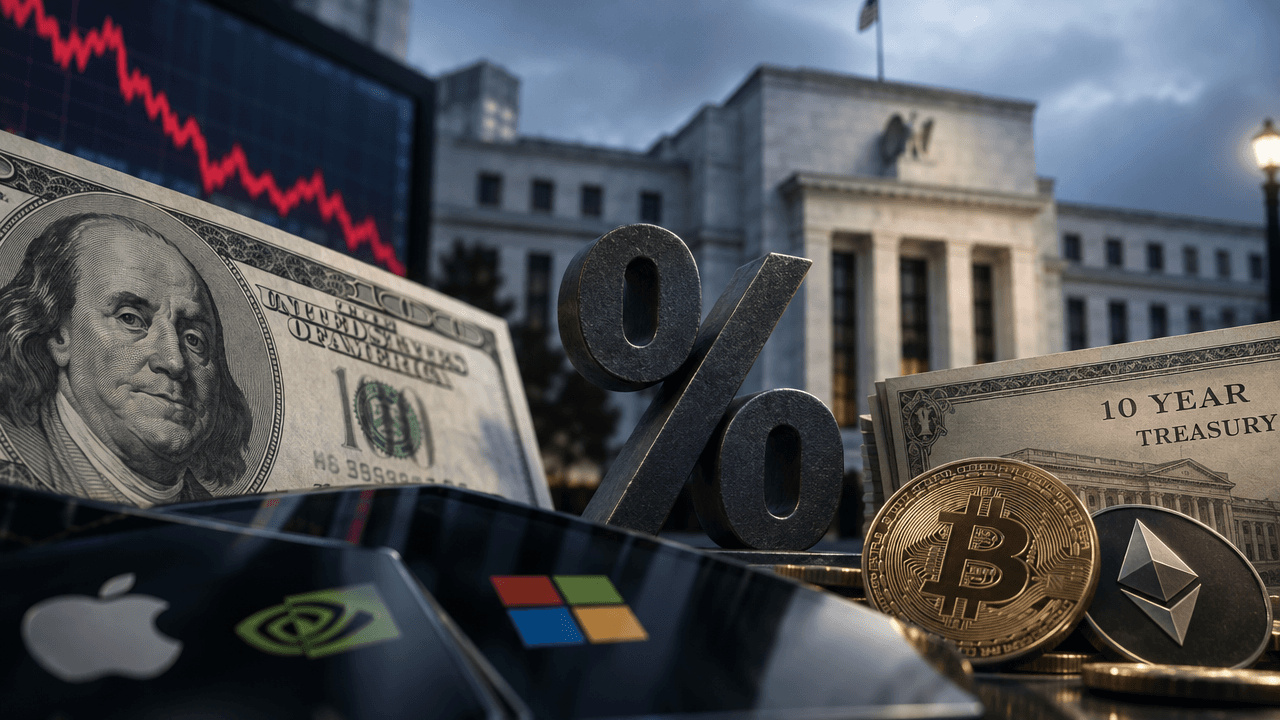
A stronger U.S. dollar and a 10-year Treasury yield near 5.15% are reshaping the market’s risk equation. As traders increasingly price a Federal Reserve rate hike at the December meeting, investors are demanding greater compensation to hold stocks, cryptocurrencies, and other assets whose valuations depend heavily on easy financial conditions. The result is a familiar but powerful macroeconomic pattern: higher expected interest rates support the dollar while reducing appetite for risk.
Why Rate-hike Expectations Matter
Markets are forward-looking. Asset prices often react before the Federal Reserve changes its policy rate because traders continuously adjust positions based on inflation data, economic growth, and central-bank communication.
Recent pricing indicated that traders had raised the probability of a 25-basis-point December hike to roughly 87%, up from about 70% a month earlier. The shift followed stronger-than-expected U.S. inflation readings and comments from Federal Reserve officials that suggested policymakers remained concerned about price pressures. [1]
A rate hike makes dollar-denominated assets more attractive by increasing the potential return available from cash, Treasury bills, and other short-term instruments. It can also encourage international investors to move capital toward the United States, creating additional demand for the dollar.
For traders, the important point is that expectations can move markets before the actual decision. If a hike is already widely anticipated, the announcement itself may have a limited impact. The larger market reaction may come from the Fed’s guidance about future policy, especially whether officials signal additional increases or a prolonged period of restrictive rates.
The 10-year Yield As A Competitor To Risk Assets
The U.S. 10-year Treasury yield is one of the most influential reference rates in global finance. It affects borrowing costs, equity valuations, mortgage rates, corporate financing, and the discount rates used to value future cash flows.
The yield rose from approximately 4.86% to 5.15% over the week ending November 13, with an intraday move as high as 5.17%. [2] Another market analysis reported a 10-year yield close at 5.15% on November 13 after hotter inflation data and hawkish Federal Reserve commentary lifted expectations for tighter policy. [6]
Why does that matter for growth stocks? A company’s value is based partly on the expected value of its future earnings. When interest rates rise, those future earnings are discounted more heavily. Businesses that promise rapid growth many years from now can therefore experience greater valuation pressure than mature companies with stronger current cash flows.
The same logic applies to cryptocurrencies, although digital assets do not produce conventional interest income. When a relatively low-risk Treasury yield approaches or exceeds 5%, holding a volatile asset becomes more expensive from an opportunity-cost perspective. Investors may demand a higher expected return before allocating capital to crypto or speculative technology shares. [2]
How A Stronger Dollar Pressures Global Markets
A rising dollar can tighten financial conditions beyond the United States. Many commodities, loans, and international transactions are priced in dollars. When the currency appreciates, dollar-denominated debt becomes more expensive for borrowers whose revenues are earned in other currencies.
A strong dollar can also reduce the translated value of overseas earnings for U.S.-listed multinational companies. At the same time, international investors may see their returns reduced when they convert U.S. assets back into their home currencies.
This creates a feedback loop. Higher Treasury yields attract capital to the United States, supporting the dollar. The stronger dollar tightens conditions for global borrowers and can weigh on emerging-market assets. Investors then become more selective, favoring companies with durable cash flow, manageable debt, and less sensitivity to economic slowdowns.
Technology-linked assets and cryptocurrencies are especially vulnerable when several pressures occur together: rising yields, a stronger dollar, reduced liquidity, and weaker expectations for future growth. Recent market commentary described this combination as a shift away from easing expectations toward resilient growth, persistent inflation, and tighter monetary policy. [7]
What Traders Should Watch Next
The December Federal Reserve meeting is important, but it is not the only event that matters. Traders should monitor inflation, employment, consumer spending, Treasury auctions, and the language used by Federal Reserve officials.
A 25-basis-point hike that is fully expected may produce a muted initial reaction. However, a signal that rates could remain high for longer may renew pressure on technology stocks and cryptocurrencies. Conversely, evidence that inflation is cooling or economic activity is weakening could push yields lower and support a relief rally in risk assets.
The reaction in bond yields may be more informative than the rate decision itself. If the 10-year yield continues climbing after a widely expected hike, markets may be interpreting the Fed’s message as more restrictive than anticipated. If yields fall, investors may be looking beyond the immediate hike toward slower growth or eventual policy easing.
For SimFi traders, this is a useful reminder to separate direction from risk management. A trader who expects dollar strength should still define an entry, stop-loss level, position size, and invalidation point. Macro themes can remain correct while individual trades fail because markets move sharply, reverse unexpectedly, or price in the news early.
Practical Takeaways For Simfi Traders
First, track interest-rate expectations rather than focusing only on the current Fed funds rate. Futures pricing can change quickly after inflation releases or central-bank speeches.
Second, watch the dollar and the 10-year yield together. A rising dollar combined with rising yields often signals tighter conditions for risk assets. A falling yield may provide support even if the dollar remains firm.
Third, avoid treating every decline in technology stocks or crypto as a standalone technical event. Macro factors may be driving correlations across multiple markets.
Finally, build scenarios instead of relying on a single forecast. Consider what could happen if the Fed hikes by 25 basis points, signals another hike, or adopts a more cautious tone. Testing each scenario in a simulated environment can help traders evaluate decisions without risking real capital.
Conclusion
Rate-hike expectations support the dollar because they increase the appeal of U.S. interest-bearing assets. At the same time, a 10-year Treasury yield near 5.15% raises the hurdle that stocks, cryptocurrencies, and other risk assets must clear to attract capital.
The central question is not simply whether the Federal Reserve raises rates in December. It is whether inflation, Treasury yields, and Fed communication point to a longer period of restrictive financial conditions. Until that outlook changes, dollar strength and elevated yields are likely to remain important forces shaping global markets.