
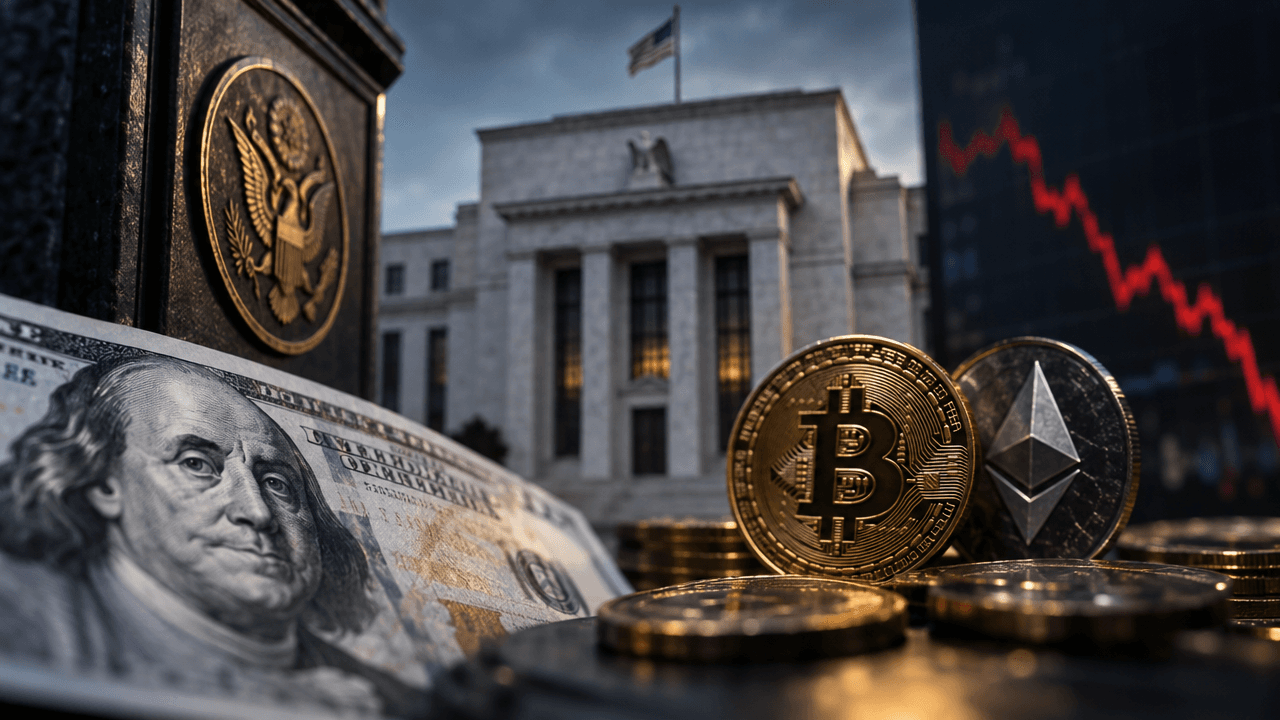
When markets begin pricing in higher interest rates, the impact rarely stays confined to government bonds. The latest shift in Federal Reserve expectations is weighing on cryptocurrencies, technology shares and other risk-sensitive assets as traders prepare for a potentially tighter U.S. monetary-policy path. Bitcoin fell toward $63,500 after briefly trading near $62,400, while Ether and major altcoins also moved lower. [5][3]
The move reflects more than a single down day in crypto. It is a reminder that digital assets remain closely linked to global liquidity, real yields, the U.S. dollar and investor confidence. For traders, understanding those connections is essential—particularly when market sentiment changes faster than the underlying fundamentals.
Why Fed Expectations Matter For Crypto
Interest-rate expectations influence asset prices before the Federal Reserve actually changes its policy rate. If traders believe borrowing costs will remain higher, they adjust portfolios immediately. Cash and short-term bonds become more attractive because they offer higher returns with less volatility, while speculative investments face a higher opportunity cost.
Cryptocurrencies do not generate traditional interest income. Investors generally hold them for potential price appreciation, network utility or portfolio diversification. When safer assets offer increasingly competitive yields, the incentive to hold volatile, non-yielding assets can weaken.
Higher rates also increase the cost of leverage. In crypto markets, traders often use borrowed funds to increase exposure to Bitcoin, Ether and altcoins. As funding becomes more expensive, some participants reduce their positions. Forced liquidations can then accelerate a decline, creating a feedback loop in which falling prices trigger more selling.
The recent market reaction reflects this process. Reports on the Federal Reserve’s latest meeting indicated that most officials supported additional rate increases, while some policymakers considered a move larger than 25 basis points if incoming data justified it. Market pricing showed traders assigning a high probability to a quarter-point December increase, with a smaller probability of a half-point move. [2][4]
The Dollar And Risk Appetite
A hawkish Fed outlook can also support the U.S. dollar. Higher expected rates may attract capital toward dollar-denominated assets, particularly when investors believe the United States will offer better relative returns than other major economies.
A stronger dollar often creates pressure across global markets. Commodities become more expensive for buyers using other currencies, international liquidity can tighten, and investors may reduce exposure to assets perceived as high risk. Crypto is especially sensitive because it trades continuously, attracts substantial leverage and is widely treated as a risk asset during periods of market stress.
This does not mean Bitcoin always falls when the dollar rises. Crypto markets can rally during periods of monetary tightening if adoption, institutional demand or favorable industry developments overwhelm macroeconomic pressure. However, when several forces point in the same direction—higher yields, a stronger dollar, reduced leverage and weaker equity sentiment—the short-term environment becomes more challenging.
Bitcoin’s decline toward the low-$60,000 area illustrates how macroeconomic expectations can dominate trading activity. Ether and altcoins typically experience even greater volatility because they have smaller liquidity pools and higher sensitivity to changes in risk appetite. Recent reporting showed Ether weakening alongside Bitcoin, while other major tokens also posted losses. [5]
What Traders Should Watch Next
The Federal Reserve’s December decision is important, but the data leading up to it may matter just as much. Traders should monitor inflation readings, employment reports, wage growth and consumer-demand indicators. Stronger-than-expected economic data could reinforce the case for higher rates, while signs of slowing inflation or weakening growth could reduce expectations for additional tightening.
Treasury yields are another critical signal. If yields continue rising, markets may interpret that as confirmation that financial conditions are becoming less supportive. The dollar index can provide a second layer of information: a rising dollar combined with climbing yields generally creates a more difficult backdrop for crypto and other speculative assets.
Positioning and market structure also deserve attention. A sharp increase in open interest, excessive long exposure or crowded bullish trades can make the market vulnerable to liquidation cascades. Conversely, a decline in leverage may create a healthier foundation for a recovery, even if prices remain volatile.
For SimFi traders, the objective is not to predict every Federal Reserve headline. It is to build a process that responds to changing probabilities. That may include reducing position size during high-impact events, using defined risk levels, avoiding excessive leverage and testing strategies across both trending and range-bound conditions.
Practical Takeaways For Simfi Traders
First, separate the policy decision from the expectation. Markets often move when rate probabilities change, even before officials announce anything.
Second, track correlated markets. Bitcoin weakness accompanied by rising Treasury yields and a stronger dollar may signal broad macro pressure rather than an isolated crypto-specific problem.
Third, account for volatility expansion. Central-bank communication can cause rapid price swings in both directions, making stop placement and position sizing more important than usual.
Fourth, avoid treating a single support level as guaranteed. Bitcoin’s move toward approximately $62,400 shows how quickly a widely watched area can be tested when leverage and sentiment deteriorate. [1][3]
Finally, use simulated trading to evaluate decisions without putting capital at risk. A useful exercise is to model three scenarios: a 25-basis-point hike, a larger-than-expected hike and a pause accompanied by dovish guidance. Record how each scenario affects entries, exits, leverage and correlations.
The Broader Market Lesson
The latest crypto selloff demonstrates that digital assets are part of a wider financial system. Technological innovation and adoption remain important, but liquidity conditions often determine how investors value those themes in the short term.
A hawkish Federal Reserve does not automatically end a crypto bull market, nor does a rate cut guarantee a rally. The key issue is how expectations evolve relative to what markets have already priced in. Traders who monitor the dollar, yields, economic data and leverage can better distinguish temporary volatility from a broader change in risk conditions.
For now, December rate-hike expectations are keeping pressure on Bitcoin, Ether and other risk assets. The most disciplined response is not to chase declines or blindly buy weakness, but to manage exposure, test assumptions and let new information—not emotion—guide the next trade.