
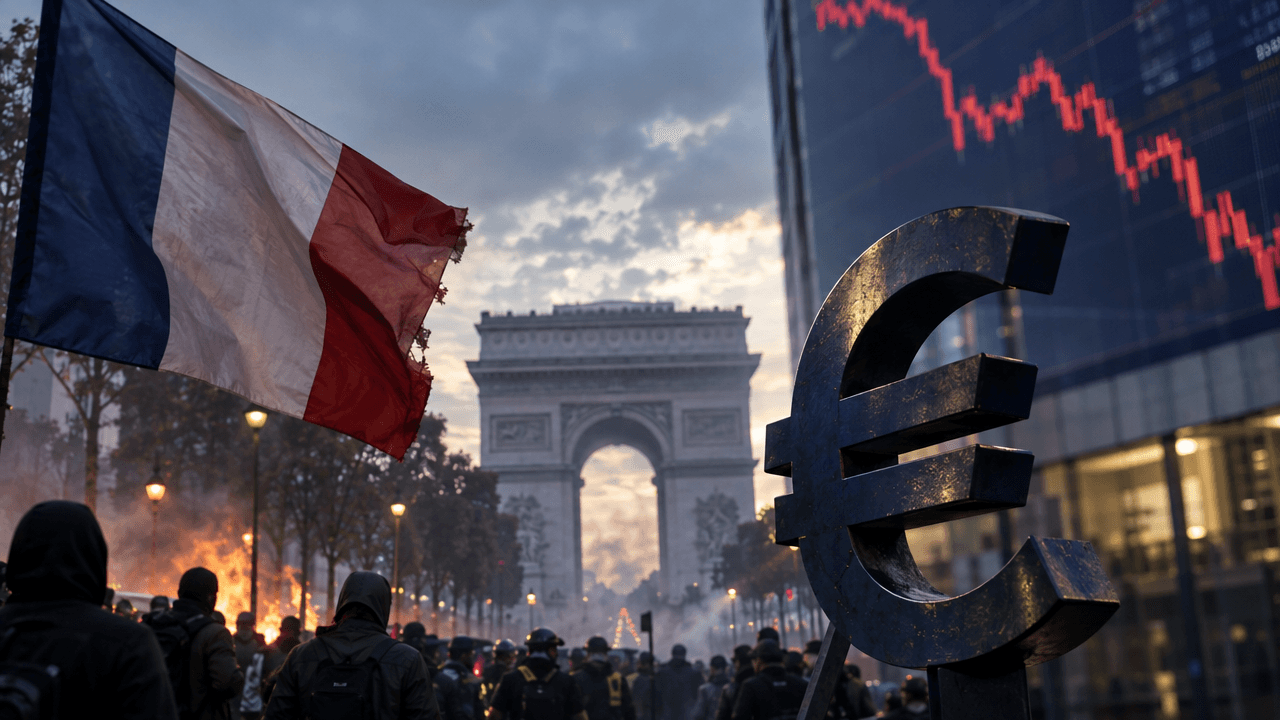
European equity futures slipped at the start of the week as investors assessed renewed political and social uncertainty in France. EURO STOXX 50 futures fell 0.4%, while DAX futures declined 0.3%. The euro also weakened, reflecting concern that unrest could complicate France’s fiscal policy and increase political risk across the euro area. [3]
The moves were modest across the broader market, but the reaction in French assets was sharper. France’s CAC 40 underperformed regional benchmarks, while French government bonds and major banks came under pressure. The pattern suggests that investors are not simply responding to a day of protests; they are reassessing the country’s ability to manage its deficit, pass a budget, and maintain confidence in its financial institutions. [2]
FRANCE BECOMES THE MARKET’S FOCUS
The latest unrest adds another layer of uncertainty to an already difficult political backdrop. Protests over the cost of living, public services, and government spending have highlighted the challenge facing France’s minority government as it attempts to negotiate a 2027 budget. Investors are also looking ahead to next year’s presidential election, where the possibility of a stronger showing by Marine Le Pen’s National Rally is influencing risk assessments. [1]
Political uncertainty matters to markets because it can delay fiscal decisions and weaken confidence in economic planning. If lawmakers struggle to approve spending cuts, tax measures, or deficit-reduction plans, investors may demand greater compensation for holding French debt. That can push government borrowing costs higher and make it more expensive for the state to finance existing obligations.
For equity investors, the concern is not limited to government bonds. Higher borrowing costs can pressure banks, reduce consumer confidence, and weigh on companies that depend heavily on domestic spending. French banks were among the notable decliners, with BNP Paribas and Société Générale each losing more than 2% in early trading. [2]
Why The Euro Is Weakening
The euro’s decline reflects the fact that political risk can influence currency markets even when the immediate economic impact is difficult to quantify. The currency fell approximately 0.2% to 0.3% against several major counterparts, including the U.S. dollar, as investors reduced exposure to euro-denominated assets. [2]
France is the eurozone’s second-largest economy, so concerns about its fiscal position can have implications beyond Paris. Markets often compare French government bond yields with German Bund yields through the OAT-Bund spread. A widening spread indicates that investors view French debt as riskier relative to Germany’s benchmark securities.
That spread has reportedly reached its highest level since the European sovereign debt crisis of the early 2010s, making it an important indicator for traders to monitor. [1] A sustained increase could signal that political concerns are becoming a broader eurozone risk rather than a temporary issue concentrated in French equities.
Still, a weaker euro is not automatically negative for every European company. Exporters can benefit when their products become cheaper for overseas buyers and foreign revenues translate into more euros. However, that benefit may be offset if political stress reduces foreign investment or increases volatility across European markets.
What Traders Should Watch Next
The first priority is the French government’s ability to contain unrest and make progress on its budget. Investors will be watching for signs of compromise, parliamentary support, and credible measures to control the deficit. A clear fiscal plan could calm bond markets, while prolonged deadlock could intensify pressure on French assets.
The OAT-Bund spread is another key signal. Equity traders should not view the CAC 40 in isolation. If French borrowing costs rise while German yields remain relatively stable, the spread may provide an earlier warning of deteriorating confidence.
Currency direction also deserves close attention. The euro was already trading near a recent low against the dollar, and additional political stress could encourage further selling. A weaker euro may support exporters, but it can also raise the cost of imported energy and raw materials, potentially adding to inflationary pressure.
Finally, earnings will help determine whether the market weakness remains political or becomes more fundamentally driven. European equities entered the week after strong gains in the previous week, and investors were already preparing for a busy corporate earnings calendar. [4] If companies report resilient demand and stable margins, political concerns may remain contained. Disappointing guidance, however, could amplify the market reaction.
Practical Takeaways For Simfi Traders
SimFi traders can use this event to practise separating headline risk from broader market structure. The initial futures decline indicates caution, but it does not automatically establish a lasting downtrend. Traders should compare price action in French equities, European indexes, the euro, and French-German bond spreads before forming a directional view.
Risk management is especially important when markets are reacting to political events. Volatility can increase quickly as new statements, protests, or policy announcements reach the market. Smaller position sizes, predefined stop levels, and avoidance of excessive leverage can help prevent a short-term headline from becoming a major account drawdown.
It is also useful to track relative performance. If the CAC 40 continues to underperform while the DAX and broader STOXX indexes remain comparatively stable, the market may be pricing a France-specific risk premium. If weakness spreads across European indexes and the euro, the issue may be developing into a wider regional risk event.
Conclusion
European equity futures are slipping because France has become a focal point for concerns about political stability, fiscal credibility, and social unrest. The immediate declines in EURO STOXX 50 and DAX futures are limited, but the pressure on French stocks, bonds, banks, and the euro shows why investors are monitoring developments closely.
For traders, the key is to avoid reacting to one headline in isolation. The most important signals will be whether France can advance its budget, whether the OAT-Bund spread continues to widen, and whether political stress begins to affect earnings expectations across Europe. Until those questions become clearer, cautious positioning and disciplined risk management remain more valuable than trying to predict every short-term market move.