
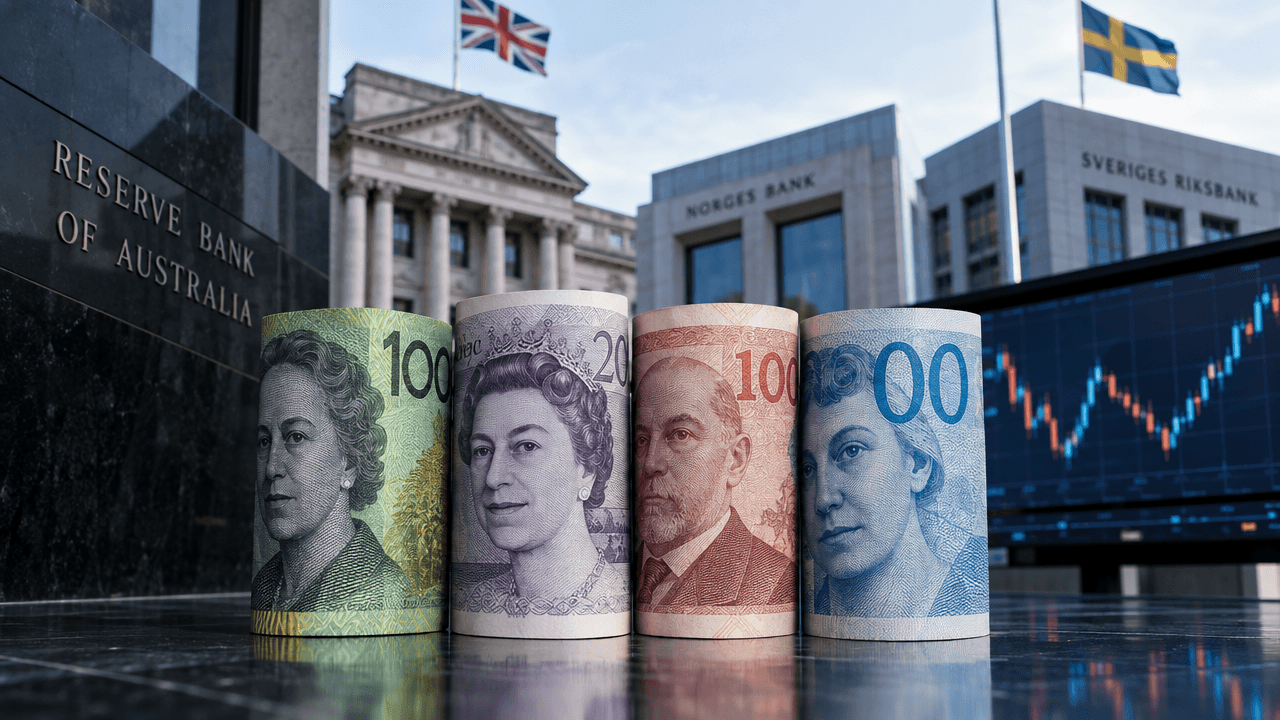
Foreign exchange markets are entering a potentially volatile week as several major central banks prepare to announce interest-rate decisions. Traders are facing an unusual concentration of policy risk, with Australia, the United Kingdom, Norway and Sweden all in focus. Even where a rate move is already widely expected, currencies can react sharply to the accompanying guidance on inflation, economic growth and future policy.
The key lesson for forex participants is that volatility often comes less from the decision itself than from the gap between expectations and reality. A central bank can deliver the anticipated hike and still weaken its currency if policymakers signal that further increases are unlikely. Conversely, a “hold” decision may support a currency if the statement suggests that tightening remains possible.
THE WEEK’S CENTRAL BANK CALENDAR
The Reserve Bank of Australia is the first major event on the agenda. Markets widely expect the RBA to raise its cash rate by 25 basis points, from 4.60% to 4.85%. A hike would represent the fifth increase of 2026 and take Australian borrowing costs to their highest level since 2008. Market pricing has placed the probability of the move near 80%, while several major banks and economists also support the expectation. [8][11]
The RBA’s decision is scheduled for Tuesday, November 3, after its two-day policy meeting. The central bank is responding to inflation that has remained persistently above its 2% to 3% target range. Governor Michele Bullock’s recent comments have reinforced expectations that policymakers are concerned about renewed price pressure. [9][13]
The Bank of England follows on Thursday, November 5. Economists expect Bank Rate to rise from 3.75% to 4.00%, which would be the BoE’s first increase since August 2023. The move is being linked partly to higher energy costs and renewed inflation risks. However, traders will pay close attention to whether the Monetary Policy Committee signals that additional increases are likely. [16][18]
The Norges Bank also announces its policy decision on November 5, while Sweden’s Riksbank is scheduled to publish its monetary policy decision on November 4. These events could create notable moves in the Norwegian krone and Swedish krona, particularly if either central bank surprises markets with a change in its policy outlook. [1][2]
Why Expectations Matter More Than The Headline
A fully anticipated rate hike does not automatically create a bullish currency reaction. By the time the announcement arrives, investors may already have bought the currency in expectation of higher yields. When the decision is confirmed, those traders may take profits, producing a “buy the rumor, sell the fact” move.
For the Australian dollar, the immediate focus will be whether the RBA leaves the door open to another increase. Markets have reportedly considered the possibility that the cash rate could reach 5.10% in a later meeting if inflation remains difficult to control. A firm tightening bias could support AUD/USD and strengthen the Australian dollar against lower-yielding currencies. [8]
The pound faces a similar situation. A 25-basis-point BoE hike is heavily anticipated, with some market pricing assigning the move a probability of roughly 95%. That leaves the voting split, inflation forecasts and forward guidance as potentially more important than the rate decision itself. If policymakers warn that the UK economy is too weak to sustain repeated hikes, sterling could fall even after the increase. [19][20]
For the krone and krona, market reaction may depend on relative policy expectations. Norway’s policy rate is currently listed at 4.5%, making Norges Bank one of the higher-yielding central banks in the group. Any indication that rates will remain elevated could help the krone, while a more cautious outlook could pressure NOK crosses. [10]
Trading The Volatility Without Chasing It
Central-bank weeks can offer opportunity, but they also increase the risk of slippage, sudden reversals and wider spreads. Traders should identify the exact announcement times and reduce reliance on highly leveraged positions immediately before the releases.
One practical approach is to define two scenarios before the decision. In the first, the central bank delivers the expected move and adopts a hawkish tone. In the second, it either surprises markets or provides less support for future tightening. This framework helps traders avoid making emotional decisions after the first price spike.
It is also important to monitor currency pairs rather than currencies in isolation. A hawkish RBA may strengthen the Australian dollar against the US dollar, but the move could be smaller against the pound if the BoE also signals a prolonged tightening cycle. Similarly, a strong Norges Bank statement could support NOK/SEK if Sweden’s central bank sounds more cautious, even if both currencies rise against the euro.
Technical levels can add structure to the analysis. Traders may mark the previous day’s high and low, identify areas where price consolidated before the announcement, and wait for a confirmed breakout or failed breakout. In fast markets, waiting for the first reaction to settle can be safer than entering during the initial move.
Key Takeaways For Simfi Traders
The week’s events reinforce several principles that apply to simulated finance and live-market analysis. First, consensus expectations are already reflected in price, so the surprise element is usually found in guidance, voting patterns and forecasts.
Second, risk management should take priority over prediction. A correct directional view can still produce a loss if position size is excessive or if volatility triggers a stop before the market establishes its trend.
Third, central-bank decisions should be assessed comparatively. Forex is a relative market, and the strongest opportunity may come from the contrast between two policy paths rather than from a single currency’s domestic outlook.
Finally, traders should distinguish between an initial reaction and a sustained trend. A currency may jump on a rate hike before reversing when investors study the statement and press conference. Reviewing price action across several timeframes can help separate temporary volatility from a genuine repricing of interest-rate expectations.
Conclusion
With the RBA, BoE, Norges Bank and Riksbank all in focus, global forex volatility is likely to remain elevated. Australia’s expected hike and the BoE’s anticipated return to tightening have already shaped market positioning, but the wording of each decision may determine what happens next.
For traders, preparation is more valuable than prediction. Track expectations, map alternative outcomes, control leverage and wait for confirmation when conditions are unstable. In a week crowded with rate decisions, disciplined execution may matter just as much as identifying the correct direction.