
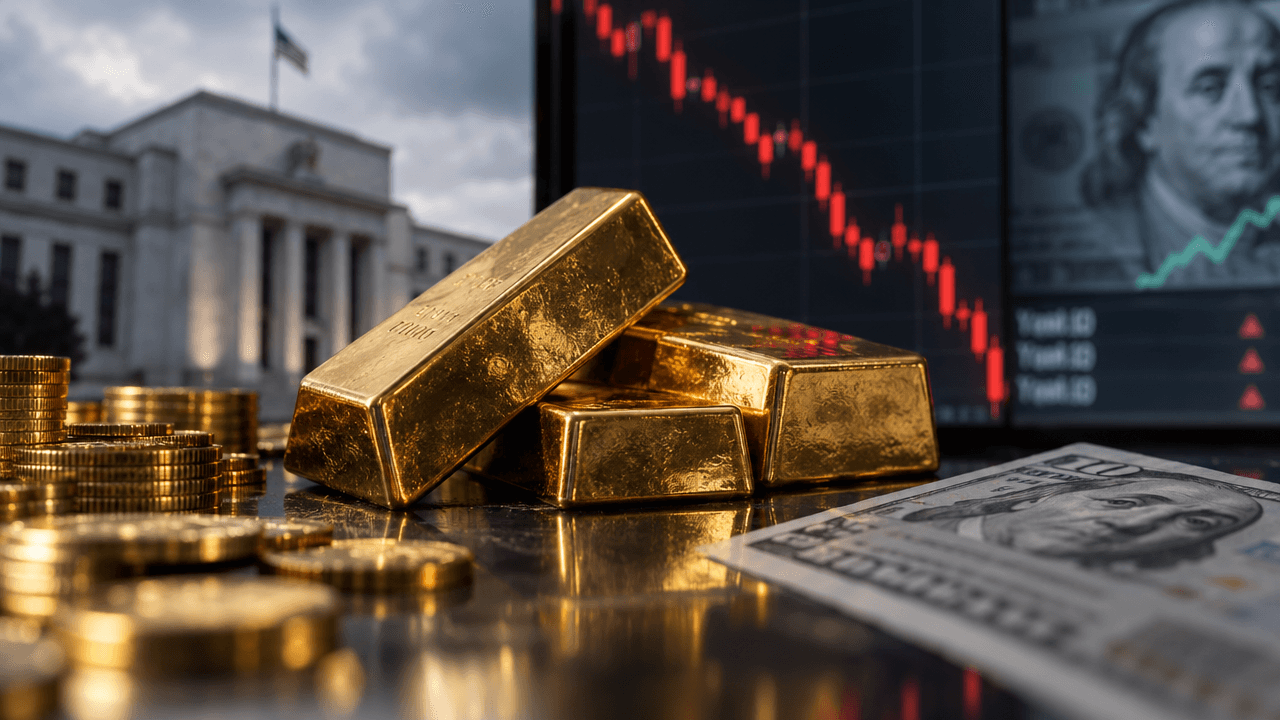
Gold fell sharply as rising Treasury yields and a stronger U.S. dollar reduced demand for the non-yielding precious metal. Spot gold declined roughly 2.6% to around $4,031 per ounce, extending a pullback that followed hotter-than-expected U.S. inflation data. Another market report placed spot gold near $4,021, down almost 3% on the session. [1]
The move highlights a familiar relationship in financial markets: gold often struggles when investors can earn more attractive returns from interest-bearing assets, particularly U.S. government bonds. At the same time, because gold is priced in dollars, a stronger greenback makes bullion more expensive for buyers using other currencies.
What Drove Gold Lower
The immediate catalyst was a shift in expectations for U.S. monetary policy. Stronger inflation data increased concern that price pressures remain persistent, making traders more cautious about assuming that the Federal Reserve will ease policy quickly. Instead, markets began to price in a greater possibility of additional rate increases or higher interest rates lasting for longer.
That repricing pushed Treasury yields higher. Reports indicated that the benchmark 10-year Treasury yield moved above 5%, with one market update citing a rise of approximately 12 basis points to 5.012%. The dollar also advanced against a basket of major currencies, adding another layer of pressure on bullion. [14]
Gold does not pay interest or dividends. When bond yields rise, investors face a higher opportunity cost for holding gold rather than Treasuries. The comparison becomes especially important when inflation-adjusted, or real, yields increase. If investors believe bonds can provide a reliable return after inflation, the appeal of holding a non-income-producing asset may decline.
Why The Dollar Matters
The relationship between gold and the dollar is not mechanical, but it is an important part of the market’s daily pricing process. Gold is generally quoted in U.S. dollars, so a stronger dollar raises the effective cost for international buyers. That can reduce demand even when the underlying interest in gold has not changed significantly.
For example, a European or Asian investor may see the dollar appreciate while the dollar price of gold remains unchanged. In local-currency terms, bullion has already become more expensive. If gold also declines in dollar terms, the currency effect can amplify the move.
The stronger dollar also reflects broader expectations about the U.S. economy and interest rates. Higher expected returns on dollar-denominated assets can attract international capital, supporting the currency and creating additional headwinds for gold. Recent market coverage described the dollar rising alongside Treasury yields after inflation data reinforced expectations of a more aggressive Federal Reserve stance. [1]
A PULLBACK DOES NOT END GOLD’S LONG-TERM STORY
A sharp daily decline can change market sentiment quickly, but it does not necessarily invalidate the broader investment case for gold. Bullion can still attract demand during periods of geopolitical uncertainty, financial stress, concerns about government debt, or declining confidence in major currencies.
The reason for higher yields also matters. Yields rising because of stronger economic growth can be negative for gold, as investors may prefer productive assets and income-generating securities. Yields rising because of fiscal concerns, heavy government borrowing, or higher inflation expectations may create a more complicated environment. Those same concerns can eventually support gold’s role as a store of value, even if the initial reaction is bearish.
Market commentary has also noted that gold’s safe-haven appeal can return if concerns about debt sustainability or financial stability intensify. In that scenario, higher yields may initially hurt bullion, but broader worries about the credibility of currencies or bond markets could later revive demand. [9]
What Traders Should Watch Next
The next major driver is likely to be the interaction between inflation, labor-market data, Federal Reserve communication, Treasury yields, and the dollar. Traders should avoid focusing on gold’s headline price alone. The direction of real yields and the U.S. Dollar Index can provide useful context for understanding whether a move is being driven by interest-rate expectations or by a change in risk sentiment.
A practical framework includes four steps.
First, monitor inflation releases and Federal Reserve speeches for evidence that policymakers are becoming more or less restrictive.
Second, track the 10-year Treasury yield and real yields. A sustained rise in both generally creates a stronger headwind for gold than a temporary move in nominal yields.
Third, watch whether the dollar’s strength is broad or concentrated. A short-lived currency rally may have limited consequences, while a durable trend can weigh on gold for weeks or months.
Fourth, define risk before entering a trade. Gold’s volatility can increase around economic data, and a move of several percentage points in a single session can quickly affect leveraged positions.
The Simfi Lesson
For SimFi traders, this episode offers a useful exercise in cross-market analysis. Instead of treating gold as an isolated chart, compare XAU/USD with Treasury yields and the dollar. If yields and the dollar are both rising, bearish pressure on gold may be strengthened. If yields fall while the dollar weakens, conditions may become more supportive.
However, correlations can break down during crises. Gold may rise alongside the dollar when investors seek liquidity and safety, or it may hold firm despite higher yields when geopolitical risks dominate. The goal is not to follow one rule blindly, but to identify which market force is controlling price action.
Gold’s fall toward $4,031 demonstrates how quickly macroeconomic expectations can reshape commodity markets. Higher yields and a stronger dollar created a powerful short-term headwind, but the longer-term outlook depends on inflation, fiscal policy, central-bank decisions, and investor confidence. For traders, the most valuable takeaway is to connect the chart with the broader market story before acting.