
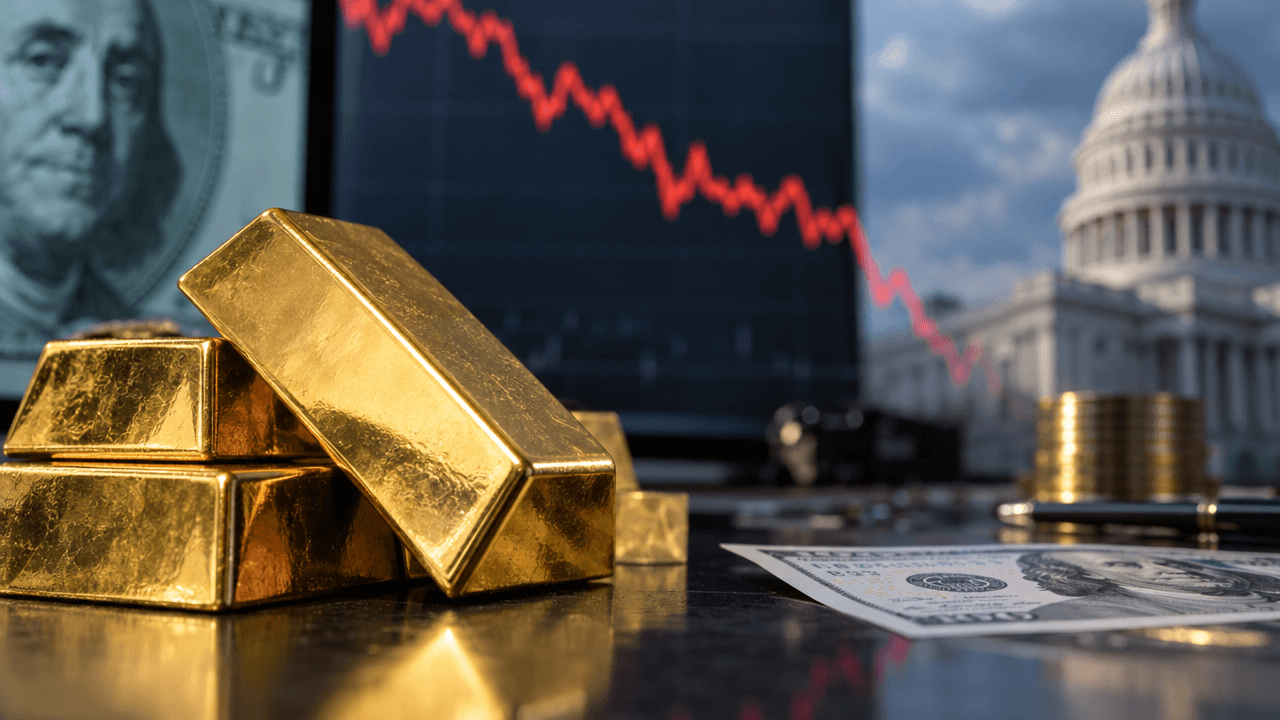
Gold plunged nearly 3% as a stronger U.S. dollar and rising Treasury yields forced investors to reassess the outlook for interest rates. Spot gold fell about 2.7% to approximately $4,028 per ounce, while December U.S. gold futures settled around 2.0% lower near $4,030. The sharp reversal highlights how quickly bullion can lose momentum when markets reduce expectations for near-term monetary easing.
The sell-off was not simply a reaction to weaker demand for precious metals. It reflected a broader shift in macroeconomic expectations. Investors increasingly focused on inflation, employment, and Federal Reserve policy, with stronger economic signals raising the possibility that interest rates could remain elevated—or move higher—for longer.
Why The Dollar Matters
Gold is priced globally in U.S. dollars, which gives the currency a direct influence on bullion demand. When the dollar strengthens, gold becomes more expensive for buyers using euros, yen, pounds, and other currencies. That can reduce international demand and encourage traders to close long positions.
A stronger dollar also frequently reflects rising confidence in U.S. economic conditions or expectations for tighter Federal Reserve policy. In this case, both forces worked against gold. Recent market reporting linked the decline to a firmer dollar, higher Treasury yields, and reduced expectations for rate cuts. [1]
Currency movements can have an especially powerful effect after a strong gold rally. Traders who bought bullion during a period of dollar weakness may decide to lock in profits when the currency turns higher. That selling can intensify the initial decline, particularly in futures markets where leveraged positions are common.
For traders, the practical lesson is to monitor the U.S. Dollar Index alongside gold. A rising dollar does not guarantee that gold will fall, but a sharp dollar rally creates a significant headwind for the metal.
RISING YIELDS INCREASE GOLD’S OPPORTUNITY COST
Gold does not pay interest or dividends. Its appeal comes from capital appreciation, portfolio diversification, inflation protection, and its role as a store of value. When bond yields rise, investors can earn more income from relatively low-risk government securities, making a non-yielding asset less attractive.
That trade-off is known as opportunity cost. If a Treasury security offers a higher yield, investors may require a stronger reason to hold gold instead. Rising yields can therefore pressure bullion even when concerns about inflation or geopolitical risk remain present.
Recent market data showed Treasury yields climbing as traders reassessed the Federal Reserve’s policy path. Reports also noted that higher interest rates increase the cost of holding non-yielding gold, reducing its appeal relative to interest-bearing assets. [6]
The relationship is particularly important for real yields, which adjust nominal bond yields for inflation. If real yields rise, gold often faces additional pressure because investors are receiving a stronger inflation-adjusted return from bonds. Gold can still rise during periods of increasing real yields, but it generally requires strong safe-haven demand or serious doubts about financial stability to overcome that disadvantage.
The Federal Reserve Expectations Reset
Markets are constantly adjusting to new information about central-bank policy. Inflation data, employment reports, Federal Reserve speeches, and economic growth figures can all change expectations within minutes.
The latest decline followed a period in which investors were already watching inflation closely. Stronger-than-expected price pressures and hawkish comments from Federal Reserve officials helped shift attention away from rate cuts and toward the possibility of additional tightening. One market report said investors were pricing a higher probability of a December rate hike as persistent inflationary pressure continued to influence expectations. [5]
That change matters because gold tends to benefit when traders anticipate lower interest rates. Easier policy can weaken the dollar, reduce bond yields, and increase demand for assets perceived as protective against inflation or currency depreciation. The opposite combination—higher yields and a stronger dollar—creates a challenging environment.
However, one sharp decline does not automatically establish a long-term bear market. Gold can recover if upcoming economic data weakens, inflation cools, Treasury yields retreat, or risk aversion returns. The key issue is whether the recent policy repricing continues.
What Traders Should Watch Next
The next moves in gold will likely depend on the interaction between economic data and technical price levels. Traders should watch inflation reports, employment figures, Federal Reserve communications, and changes in two-year and 10-year Treasury yields.
The two-year yield is especially sensitive to expectations for near-term Fed policy, while the 10-year yield reflects a broader combination of inflation, growth, fiscal, and term-premium considerations. If both yields continue rising, gold may struggle to regain momentum. If yields reverse lower, bullion could find support even if the dollar remains relatively firm.
Price action around the $4,000 area may also become important. A sustained break below a psychologically significant level could encourage additional profit-taking and trigger stop-loss orders. Conversely, a rapid recovery above recent support would suggest that buyers are treating the decline as a correction rather than a fundamental change in trend.
Simulated Finance traders should avoid reacting to a single large candle. Instead, they can create scenarios: one for continued dollar strength and rising yields, another for softer data and renewed rate-cut expectations, and a third for a risk-off shock that boosts safe-haven demand. Each scenario should include a defined entry, invalidation level, position size, and maximum acceptable loss.
Conclusion
Gold’s nearly 3% plunge demonstrates that bullion remains highly sensitive to interest-rate expectations, currency movements, and investor positioning. The immediate pressure came from a stronger dollar, rising yields, and reduced confidence in near-term monetary easing.
The most valuable takeaway is not to view gold in isolation. Understanding the relationship between bullion, the dollar, Treasury yields, inflation, and Federal Reserve policy provides a more complete framework for interpreting sudden market moves. For disciplined traders, the decline is a reminder that preparation matters more than prediction: track the macro drivers, manage risk, and wait for confirmation before assuming the next major trend.