
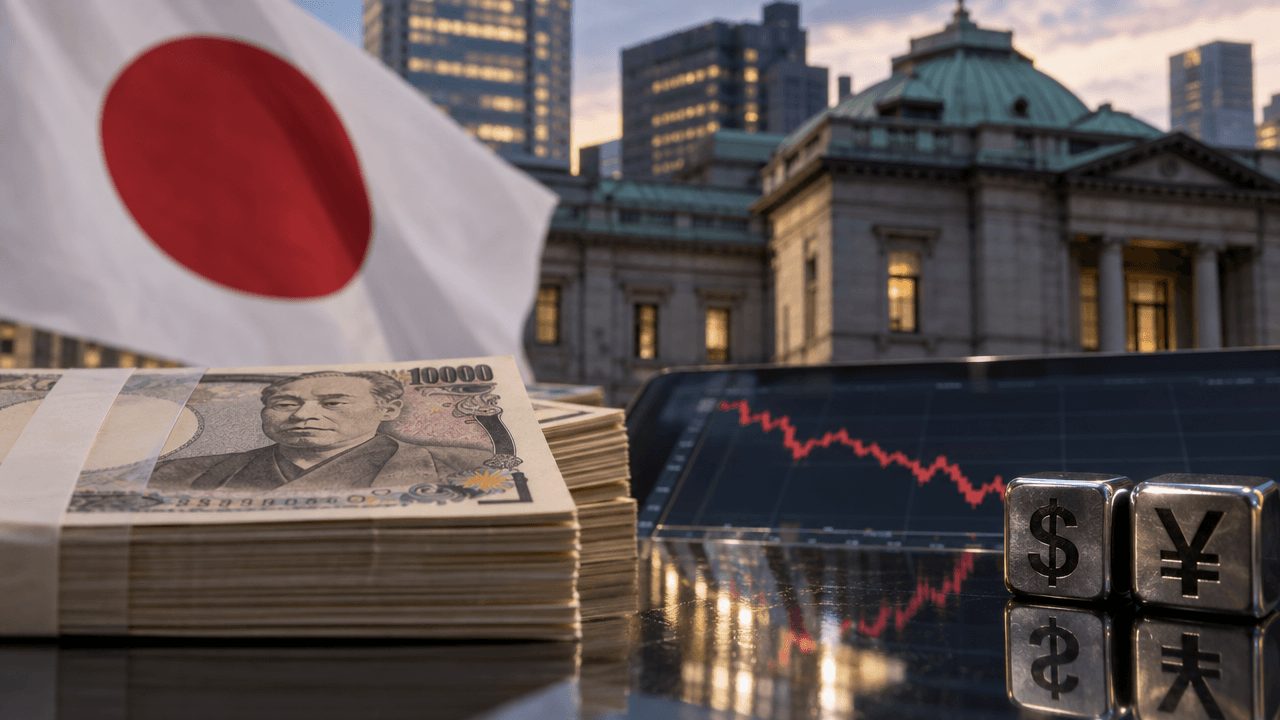
The yen’s next major move may depend less on headlines about the dollar and more on whether Japanese investors are willing to keep buying Japanese government bonds. That relationship was highlighted on October 20, when Japan’s 20-year government-bond auction drew exceptionally strong demand and briefly pushed USD/JPY lower from levels near 158.
The auction attracted bids worth 5.84 times the amount sold, up sharply from 4.01 times at the previous auction and above the 12-month average of 3.73. It was reportedly the strongest demand ever recorded for Japan’s 20-year bond issue. [1][7]
For currency traders, the result matters because bond demand can influence yields, capital flows, expectations for monetary policy, and the perceived need for government intervention. The yen is not driven by one market in isolation. When Japanese fixed-income assets become more attractive, demand for yen can increase as investors allocate money domestically.
The Bond-currency Connection
A bond auction is a direct test of investor demand. When demand is strong, buyers compete to obtain the available securities. Prices generally rise, yields decline, and confidence in the market improves. When demand is weak, investors may require higher yields to hold the debt, potentially raising borrowing costs and creating concern about fiscal or monetary stability.
The latest 20-year auction produced an immediate decline in long-term Japanese yields. The 20-year yield fell as much as six basis points to 3.71% after the result, while the 30-year yield also declined. [7][10]
At first glance, lower yields might appear negative for the yen because currencies often benefit from higher interest rates. However, the broader message was more important than the one-day yield move. Strong demand suggested that domestic and institutional investors were returning to Japanese bonds at elevated yield levels. That can support the yen by reducing the incentive to move capital overseas.
Japanese banks, insurers, pension funds, and other institutions regularly compare domestic bonds with foreign assets. For years, low Japanese yields encouraged investors to purchase overseas bonds and hedge some or all of the currency exposure. If Japanese yields become sufficiently attractive, those flows can slow, reverse, or become less negative for the yen.
WHY USD/JPY REMAINS VULNERABLE NEAR 158
USD/JPY near 158 reflects the continuing importance of the interest-rate gap between the United States and Japan. If U.S. yields remain substantially higher than Japanese yields, investors may still prefer dollar assets. That creates persistent demand for dollars and keeps the yen under pressure.
Yet exchange rates can become particularly sensitive when they approach levels that attract official attention. A weaker yen raises the cost of imported energy, food, and raw materials, placing pressure on Japanese households and businesses. It can also complicate the Bank of Japan’s efforts to guide inflation and interest-rate expectations.
The strong auction therefore delivered two signals. First, it showed that Japanese investors may be more willing to hold long-duration domestic debt. Second, it demonstrated that the bond market can respond positively even while the currency remains historically weak.
The yen gained about 0.2% after the auction, trading near 158.15 per dollar. Market observers also noted that the currency had been relatively resilient against the euro and Swiss franc, suggesting that returning institutional demand could become a structural support for Japanese assets. [1][4]
Policy Normalization And Intervention Expectations
Bond demand also affects how traders interpret future policy. A well-received long-term auction can reduce concerns that the government will need to rely on unusually high yields to attract buyers. It may also give policymakers greater flexibility as they consider the pace of monetary normalization.
The Bank of Japan must balance several competing risks. Raising rates too quickly could weaken economic activity and pressure heavily indebted borrowers. Keeping rates too low for too long could encourage further yen selling, especially if U.S. yields stay high.
A stronger yen caused by genuine private-sector demand is generally more durable than a short-lived move caused by verbal warnings or direct foreign-exchange intervention. Intervention can alter positioning quickly, but it does not permanently change the interest-rate differential or the underlying flow of capital.
For that reason, traders should treat the auction as evidence rather than proof of a lasting yen reversal. One strong result does not establish a trend. The next auctions, secondary-market yields, and institutional allocation decisions will determine whether demand is broadening.
Practical Takeaways For Traders
The first takeaway is to monitor Japanese bond auctions alongside USD/JPY. A weak auction combined with rising yields can signal market stress, while a strong auction may indicate renewed confidence and potential support for the yen.
The second is to distinguish between rising yields caused by healthy demand expectations and rising yields caused by forced selling. The former can strengthen domestic assets; the latter may increase volatility and undermine investor confidence.
The third is to watch the shape of Japan’s yield curve. If long-term yields fall after strong demand while shorter-term yields remain relatively firm, the curve may flatten. That can influence expectations for future Bank of Japan policy and alter the attractiveness of different yen-funded strategies.
In a SimFi environment, traders can build a scenario plan rather than relying on a single directional forecast. One scenario could involve strong auctions, stable or falling long-term yields, and a gradual move lower in USD/JPY. Another could feature weak demand, rising yields, and renewed concern about fiscal sustainability. A third could combine a weak yen with official warnings about excessive currency moves.
The most effective approach is to define entry levels, invalidation points, and maximum risk before the data arrives. The auction itself is important, but the market’s reaction often reveals more than the headline number.
Conclusion
Japan’s 20-year bond auction demonstrated why yen analysis requires more than tracking the U.S. dollar or waiting for central-bank announcements. Record demand showed that higher yields can attract domestic investors back into Japanese government debt, potentially creating a foundation for stronger yen demand.
USD/JPY near 158 remains exposed to U.S.-Japan rate differentials, intervention concerns, and changing policy expectations. But if strong Japanese bond demand continues across future auctions, the currency may receive support from a deeper and more sustainable source: the repatriation and reallocation of Japanese capital.
For traders, the key question is no longer simply whether the yen is weak. It is whether Japanese investors are beginning to see enough value at home to change the flows that helped keep it weak.