
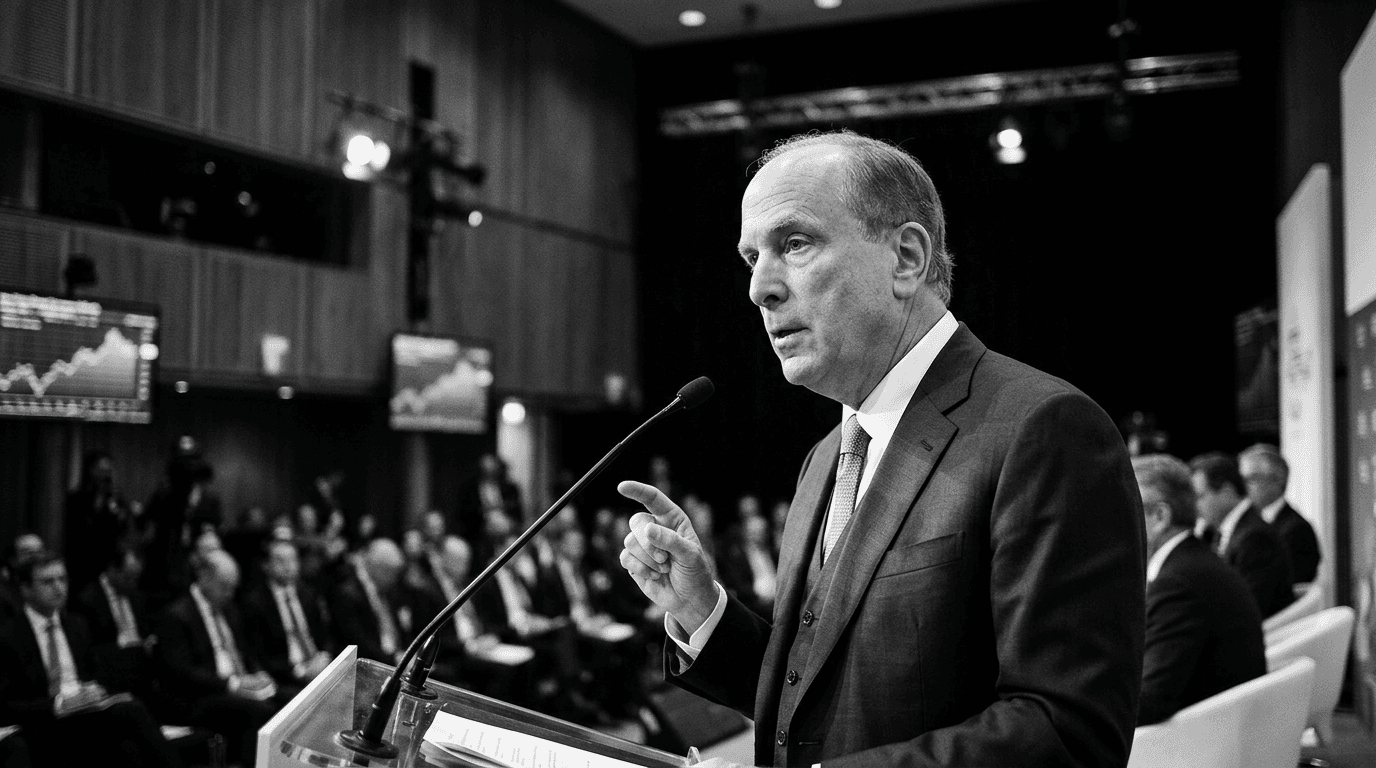
When the head of the world’s largest asset manager says the United States is “very close, if not in, a recession,” markets listen. Larry Fink, CEO of BlackRock, has added his voice to a growing chorus warning that the U.S. economy is weakening, and his comments have already shaken risk sentiment, fueled a bond rally, and driven traders into traditional safe havens in foreign exchange and fixed income. For active traders and investors, this is not just another headline – it’s a potential regime change in how markets are priced and how risk is managed.
What Fink Is Really Saying
Fink’s warning carries weight because of his vantage point. As CEO of BlackRock, he sits at the intersection of global capital flows, corporate boardrooms, and policy discussions. In past episodes, he has noted that many CEOs already feel like they are operating in “recession-like” conditions even before official data confirms it.[1]
His latest message is essentially this: the headline numbers may still look decent, but under the surface, the economy is losing momentum. That can show up in several ways:
- Slower revenue growth in cyclical sectors such as manufacturing, retail, and transportation
- Tighter corporate budgets, hiring freezes, and delayed capital expenditure
- Rising financing costs for weaker balance sheets as credit conditions tighten
Importantly, Fink is not waiting for a textbook confirmation. In the U.S., an official recession is only declared retrospectively by the National Bureau of Economic Research (NBER), often months after the downturn has begun. Markets, however, do not wait. They trade on expectations, and his suggestion that the U.S. may already be in recession is a signal that corporate leaders and large asset managers are pricing in a much weaker outlook than recent data alone might suggest.
WHY THIS MATTERS MORE THAN A TYPICAL “RECESSION CALL”
Recession talk is nothing new on Wall Street, but several factors make this warning more market-relevant:
First, Fink’s comments align with other late-cycle signals: flat or inverted yield curves, slowing earnings revisions, and pockets of stress in credit markets. When macro narratives and market signals converge, traders pay attention.
Second, the message comes after a long period of resilience where the U.S. economy repeatedly “surprised to the upside.” When a persistent soft-landing narrative gives way to rising recession risk, the repricing can be abrupt.
Third, Fink’s network amplifies the information content. His comment that many CEOs already feel like the economy is in recession suggests business leaders are behaving more defensively – cutting costs, slowing investment, and guarding cash – which can itself become a self-fulfilling drag on growth.[1]
Market Reaction: Bonds, Stocks, And Fx
The immediate response to Fink’s remarks has followed a familiar risk-off pattern: bond yields down, safe-haven currencies up, and pressure on growth-sensitive assets.
In bonds, recession fears typically drive a rally in government debt as investors seek safety and price in future rate cuts. Lower yields on the long end of the curve reflect expectations of weaker growth, lower inflation, or both. If traders start to believe the Fed will eventually need to ease more aggressively, the front end of the curve can also move sharply, steepening or re-steepening an inverted curve.
In equities, the impact is more nuanced. On one hand, lower yields can support high-duration sectors such as technology, at least temporarily. On the other, recession risk compresses earnings expectations and risk appetite, which tends to hit cyclicals, small caps, and highly leveraged companies hardest. Volatility typically rises as investors reassess what they’re willing to pay for future cash flows in a weaker growth environment.
In foreign exchange, the pattern often looks like this:
- Stronger demand for safe-haven currencies such as the U.S. dollar, Japanese yen, and Swiss franc
- Pressure on high-beta and commodity-linked currencies tied to global growth (e.g., AUD, NZD, some EM FX)
- Greater dispersion as markets distinguish between economies with room to ease versus those already constrained
Fink’s warning reinforces this risk-off behavior, especially when it comes on the back of other geopolitical and macro risks that are already pushing traders toward defensive positioning.
What This Means For Traders And Simulated Finance
For traders, the important question is not simply, “Is the U.S. in a recession?” but, “How does the market THINK about the probability of recession – and what is already priced in?”
That mindset shift is critical across asset classes
- In indices and single stocks, focus on earnings sensitivity to growth. Recession risk tends to reward quality: strong balance sheets, stable cash flows, and pricing power.
- In rates and bonds, monitor market-implied expectations for policy rates and inflation breakevens. These show how aggressively the bond market is pricing future easing or disinflation.
- In FX, track shifts in carry, risk sentiment, and relative growth expectations. Safe-haven flows can overwhelm traditional carry trades when recession risk spikes.
This is where Simulated Finance (SimFi) becomes particularly powerful. A simulated environment lets traders:
- Test how strategies perform under recession-like stress scenarios without risking real capital
- Practice adjusting position sizing, leverage, and stop-loss placement as volatility rises
- Explore cross-asset relationships – for example, how an equity selloff might interact with a bond rally and FX safe-haven flows
By recreating historical downturns and building custom stress tests, traders can learn how a portfolio might behave if Fink’s warning evolves into a full-blown downturn, or if markets decide they overreacted and stage a risk-on reversal.
Practical Takeaways For The Months Ahead
Regardless of whether the U.S. is formally “in” a recession, Fink’s commentary offers several actionable lessons for both real and simulated trading:
1) Trade the path, not the label You don’t need an official recession declaration. Focus on the trajectory of growth, earnings, and policy expectations. Markets move on changes at the margin.
2) Respect the bond market’s message A sustained rally in Treasuries, coupled with falling real yields, often signals a shift in growth expectations. When that aligns with CEO-level caution, it’s a strong signal that risk appetite may remain fragile.
3) Prioritize risk management over prediction It is extremely hard to time recessions precisely. It is easier – and more important – to size positions conservatively, use clear exit levels, and avoid over-concentration in the most cyclical exposures.
4) Watch credit and funding conditions Recessions hurt weakest balance sheets first. Spreads in high-yield credit, bank funding costs, and tightening lending standards can all confirm or challenge the recession narrative.
5) Use simulation to rehearse “what if” scenarios In a SimFi environment, you can build playbooks for different paths: a shallow slowdown, a deeper recession, or a no-landing continuation. Practicing these scenarios in advance can turn uncertainty from a threat into an opportunity.
Ultimately, Fink’s warning is not a guarantee of a deep downturn, but it is a reminder that the economic regime may be shifting from late-cycle resilience to early-cycle contraction. For traders, the edge will go to those who respond with disciplined risk management, thoughtful cross-asset analysis, and robust scenario planning rather than binary bets on whether the word “recession” shows up in the headlines.