
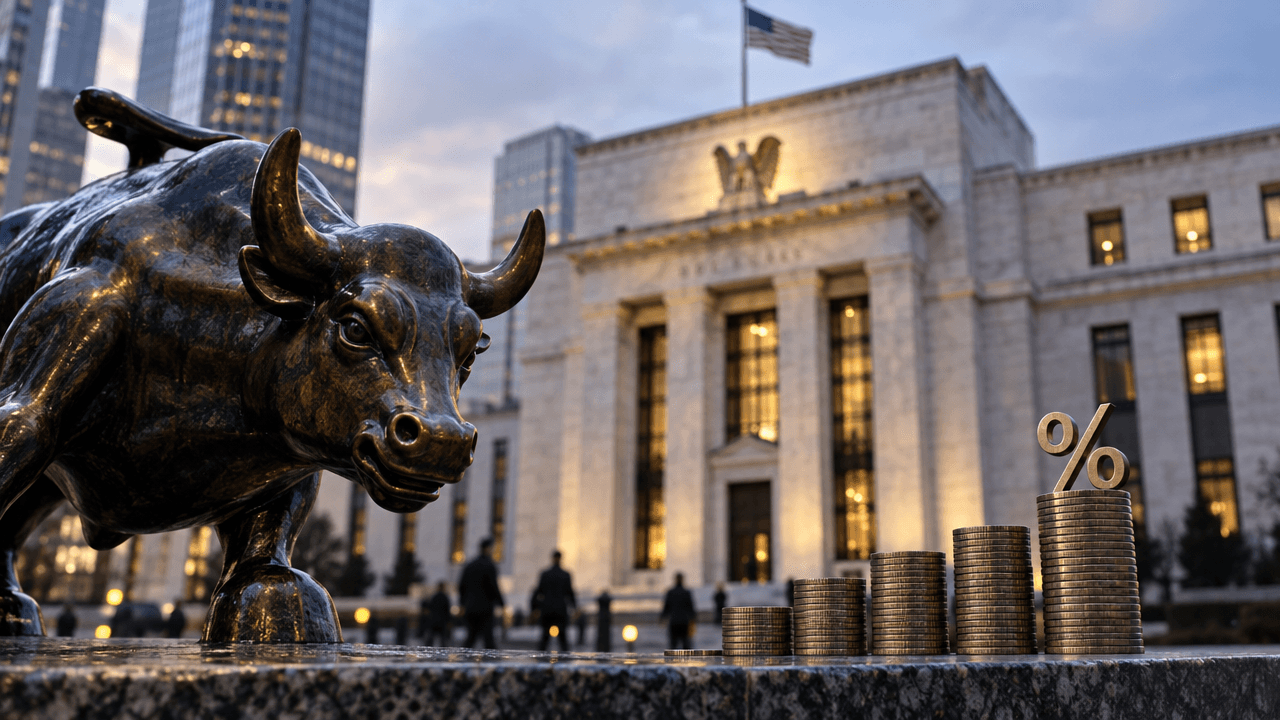
Financial markets are assigning a high probability to a Federal Reserve interest-rate hike at the December 8–9 meeting, with futures and prediction-market pricing placing the odds near 80%–82%. The shift reflects a stronger-than-expected employment report, renewed concern about inflation, and the view that the US economy may be resilient enough to withstand another increase in borrowing costs. However, the December decision is not locked in. The next major test is inflation data, particularly the October Consumer Price Index (CPI).
Why Rate-hike Expectations Have Risen
The strongest catalyst has been the October employment report. US employers added 165,000 jobs, far above estimates of approximately 65,000–70,000, while the unemployment rate declined to 4.1% from expectations of 4.2%. [4][6]
For Federal Reserve policymakers, this combination matters. A cooling labor market could justify patience, especially if inflation were moving steadily toward the central bank’s target. But stronger hiring and a lower unemployment rate suggest that demand remains firm. That gives officials more room to keep policy restrictive if inflation continues to run above desired levels.
Markets responded quickly. Before the employment report, traders saw roughly a 67% chance of a December hike. After the data, pricing moved as high as 85% before easing toward the high-70% or low-80% range. [1][3][6] The current message from interest-rate markets is clear: a quarter-point increase is viewed as the most likely outcome, but investors still expect incoming data to determine the final decision.
What A December Hike Would Mean
A standard 25-basis-point increase would raise the federal funds target range from 3.75%–4.00% to 4.00%–4.25%. [2][10] Although a quarter-point move may appear small, interest rates influence the entire economy.
Higher policy rates can increase borrowing costs for households and businesses. Credit-card interest, adjustable-rate loans, business financing, and some mortgage products may become more expensive. Companies may also face a higher hurdle when evaluating investments, hiring plans, or expansion projects.
Financial markets often react before the Fed acts. Treasury yields can rise as traders adjust expectations, while the US dollar may strengthen because higher rates can make dollar-denominated assets more attractive. Equity markets may be more sensitive, particularly growth stocks whose valuations depend heavily on future earnings. Companies with strong cash flow and limited debt may be better positioned than highly leveraged businesses.
For traders, the key point is that the rate decision itself may not be the biggest surprise. When a hike is already widely expected, markets often focus more on the Fed’s guidance about what comes next.
Why Cpi Is The Next Major Test
The October CPI report is likely to determine whether December rate-hike expectations strengthen or retreat. Analysts surveyed ahead of the release expected both headline and core inflation to increase by approximately 0.3% month over month, a pace that would support the case for another hike. [5]
Headline CPI includes food and energy prices, while core CPI excludes those categories to provide a clearer view of underlying price pressure. Federal Reserve officials typically monitor a broad range of indicators, but persistent core inflation can be especially important because it may reflect pressures in services, wages, housing, and consumer demand.
A hotter-than-expected CPI reading could push rate-hike probabilities above their current range and lift Treasury yields. It could also increase pressure on interest-rate-sensitive stocks and support the dollar. Conversely, a softer inflation report could cause traders to reduce their expectations, particularly if the labor market begins to show signs of cooling.
Prediction markets have pointed to a modest monthly CPI increase, with pricing suggesting a greater likelihood of a reading above 0.2% than above 0.3%. [14] That implies investors see some inflation risk but are not uniformly positioned for a major upside surprise.
How Traders Should Read The Signal
An 80% probability is not a guarantee. It means that current market prices resemble the outcome investors would expect if a hike were substantially more likely than no change. These probabilities can move quickly when new data changes the outlook.
Traders should distinguish between the probability of a December hike and the expected path after December. A quarter-point increase may be treated as a “one and done” move if inflation moderates or employment weakens. But if inflation remains elevated and economic growth stays strong, markets may begin pricing additional increases in the following months. Recent reporting indicates that some traders have already brought forward expectations for another potential hike. [6]
Practical steps include monitoring CPI’s headline and core readings, tracking Treasury-yield movements, watching the dollar for confirmation, and comparing market pricing with Federal Reserve communications. It is also important to manage risk around data releases because volatility can rise sharply when positioning is crowded.
The Broader Market Takeaway
The market’s high probability of a December Fed hike reflects confidence in the US economy as much as concern about inflation. Strong employment gives policymakers flexibility, while persistent price pressure argues against easing financial conditions too quickly.
Still, expectations remain data-dependent. CPI will provide the next major evidence, followed by the November employment report scheduled before the December meeting. [10] If both reports remain firm, a 25-basis-point increase could become even more firmly embedded in market prices. If inflation cools or labor conditions deteriorate, investors may reassess the need for additional tightening.
For now, the central message is that markets expect the Fed to raise rates in December, but the longer-term direction will depend on whether inflation is genuinely slowing. Traders who focus only on the headline probability may miss the more important question: whether the next hike marks the end of the tightening cycle or the beginning of a renewed series of increases.