
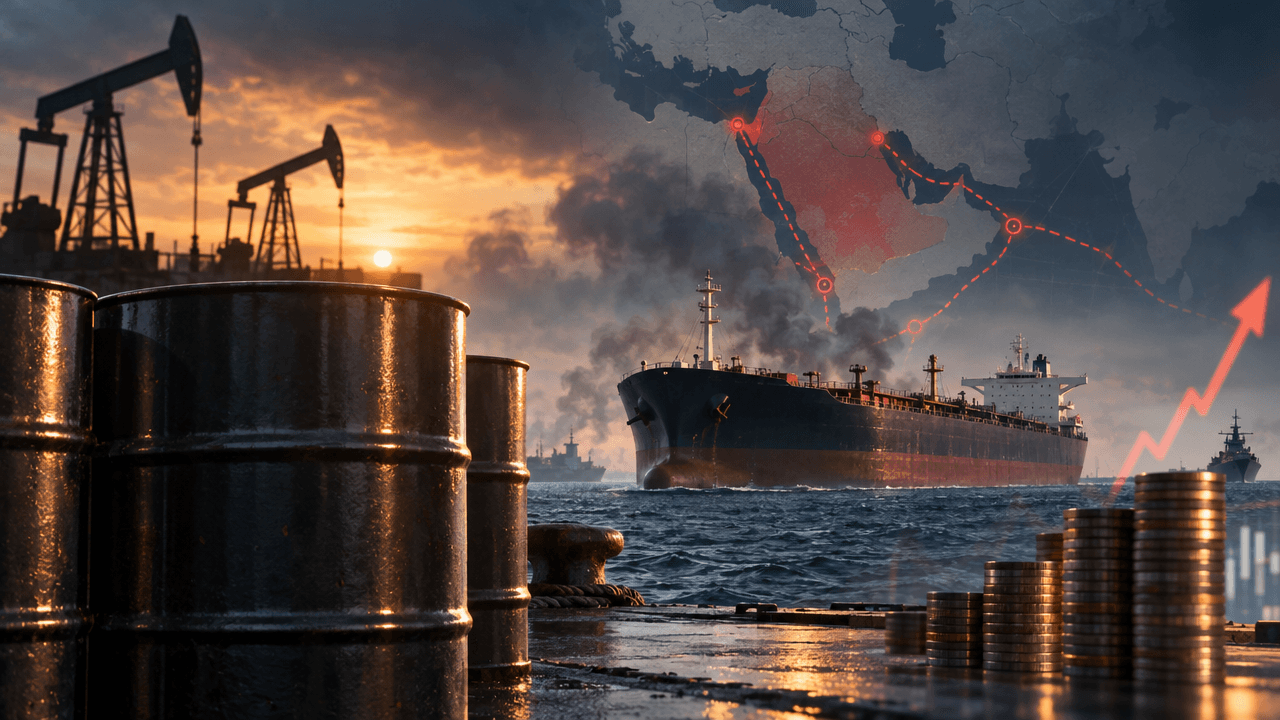
Oil prices have entered a tug-of-war between improving supply flows and worsening geopolitical risks. Hopes for diplomatic progress between the United States and Iran recently pushed crude toward two-month lows, but those hopes weakened as attacks on commercial shipping intensified around the Strait of Hormuz. Brent crude then rebounded, rising more than 1% to approximately $92.53 per barrel during Wednesday trading. [4]
The market reaction reflects a central challenge for energy traders: oil does not need to be physically removed from the market to become more expensive. When tankers face greater danger, insurers raise premiums, shipping companies alter routes, and cargoes take longer to reach buyers. The resulting risk premium can lift prices even while total production remains relatively strong.
The Geopolitical Risk Premium
The Strait of Hormuz is one of the world’s most important energy corridors, connecting major Gulf producers with customers across Asia, Europe, and elsewhere. Any disruption in or around the waterway can quickly affect expectations for crude, refined fuels, natural gas, and freight.
Recent attacks have kept that risk firmly in focus. At least 10 ships were reportedly hit during the first 10 days of November, following 37 attacks in October—the highest monthly total since the conflict began, according to data cited by the Washington Institute for Near East Policy. [2]
Diplomatic developments have moved markets in the opposite direction. When investors see credible progress toward a US-Iran agreement, they anticipate safer shipping, more reliable exports, and a reduced chance of damage to energy infrastructure. Prices can fall quickly as traders unwind precautionary positions.
But diplomacy is not the same as de-escalation. Negotiations may continue while attacks persist, leaving the market to price both possible outcomes: a rapid return to normal shipping conditions or a deeper regional confrontation. That uncertainty is one reason crude prices have remained volatile.
Why Supply Recovery Has Not Eliminated The Threat
Oil flows from the Middle East have shown signs of recovery, limiting the immediate physical shortage feared earlier in the conflict. Alternative export routes and pipelines have also helped producers move barrels without relying entirely on the most exposed shipping lanes. One recent market assessment said crude exports through the Red Sea had tripled, while pipelines in the United Arab Emirates and Saudi Arabia were operating at elevated levels. [8]
At the same time, a supply surplus can coexist with severe logistical stress. If more barrels are available but fewer tankers are willing to carry them, delivered fuel prices may rise even without a global production collapse. This distinction matters for traders and consumers alike.
Shipping costs and war-risk insurance can add substantially to the price of moving crude. A recent report estimated that transporting a barrel from the region, which previously cost about $5, could cost as much as $30 or more during the conflict because of insurance premiums, tanker rates, and security risks. [15]
These costs can spread through the entire energy chain. Refineries pay more for crude delivery, wholesalers pay more for transportation, and businesses pass some of those expenses to customers. The effects may appear in gasoline, diesel, aviation fuel, petrochemicals, and manufactured goods.
The Inflation Connection
Higher oil prices matter because energy is both a consumer expense and a production input. Households feel the impact through fuel, heating, and transportation costs. Companies face higher expenses for logistics, electricity generation, packaging, and raw materials.
The first inflation effect is direct: fuel becomes more expensive. The second is indirect: businesses attempt to protect profit margins by raising prices across other products and services. The longer the energy shock lasts, the more likely it is to influence wage demands, inflation expectations, and corporate pricing decisions.
This creates a difficult environment for central banks. If energy prices rise temporarily, policymakers may look through the initial increase. But persistent shipping disruption can make the shock broader and longer-lasting. Inflation may then decline more slowly, reducing the room for interest-rate cuts or delaying monetary easing.
Financial markets are especially sensitive to this issue because lower interest rates can support economic growth, equity valuations, and borrowing activity. If central banks remain cautious because of energy-driven inflation, traders may need to revise expectations for bonds, currencies, and risk assets.
What Traders Should Watch
The most important signal is not simply the daily price of crude. Traders should monitor whether attacks are increasing, whether commercial vessels are avoiding key routes, and whether insurers and shipping firms are imposing additional restrictions.
Diplomatic statements also require careful interpretation. A headline about talks may briefly pressure oil prices lower, but markets will look for evidence that negotiations are producing verifiable security improvements. A ceasefire announcement without safer passage for tankers may have a limited effect.
Inventory data, refinery utilization, and regional export volumes are equally important. Strong inventories and recovering production can moderate the impact of geopolitical headlines. Conversely, falling stockpiles or refinery disruptions could amplify a shipping-related price increase.
For SimFi traders, this environment is a useful reminder to manage exposure around news events. Avoid assuming that a single directional move will continue. Define risk before entering a position, consider smaller trade sizes during headline-driven volatility, and distinguish between an immediate price reaction and a lasting change in supply fundamentals.
The Broader Market Outlook
The oil market is currently balancing two competing forces. On one side, recovering exports, alternative routes, and signs of excess supply can limit prices. On the other, attacks on shipping and uncertainty surrounding US-Iran diplomacy can preserve a substantial risk premium.
That balance may produce sharp swings rather than a smooth trend. A credible diplomatic breakthrough could lower freight costs and release some of the premium embedded in crude. Further attacks on tankers or energy infrastructure could quickly reverse that move and push prices higher.
The key lesson is that energy markets respond not only to how much oil exists, but also to whether it can be moved safely and affordably. Until shipping security improves and diplomacy becomes more durable, oil prices may remain supported—and inflation concerns may continue to complicate the path toward lower interest rates.