
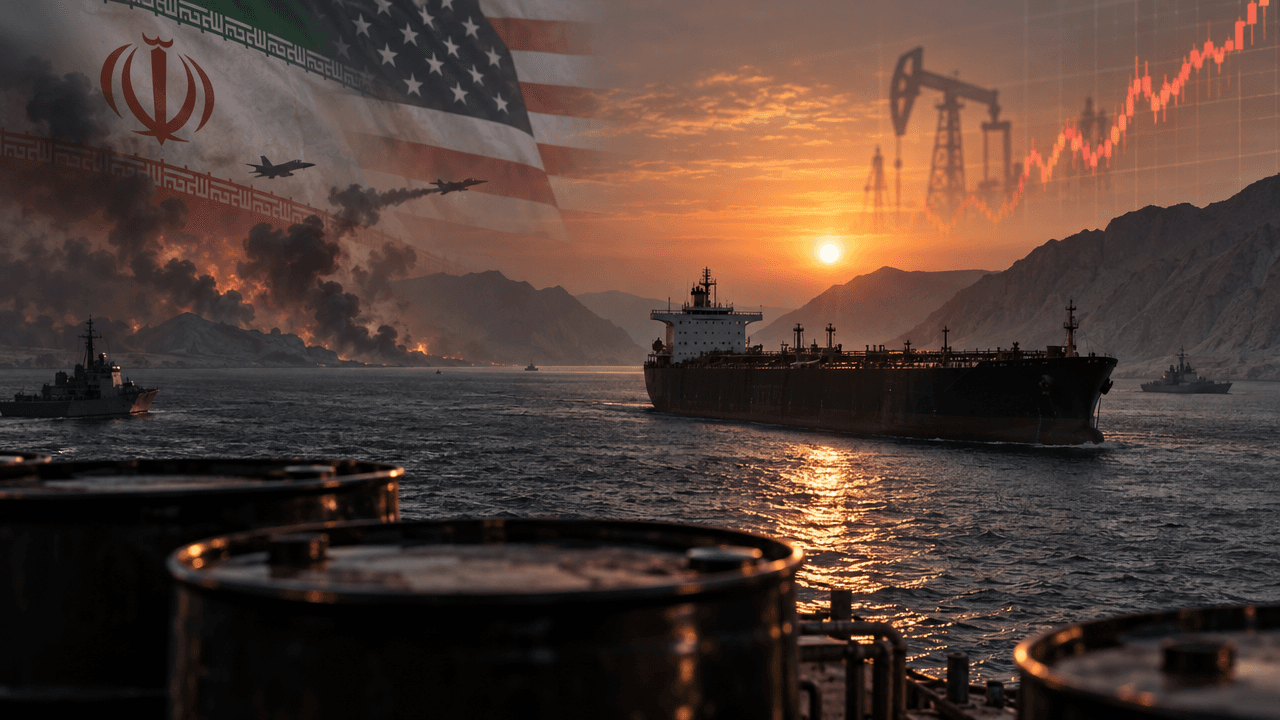
Oil prices are rising as renewed military tensions around the Middle East increase the risk of supply disruptions through the Strait of Hormuz, one of the world’s most important energy routes. Reports of attacks on commercial vessels, expanding US-Iran exchanges, and fresh US strikes on Iranian targets have pushed traders to price in a larger geopolitical risk premium. Brent crude recently settled at $93.14 a barrel, up 0.76% from the previous session. [3]
The immediate market concern is not only whether oil production facilities are damaged. It is whether tankers can continue moving safely through the narrow waterway connecting the Persian Gulf with global markets. Any sustained disruption could delay cargoes, raise insurance and freight costs, and force buyers to compete for alternative supplies.
Why The Strait Of Hormuz Matters
The Strait of Hormuz is a critical chokepoint for global energy markets. Large volumes of crude oil, refined products, and liquefied natural gas pass through the waterway every day. Even when production remains intact, uncertainty about shipping can affect prices because energy markets respond to the possibility of future shortages as much as to confirmed losses of supply.
Recent reports indicate that multiple vessels have been attacked or caught in incidents near the strait. Two more oil tankers reportedly exploded on Monday, bringing the number of tankers that caught fire in the waterway since Sunday to six, according to regional reporting. [1] On November 17, additional vessel attacks were reported around Hormuz while Tehran also targeted Bahrain, and the United States carried out strikes on locations connected with Iran’s military activity. [2]
For traders, the key question is whether these incidents remain isolated or become a sustained campaign against commercial shipping. A temporary shock may lift prices briefly before risk premiums fade. A prolonged disruption could affect physical inventories, refinery planning, and global inflation expectations.
The New Geopolitical Risk Premium
Oil prices often react sharply when geopolitical developments threaten a major producing region, even before measurable supply is lost. Traders must estimate the probability of escalation, the potential duration of the disruption, and the ability of producers and shipping companies to adapt.
That uncertainty explains why crude can rise even while broader market forces point in the opposite direction. Expectations of recovering Middle East exports and a possible global supply surplus have recently limited the upside in oil. Brent was reported trading near $92.76 a barrel on November 17, with concerns over tanker attacks offsetting the bearish effect of improving export prospects. [4]
This creates a two-sided market. A de-escalation could cause a rapid decline as the geopolitical premium disappears. Further attacks, damage to energy infrastructure, or restrictions on navigation could produce another sharp advance. The result is likely to be elevated volatility rather than a steady trend.
Inflation And Central-bank Expectations
Higher oil prices can influence the economy through fuel, transportation, manufacturing, and household energy costs. If crude remains elevated, gasoline and diesel prices may rise, increasing headline inflation. Businesses facing higher logistics and input costs may also pass those expenses on to consumers.
The inflation impact depends on both price levels and duration. A short-lived oil spike may have limited economic consequences. A sustained move higher can affect inflation expectations and wage negotiations, making the shock more difficult for central banks to ignore.
This is why the latest developments could reinforce hawkish expectations. Central banks may become more cautious about cutting interest rates if energy prices threaten to slow progress on inflation. Markets could respond through higher bond yields, a stronger currency in some economies, and pressure on interest-rate-sensitive sectors such as technology, real estate, and consumer discretionary stocks.
However, policymakers must also consider the growth risk. Higher energy costs reduce household purchasing power and raise operating expenses for companies. If the oil shock becomes severe, central banks could face the difficult choice of responding to inflation while avoiding additional damage to economic activity.
What Traders Should Watch
The first indicator is the security of commercial shipping. Traders should monitor reports from maritime authorities, tanker operators, and insurers rather than relying solely on headline-driven price moves. A decline in vessel traffic through Hormuz would suggest that the market is facing a more serious physical supply risk.
The second is the response of major oil producers. Additional output from countries with spare capacity could cushion the impact of disrupted flows. Traders should also watch inventory data, refinery utilization, export schedules, and price differences between regional crude grades.
The third is the shape of the futures curve. A market moving into backwardation, where near-term prices trade above later contracts, may indicate stronger immediate demand for physical barrels. A more stable or contango-shaped curve could suggest that traders expect the disruption to fade or supplies to recover.
Finally, risk management is essential. Geopolitical markets can move rapidly in both directions, and overnight gaps are possible. Position size, stop-loss planning, and awareness of contract specifications are especially important when trading energy futures or related instruments.
Practical Takeaways For Simfi Traders
The current environment offers a useful lesson: a bullish oil headline does not automatically mean prices will continue rising. Traders should separate the initial news reaction from confirmation in price action, volume, inventories, and shipping data.
A disciplined approach is to identify the event risk, define the invalidation level, and avoid chasing a sudden spike without a clear risk-to-reward setup. It is also important to consider cross-market effects. Rising oil may support energy producers while pressuring airlines, transportation companies, and consumer sectors. Higher inflation expectations may weigh on bonds and rate-sensitive equities.
For SimFi traders, simulated accounts provide an opportunity to practice these decisions without exposing real capital. The focus should remain on process: evaluating catalysts, managing leverage, recording trades, and reviewing whether the market thesis was supported by new evidence.
Conclusion
Oil’s rise reflects more than a routine supply-and-demand adjustment. Renewed attacks near the Strait of Hormuz and fresh US-Iran military exchanges have increased the risk that a regional conflict could interfere with one of the world’s most important energy corridors. [1][2]
The next phase of the market will depend on whether shipping disruptions intensify, whether producers can replace threatened supply, and how central banks respond to renewed inflation pressure. For traders, the best strategy is to respect the volatility, follow confirmation across multiple markets, and treat risk management as seriously as the directional view.