
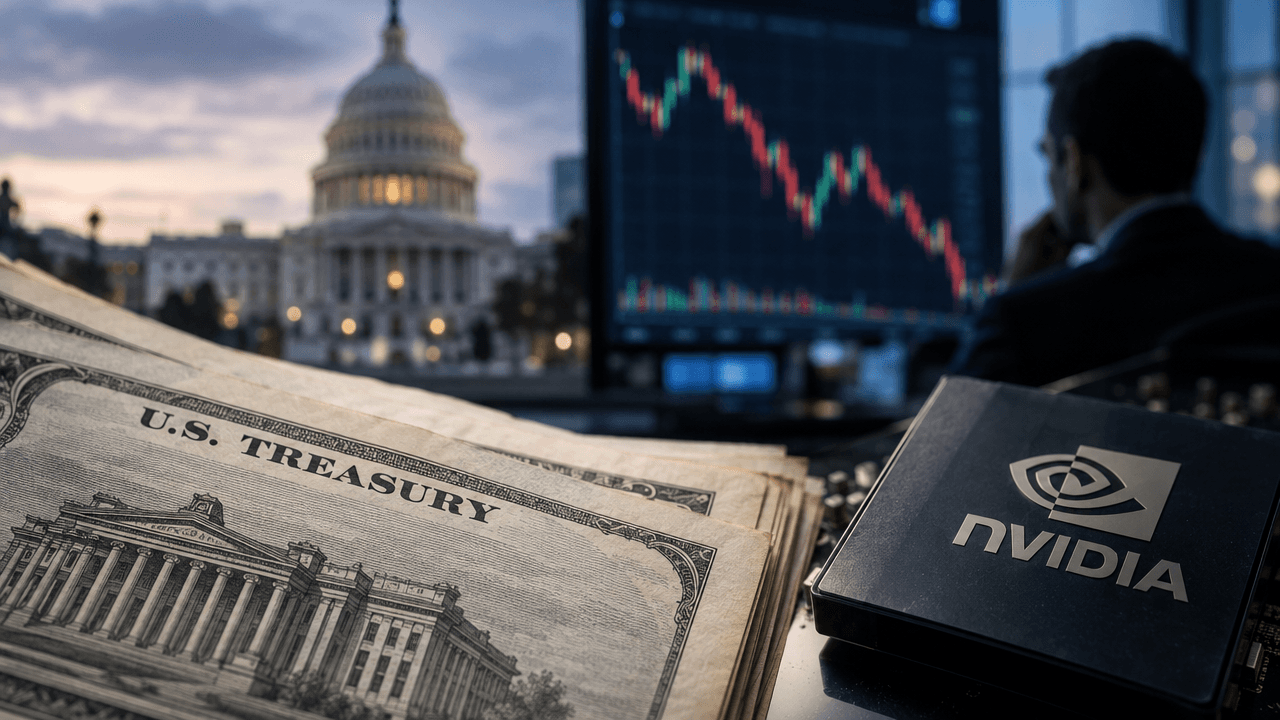
Treasury yields eased on Thursday as turmoil surrounding Nvidia weakened confidence in technology stocks and encouraged investors to seek safety in U.S. government bonds. The move was modest but meaningful: the 30-year Treasury yield fell as much as three basis points to 5.32%, while the 10-year yield hovered near 4.99%. [3]
For traders, the session offers a useful example of how quickly capital can rotate when market leadership becomes uncertain. A shock centered on one of the world’s most influential technology companies can affect equities, bonds, currencies, volatility, and expectations for economic growth. Understanding those connections is essential for navigating both traditional markets and simulated finance environments.
Why Treasury Yields Fell
Bond prices and yields move in opposite directions. When investors buy Treasuries, demand pushes bond prices higher, causing their yields to decline. When investors sell bonds, prices fall and yields rise.
The decline in long-term yields suggests that some market participants were reducing exposure to riskier assets and adding duration through longer-maturity government debt. The 30-year yield’s move toward 5.32% was particularly notable because long-term bonds are highly sensitive to changes in growth expectations, inflation concerns, and overall risk appetite.
The 10-year yield, often treated as a benchmark for global borrowing costs, remained close to 4.99%. That level shows that the defensive bid was not strong enough to erase broader pressure on bonds. Recent inflation data, expectations for Federal Reserve policy, and the Treasury’s heavy borrowing needs continued to influence the market.
In other words, investors were seeking protection, but they were not abandoning concerns about inflation or elevated interest rates.
Why Nvidia Matters Beyond Technology
Nvidia has become a central symbol of the artificial intelligence investment boom. Its chips support data centers, machine-learning applications, and a broad ecosystem of companies investing in AI infrastructure. As a result, developments involving Nvidia can influence more than the company’s own share price.
When uncertainty emerges around a major market leader, investors may reassess the sustainability of high technology valuations. They may also question whether expected AI-related growth has already been fully reflected in stock prices. That reassessment can lead to selling across technology shares, especially companies with high valuations or significant exposure to future earnings expectations.
The resulting shift is often described as a “risk-off” move. Investors reduce positions in assets that could experience large losses and favor instruments viewed as more defensive. U.S. Treasuries frequently benefit from this rotation because they are highly liquid and backed by the U.S. government.
However, a safe-haven response does not guarantee a sustained bond rally. If investors simultaneously worry about inflation, government debt issuance, or higher-for-longer interest rates, Treasury demand may remain limited. The modest yield decline in this session reflects that tension.
The Role Of The Yield Curve
The difference between short- and long-term Treasury yields provides additional information. The 10-year yield near 4.99% and the 30-year yield around 5.32% indicate that investors continue to demand extra compensation for holding longer maturities.
That premium can reflect several factors. Long-term bondholders face greater exposure to future inflation, changing interest rates, and fiscal uncertainty. They may also require higher yields to absorb the supply of government debt coming to market.
The curve should therefore be read alongside equity performance and economic data rather than treated as a standalone signal. A fall in long-term yields caused by safe-haven demand can coexist with rising short-term yields if traders expect the Federal Reserve to maintain restrictive policy.
For example, bonds at the front end of the curve tend to respond more directly to expected central bank decisions. Longer-dated bonds are influenced by the longer-term outlook for growth and inflation. A market can therefore price tighter policy in the short run while still anticipating weaker growth later.
Practical Lessons For Simfi Traders
The Nvidia-related move offers several practical lessons for traders using simulated finance platforms.
First, monitor cross-asset confirmation. If technology shares fall while Treasury prices rise, volatility increases, and defensive currencies strengthen, the market is showing a broader risk-off pattern. A single price move is less reliable than a coordinated signal across multiple markets.
Second, remember the difference between price and yield. A trader expecting safe-haven demand should generally expect Treasury prices to rise and yields to fall. Confusing those relationships can lead to incorrect trade ideas and poor risk management.
Third, distinguish headline impact from trend confirmation. A corporate shock may produce a sharp initial reaction, but the move can fade if economic data, Federal Reserve expectations, or Treasury auctions point in the opposite direction. Waiting for confirmation can be more effective than chasing the first headline-driven move.
Finally, manage duration risk carefully. Long-term Treasuries can move significantly when yields change by only a few basis points. They may offer diversification during equity weakness, but they are also vulnerable to inflation surprises and interest-rate repricing.
What To Watch Next
Traders should follow the outcome of the long-term Treasury auction, upcoming inflation and labor-market data, Federal Reserve commentary, and the broader reaction in technology shares. A successful auction could reinforce demand for long-duration bonds, while weak demand could push yields higher again.
The key question is whether Nvidia’s turmoil remains an isolated corporate shock or becomes part of a wider reassessment of technology valuations and economic growth. If concerns spread, safe-haven demand could strengthen. If investors regain confidence, Treasury yields may resume their upward pressure as capital returns to equities.
The session demonstrates that markets rarely move for one reason alone. Nvidia-related uncertainty created the immediate catalyst, but bond yields also reflected inflation, monetary policy, fiscal supply, and investor positioning. For SimFi traders, the most valuable takeaway is to connect those factors rather than trade headlines in isolation.