
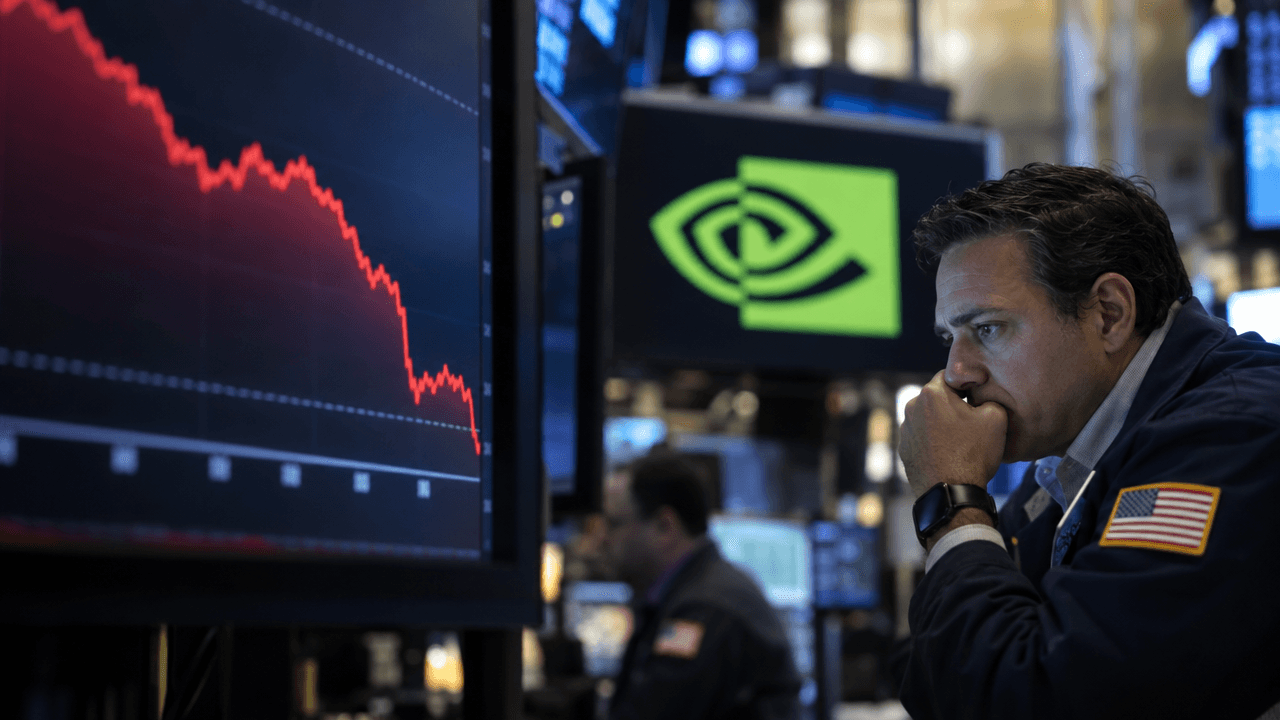
Nasdaq futures came under pressure Thursday as Nvidia-related uncertainty spread through the technology sector and raised fresh questions about the durability of the artificial-intelligence trade. Nasdaq 100 futures were down approximately 0.9%, while Nvidia shares fell sharply in after-hours trading following reports that the company’s board was considering the future of Chief Executive Jensen Huang. [1][4]
The reaction highlights how dependent market sentiment has become on a small group of mega-cap technology companies. Nvidia is not simply another large stock: it is a central supplier of the chips, software and infrastructure supporting the global AI investment cycle. When uncertainty affects Nvidia, investors often reassess the wider group of semiconductor companies, cloud providers and businesses spending heavily on AI.
What Is Pressuring The Market
Reports that Nvidia’s board was weighing a possible leadership change triggered a steep decline in the company’s shares. Nvidia reportedly dropped more than 6% in extended trading, with other reports placing the decline near 8% at one point. [2][3] The news came after reports involving Huang’s personal conduct, but the details and any potential leadership decision remained subject to confirmation.
For traders, the key issue is not only the allegations themselves. It is the possibility of an abrupt change at one of the world’s most important technology companies. Huang has led Nvidia for decades and is closely associated with its transformation from a graphics-chip manufacturer into the dominant provider of AI computing hardware.
Investors are therefore attempting to price several uncertainties at once: whether Huang remains in his position, whether the board has a credible succession plan, and whether a leadership dispute could distract management during a period of intense competition and enormous capital spending.
Why Nvidia Matters To The Nasdaq
Nvidia’s influence extends well beyond its own market capitalization. Its graphics processing units power many AI applications, and demand for those products has supported investment throughout the technology supply chain. Semiconductor manufacturers, data-center operators, networking companies and cloud platforms have all benefited from expectations of sustained AI growth.
That interconnectedness can amplify market moves. If investors become less confident in Nvidia’s leadership or future execution, they may reduce exposure to related companies even when those businesses have not released new negative information. This helps explain why Nasdaq futures fell more sharply than futures tied to some other major U.S. indexes. [5]
The sell-off is also a reminder that index performance can be heavily influenced by a limited number of highly valued stocks. A decline in one major constituent can affect passive funds, exchange-traded products and algorithmic strategies, creating additional selling pressure across the broader technology complex.
What Traders Should Watch Next
The first priority is confirmation. Headlines about a possible board decision can move prices rapidly, but initial reports may not establish whether a change will actually occur. Traders should distinguish between a board discussion, a formal announcement and a completed leadership transition.
Nvidia’s official communications will be particularly important. Investors may look for information about Huang’s status, the board’s position, succession planning and the company’s ability to maintain its product roadmap. Any indication of an interim chief executive or a permanent replacement could produce another sharp move in either direction.
The company’s upcoming earnings report is another major event for the AI trade. Nvidia’s financial results, guidance and commentary on demand will help determine whether the latest decline reflects a temporary confidence shock or a broader reassessment of the company’s growth outlook. Market participants will also examine order visibility, supply constraints, customer spending and the pace of data-center expansion.
Traders should also monitor price action in related companies rather than relying only on Nvidia’s headline move. If chip stocks, cloud providers and infrastructure firms stabilize while Nvidia remains weak, the market may be treating the situation as company-specific. If the selling broadens, it could signal a deeper reduction in risk appetite toward AI-related assets.
Practical Lessons For Simfi Traders
This event offers several useful lessons for simulated traders. First, concentrated exposure creates concentrated risk. A portfolio built around AI leaders can appear diversified while remaining highly dependent on one theme, one supply chain and a handful of companies.
Second, overnight and premarket markets can be especially volatile. Prices may react to incomplete information while liquidity is thinner than during regular trading hours. Traders should be cautious with market orders and consider how gaps could affect stop-loss execution and position sizing.
Third, separating facts from speculation is essential. A reported board discussion does not automatically mean a leadership change will occur, and a large premarket decline does not guarantee that the regular session will follow the same path. Scenario planning is more reliable than trying to predict a single outcome.
One practical approach is to define several possible scenarios before entering a trade. Under a confirmed leadership transition with a credible successor, Nvidia could recover if investors conclude that operations remain stable. Under prolonged uncertainty, volatility could persist across the AI sector. If the company provides reassurance and strong business guidance, the initial sell-off could reverse. If operational concerns emerge, the decline could broaden.
The Bigger Market Message
Nvidia-related uncertainty is a company-specific shock with market-wide consequences because the stock sits at the center of the AI investment narrative. The immediate decline in Nasdaq futures shows how quickly leadership risk can become index risk when a business has such a large role in investor expectations.
For now, the most disciplined response is to avoid treating the first market reaction as a final verdict. Follow verified company statements, watch the behavior of related stocks and manage exposure around upcoming announcements. In SimFi trading, the objective is not to imitate the fastest headline reaction. It is to build a process that remains controlled when information is incomplete and volatility rises.
The AI trade may continue to be supported by powerful long-term demand, but strong themes do not eliminate short-term risk. Nvidia’s next leadership update, earnings report and guidance will help determine whether this episode becomes a temporary setback or a broader test of confidence in the technology sector.