
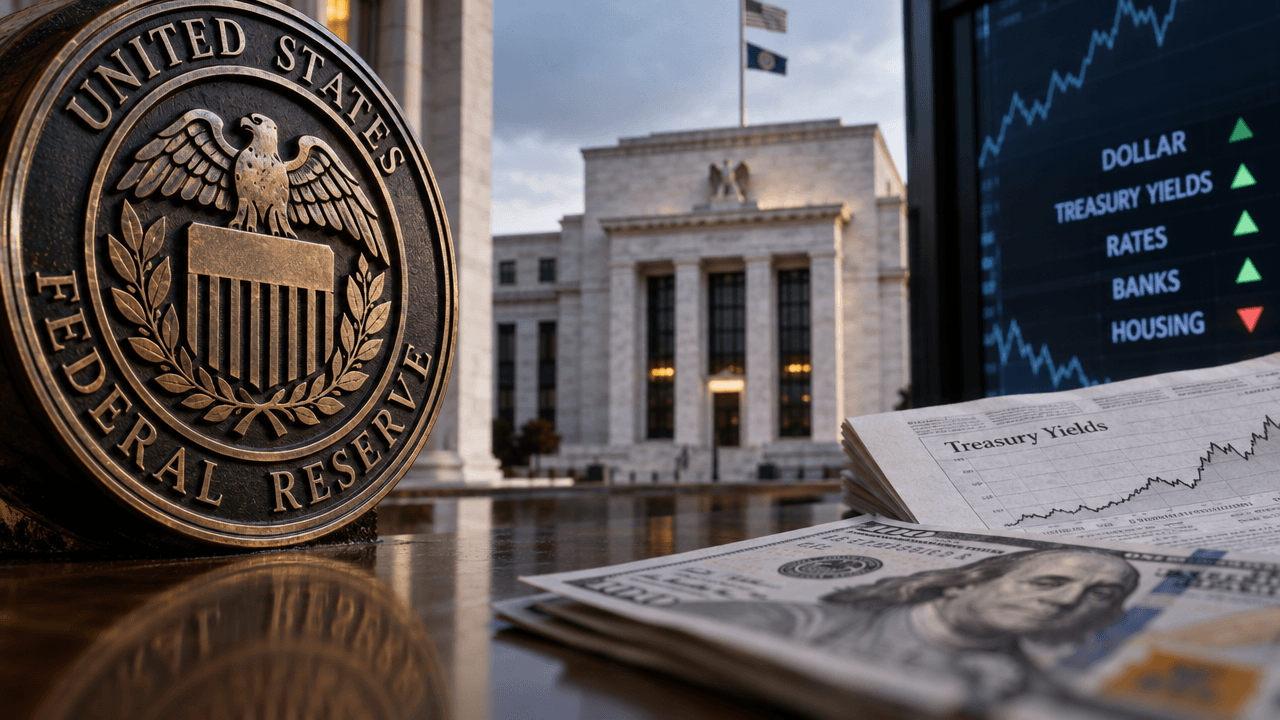
The Federal Reserve’s policy decision is the central event for global markets this week, putting the U.S. dollar and Treasury bonds at the center of investor attention. Traders largely expect policymakers to leave interest rates unchanged, but the market reaction will depend on the Fed’s guidance about inflation, economic growth, and the possibility of further tightening later this year. [1][8]
That makes this meeting more important than the rate decision alone. When an outcome is widely anticipated, financial markets often respond most sharply to the details surrounding it: the wording of the statement, the tone of the press conference, and any signals about the next meeting. For traders, the question is not simply whether the Fed holds rates. It is whether policymakers sound patient, cautious, or prepared to raise rates again.
The Dollar Responds To The Policy Path
The dollar index has risen approximately 0.4%, reaching a two-week high ahead of the announcement. [1] This strength reflects the market’s belief that U.S. interest rates may remain elevated for longer than previously expected.
Currency values are heavily influenced by interest-rate differentials. If investors can earn relatively attractive returns on dollar-denominated assets, demand for the currency tends to increase. A more hawkish Fed—one that emphasizes persistent inflation or leaves the door open to another rate increase—could support the dollar further.
Conversely, a clearly dovish message could weaken the greenback. If officials suggest that rates are sufficiently restrictive and that economic momentum is slowing, traders may bring forward expectations for eventual rate cuts. That would reduce the appeal of dollar assets, particularly if bond yields also move lower.
The important point is that a dollar rally does not require an immediate rate hike. Expectations can move markets well before policy changes occur. A single sentence suggesting that additional tightening remains possible may be enough to lift the currency if investors had positioned for a softer outcome.
Treasury Yields Keep Pressure On Markets
The benchmark 10-year Treasury yield is near 5.00%, a level that has significant implications across financial markets. Reuters reported the yield at approximately 4.9967% on Wednesday. [1] The 10-year yield influences borrowing costs for mortgages, corporate debt, business investment, and many valuation models used for stocks.
Higher yields can pressure rate-sensitive assets because future cash flows become less valuable when discounted at a higher interest rate. This is especially relevant for growth stocks, technology companies, real estate, and other assets whose valuations depend heavily on expectations of future earnings.
The rise in longer-term yields also shows that bond investors are focused on more than the Fed’s overnight policy rate. Treasury yields can climb because of stronger economic growth, persistent inflation, increased government borrowing, or concerns about the supply of bonds available to investors. In this environment, the Fed may hold rates steady while the bond market continues to impose tighter financial conditions.
That distinction matters for traders. A rate hold does not automatically mean easier conditions. If the 10-year yield remains around 5%, households and companies may continue facing elevated financing costs even without another policy move.
What Markets Are Watching In The Statement
The first signal will be the decision itself. Market pricing has assigned more than a 90% probability to an unchanged policy rate, according to reporting citing LSEG and CME FedWatch data. [8][14] Because the hold is broadly expected, volatility could depend on how much the Fed changes its forward guidance.
Traders should focus on several themes.
First, inflation. If officials continue to describe price pressures as uncomfortably high, markets may increase expectations for another hike. If inflation is characterized as moderating, investors may conclude that the tightening cycle is nearing its end.
Second, economic resilience. Strong growth and a robust labor market could give policymakers more flexibility to keep rates high. Signs of deteriorating activity, however, could make the Fed more cautious.
Third, financial conditions. The central bank will be aware that higher Treasury yields and a stronger dollar already tighten the economy. If officials believe markets have done part of the Fed’s work, they may avoid making an additional hike immediately while still maintaining a firm stance.
Finally, investors will listen closely to the chair’s press conference. The same rate decision can produce very different outcomes depending on whether the communication emphasizes patience or the need for further action.
Practical Takeaways For Simfi Traders
Simulated Finance traders should treat the announcement as a volatility event rather than a guaranteed directional opportunity. A common mistake is to trade only the expected result. Since the rate hold is already priced in, the largest move may occur if the guidance differs from expectations.
Before the announcement, define a maximum risk level and avoid entering oversized positions simply because the market appears calm. Spreads can widen and price movements can accelerate when the statement is released.
Watch the dollar and Treasury yields together. A hawkish message may produce a stronger dollar and higher yields, while a dovish message may push both lower. However, the relationship can temporarily break down if investors seek safe-haven assets or react to concerns about economic growth.
It is also useful to monitor the yield curve. A sharp rise in short-term yields would suggest that traders are pricing a more restrictive Fed. A rise concentrated in the 10-year or 30-year sector may point instead to inflation, borrowing, or supply concerns.
Conclusion
The Fed’s decision dominates the dollar and Treasury markets because expectations are already doing much of the trading. With a rate hold largely anticipated, the real catalyst will be the central bank’s guidance on inflation, growth, and future tightening.
A hawkish message could extend the dollar’s gains and keep the 10-year yield near or above 5%, increasing pressure on rate-sensitive assets. A dovish signal could produce the opposite reaction, easing yields and weakening the currency. For traders, the most effective approach is to prepare for both outcomes, manage exposure carefully, and focus on the policy path rather than the headline decision alone.