
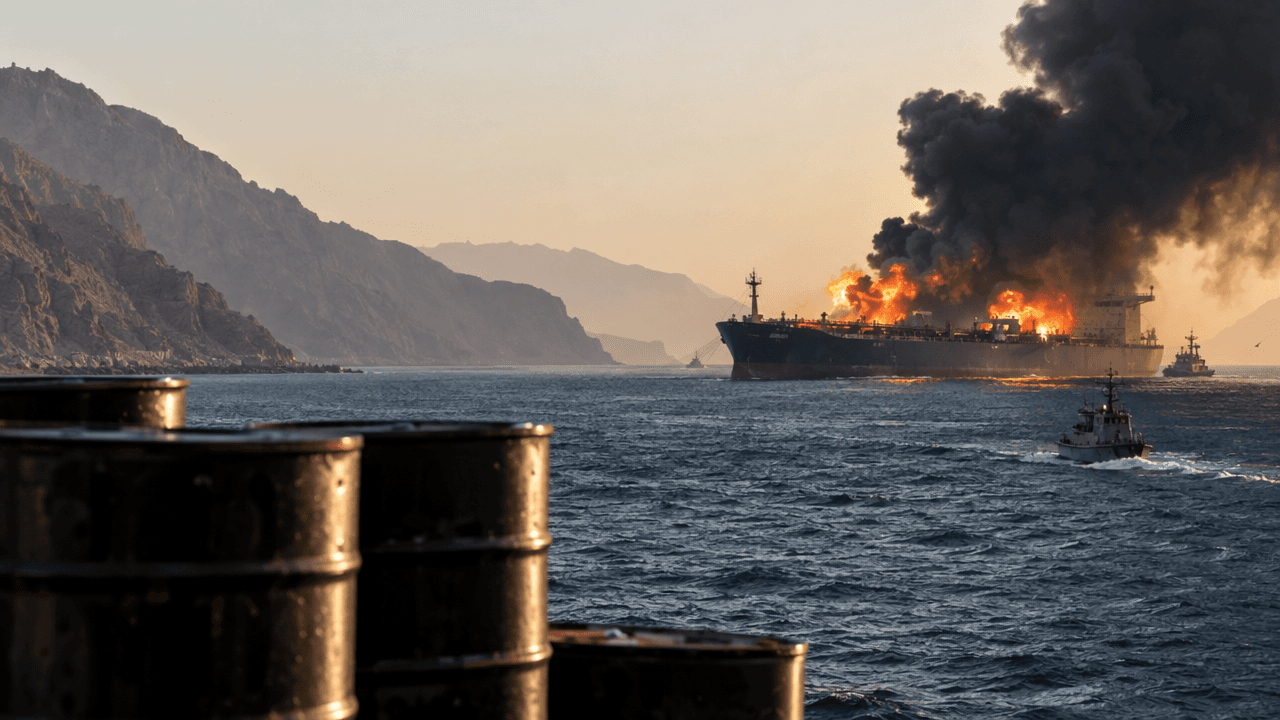
Oil prices moved higher on Friday as a tanker attack in the Strait of Hormuz revived fears that a crucial energy route could face further disruption. Brent crude traded near $116 per barrel, while West Texas Intermediate moved above $103. The advance extends a period of strength for crude markets, with both benchmarks heading toward a fourth consecutive monthly gain. [4][5]
The immediate market reaction reflects more than the damage to one vessel. Traders are pricing the possibility that additional attacks, military escalation, or tighter security restrictions could reduce the movement of oil and refined products from the Persian Gulf. In energy markets, even a potential disruption can create a risk premium before physical supply is actually lost.
Why The Strait Of Hormuz Matters
The Strait of Hormuz is one of the world’s most important energy chokepoints. In 2024, approximately 20 million barrels of oil and petroleum liquids passed through the waterway each day, equivalent to about one-fifth of global consumption. The route also represented more than one-quarter of global seaborne oil trade. [1][8]
Most of the crude and fuel moving through Hormuz is destined for Asian markets, including major consumers such as China, India, Japan, and South Korea. This concentration makes the strait difficult to replace quickly. Alternative pipelines and shipping routes exist, but their capacity is limited compared with the volume normally transported through the waterway.
That imbalance explains why a relatively isolated security incident can influence crude futures worldwide. Buyers, refiners, shipping companies, and financial traders all have to consider whether the event is temporary or the beginning of a broader interruption.
How The Attack Changed Market Pricing
The United Kingdom Maritime Trade Operations agency reported that a tanker in the strait was struck by explosive devices attached by a small boat. Responsibility for the incident was not immediately established, but the event was enough to renew concern over the safety of commercial shipping. [4]
Brent’s December contract rose by more than 1% in early trading to around $116.08 per barrel, while other reports placed the contract above $116.30 during the session. The more actively traded January contract also gained, demonstrating that the reaction was not limited to a single expiring futures position. [4][5]
This distinction matters. When only the front-month contract rises, the move can sometimes reflect expiration mechanics, temporary positioning, or a short-term delivery concern. When prices across several contract months advance, it suggests that traders are reassessing the broader balance between future supply and demand.
The current increase is also part of a larger trend. Brent was on course for a monthly gain of roughly 11% to 13% in October, while WTI was expected to rise around 14%. Those gains indicate that geopolitical risk has become a sustained factor in crude pricing rather than a one-day market reaction. [5][9]
Inflation And The Broader Economy
Higher oil prices can affect the economy through several channels. The most visible is fuel. More expensive crude can raise gasoline, diesel, jet fuel, and heating costs, increasing household expenses and business operating costs.
Transportation companies may face higher costs for moving goods. Manufacturers can also experience pressure from more expensive petrochemical feedstocks, packaging materials, and industrial energy. If those costs persist, companies may pass them on to consumers, adding to headline inflation.
Central banks typically focus on underlying inflation rather than reacting mechanically to every energy-price swing. However, a prolonged oil shock can complicate monetary policy. Policymakers may face a difficult choice between maintaining restrictive interest rates to prevent broader price increases and supporting economic activity as households lose purchasing power.
For investors, the key question is whether the rise in crude is temporary or persistent. A brief spike may have limited economic consequences. A sustained disruption could influence inflation expectations, bond yields, currency markets, corporate margins, and consumer spending.
What Traders Should Watch Next
The next market moves will depend on several indicators. First, traders will monitor whether additional vessels are attacked, delayed, or rerouted. A single incident may produce a short-lived risk premium, while repeated attacks could lead shipping companies and insurers to reassess whether the route is commercially viable.
Second, physical oil flows will be more important than headlines alone. Tanker movements, loading schedules, freight rates, and refinery inventories can reveal whether supply is actually tightening. Futures prices may react instantly, but physical market data can confirm whether the disruption is becoming structural.
Third, traders should watch the spread between front-month and later-dated contracts. A market moving into backwardation, where near-term prices exceed future prices, may signal stronger immediate demand for available barrels. A flatter curve could suggest that participants expect supply routes to normalize.
Finally, inventory reports and official statements from major producers will remain important. Additional production, emergency stock releases, diplomatic agreements, or the reopening of alternative routes could reduce the risk premium. Escalation, by contrast, could push prices higher even if global demand remains unchanged.
Practical Takeaways For Simfi Traders
For simulated-market participants, the episode offers a useful lesson in risk management. Geopolitical headlines can create sharp price gaps, wider volatility, and rapid changes in trend. Traders should avoid treating a single price move as proof that a long-term trend has begun.
Useful steps include defining risk before entering a position, monitoring contract expirations, comparing Brent with WTI, and checking whether price gains are supported by volume and broader futures-market participation. It is also important to distinguish between directional conviction and exposure size. A trader can be correct about the fundamental story and still suffer losses if leverage is excessive.
Oil can also influence related markets. Energy equities may benefit from higher crude prices, while airlines, transportation companies, and fuel-intensive manufacturers may face pressure. Inflation-sensitive bonds, currencies of oil-exporting nations, and major equity indexes can all respond as expectations change.
Conclusion
The tanker attack in the Strait of Hormuz has reminded markets that energy security remains vulnerable to geopolitical shocks. With roughly 20 million barrels per day historically moving through the waterway, even a perceived threat can affect prices far beyond the immediate incident. [1]
Brent near $116 reflects both current concern and uncertainty about what happens next. The most important issue is not simply whether oil rises after one attack, but whether shipping disruptions become frequent enough to reduce physical flows. Until that question is answered, volatility is likely to remain elevated.
For traders, the best response is disciplined preparation: follow the physical data, respect event risk, manage leverage, and recognize that oil prices can move faster than the underlying fundamentals. In a market shaped by chokepoints and geopolitical uncertainty, risk management is as important as the forecast itself.