
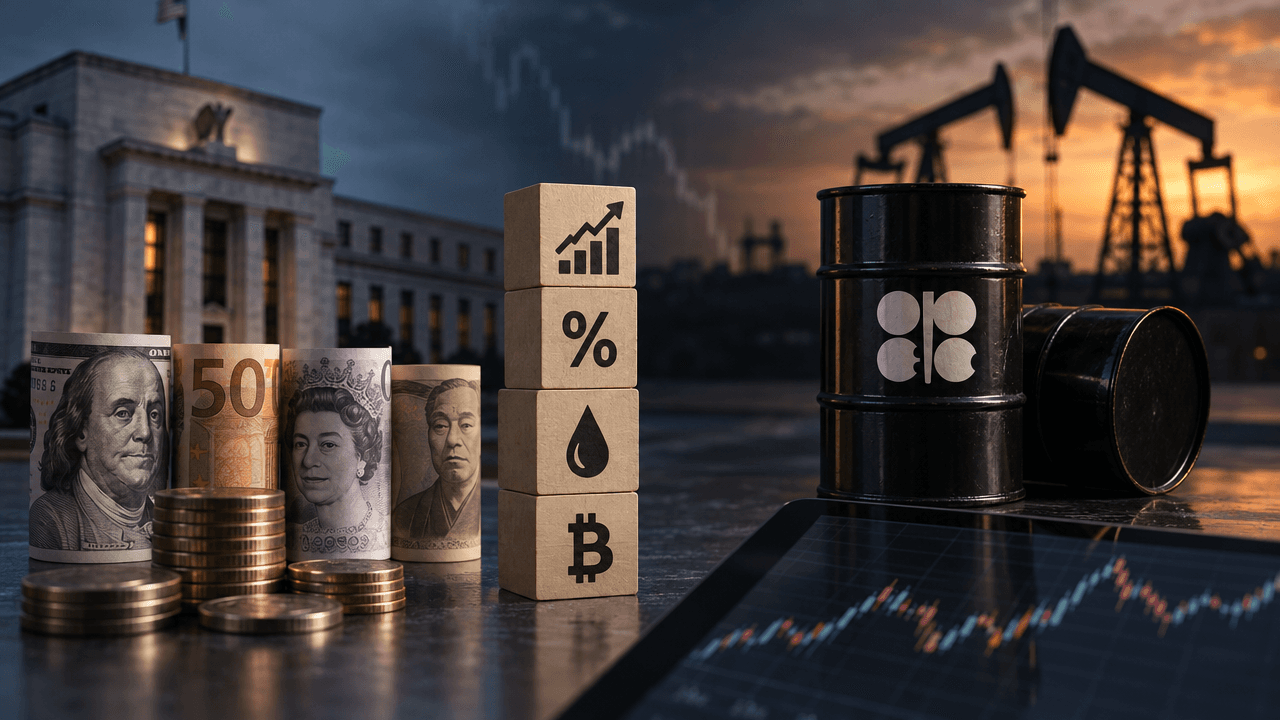
Markets are entering a risk-sensitive stretch with investors focused on two events that can influence multiple asset classes at once: the Federal Reserve’s December policy decision and the upcoming OPEC+ meeting. Neither event guarantees a sharp market move, but both have the potential to reshape expectations for borrowing costs, energy prices, the US dollar and broader risk appetite.
The caution is understandable. Monetary policy affects the cost of capital across the economy, while oil is embedded in transportation, manufacturing and household expenses. When these forces collide, traders often reduce exposure, tighten risk limits and wait for clearer information before committing to large positions.
The Federal Reserve Risk
Recent reporting indicates that markets are assigning a high probability to a 25-basis-point Federal Reserve rate increase in December. The decision is widely expected, but the size of the move and the guidance surrounding future policy remain important. [1][2]
A rate hike that has already been priced into financial markets may produce only a limited reaction if the Fed delivers exactly what investors anticipate. The larger risk comes from a surprise in the statement, updated economic projections or the press conference. If policymakers signal that further increases may be needed, Treasury yields and the dollar could move higher as traders adjust the expected path of interest rates.
Higher rates generally create a more difficult environment for speculative assets. When cash and short-term government securities offer more attractive returns, investors may demand a greater risk premium to hold equities, cryptocurrencies and other volatile instruments. The effect is not always immediate, but the direction of interest-rate expectations often influences positioning well before the official decision.
For traders, the key lesson is to separate the expected decision from the unexpected message. A widely anticipated 25-basis-point increase may already be reflected in prices. The market-moving information could instead come from the Fed’s assessment of inflation, labor-market resilience and the possibility of additional tightening in 2027.
OPEC+ AND THE OIL MARKET
The OPEC+ meeting adds a separate source of uncertainty. Producers are expected to discuss output policy for 2027 amid concerns about a potential surplus, geopolitical supply disruptions and uncertainty surrounding the recovery of crude flows through the Strait of Hormuz. [5][6]
A decision to maintain production targets could be interpreted as an attempt to balance supply discipline with the risk of losing market share. A signal that more barrels may return to the market could pressure oil futures, particularly if traders already expect demand to weaken or inventories to build. Conversely, tighter production guidance or evidence of renewed supply disruptions could support crude prices.
Oil often affects markets through several channels. Higher crude prices can benefit energy producers but increase costs for airlines, transport companies, manufacturers and consumers. They can also complicate the inflation outlook, potentially making central banks less willing to lower interest rates. Lower oil prices may ease inflationary pressure, although they can weigh on energy-sector revenues and countries that depend heavily on commodity exports.
The market may therefore react not only to the headline production decision but also to the credibility of the agreement. Any disagreement over quotas, compliance or capacity assessments could increase volatility even if the formal policy remains unchanged. Recent reporting has highlighted the possibility of a growing surplus as well as continuing risks to Middle Eastern supply routes, leaving oil prices vulnerable in both directions. [5][11]
Cross-asset Transmission
The dollar is one of the clearest links between these events. A more hawkish Fed can support the US currency by raising expected returns on dollar-denominated assets. A stronger dollar can, in turn, make commodities priced in dollars more expensive for international buyers and place pressure on emerging-market currencies.
Interest-rate futures provide another important signal. These contracts translate changing expectations about central-bank policy into market prices. Traders should watch whether rate futures confirm the Fed’s guidance or begin pricing a different path after the announcement. A sharp change in expectations can affect equities, credit markets and crypto assets even when the policy decision itself is only a quarter point.
Oil futures should be monitored alongside the dollar rather than in isolation. A stronger dollar can create downward pressure on crude, while a supply shock can push oil higher despite restrictive financial conditions. The interaction between these forces may produce short-lived moves, reversals and false breakouts.
Practical Takeaways For Traders
First, define the event risk before entering a position. Know when the Fed decision, press conference and OPEC+ communications are scheduled, and account for the possibility of wider spreads or reduced liquidity.
Second, avoid treating consensus as certainty. If a rate hike is already heavily priced, the initial move may be less important than the accompanying guidance. For OPEC+, the wording around production targets, compliance and future supply can matter as much as the headline decision.
Third, use position size and stop placement deliberately. Event-driven volatility can produce rapid price spikes that reach obvious levels before reversing. Smaller exposure and clearly defined invalidation points can help prevent one announcement from dominating a trading account.
Finally, build scenarios instead of making a single-point forecast. Consider what could happen if the Fed sounds more hawkish, if it delivers a neutral message, or if OPEC+ signals tighter supply. Then identify which instruments are most likely to respond and how those responses could interact.
Conclusion
Markets remain cautious because the risks ahead are connected, not isolated. The Federal Reserve can influence yields, the dollar and risk appetite, while OPEC+ can alter the outlook for oil, inflation and corporate costs. With no fresh, verified intraday forex or futures move establishing a clear direction, patience may be more valuable than prediction.
For SimFi traders, this is an opportunity to practice disciplined event preparation. Track expectations, compare them with the actual decisions and study how markets respond across assets. The strongest process is not about guessing every headline correctly; it is about managing uncertainty when the headlines matter most.