
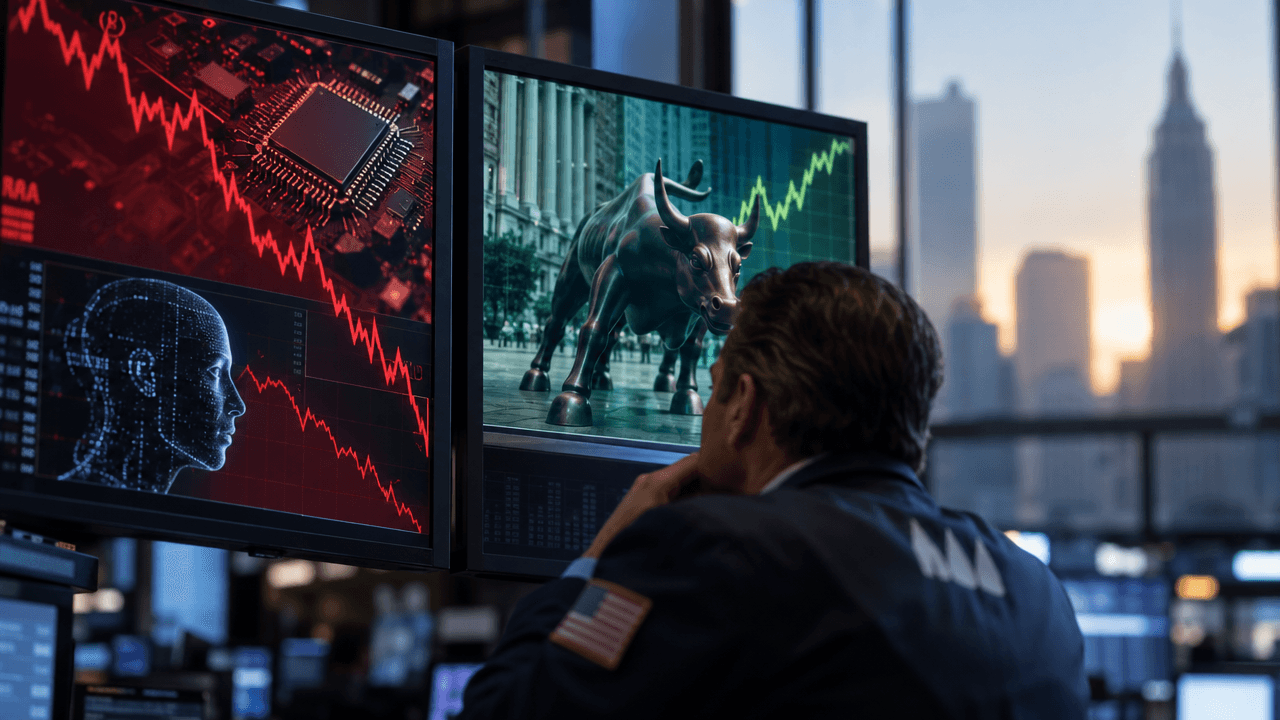
US equity futures are signaling a divided start to the trading session, with technology-sensitive benchmarks facing renewed pressure while the Dow appears relatively more resilient. The setup follows a reversal on Wall Street: stocks began Monday higher but surrendered those gains as investors reduced exposure to chipmakers, artificial intelligence companies, and other richly valued growth shares. The Nasdaq ultimately fell 1.1%, the S&P 500 declined 0.5%, and the Dow advanced 0.4%. [1][7]
The contrasting performance highlights an important market theme: this is not simply a broad-based risk-off move. Instead, investors are rotating between sectors, questioning the durability of the AI trade, and reassessing how much future growth is already reflected in technology valuations.
TECHNOLOGY REMAINS THE MARKET’S PRESSURE POINT
Semiconductor and AI-linked shares continue to determine the direction of the Nasdaq and exert an outsized influence on the S&P 500. These companies have driven much of the market’s gains, but their large valuations also make them particularly sensitive to changes in interest rates, earnings expectations, and investor sentiment.
When chip stocks decline, the effect can extend well beyond the semiconductor industry. Technology companies are heavily represented in major indexes, so weakness in a relatively small group of large-cap names can pull down an entire benchmark. Monday’s session demonstrated that dynamic as the Nasdaq fell sharply despite strength in several areas of the broader market. [3]
The current concern is whether AI-related spending can continue expanding at the pace investors have anticipated. Companies are committing substantial capital to data centers, chips, and computing infrastructure. Traders are increasingly asking when those investments will translate into revenue growth and stronger profits. Until that answer becomes clearer, AI shares may remain vulnerable to profit-taking and sharp swings.
Why The Dow Is Holding Up Better
The Dow’s gain illustrates how index composition can shape the appearance of market performance. Compared with the Nasdaq, the Dow has less direct exposure to high-growth technology companies and includes more established businesses from industrial, consumer, financial, and healthcare sectors.
That difference can make the Dow comparatively defensive when investors are selling expensive growth stocks. It does not necessarily mean that the entire market is healthy, however. A rising Dow alongside a falling Nasdaq may indicate sector rotation rather than broad conviction.
For traders, this distinction matters. Looking only at the Dow could suggest that risk appetite remains firm, while focusing only on the Nasdaq could imply a much deeper market breakdown. The more accurate interpretation is that investors are becoming selective. Capital is moving away from crowded technology trades while opportunities in less expensive or less rate-sensitive sectors are being evaluated.
What Could Drive The Next Move
The market is entering a busy period for potential catalysts, including major corporate earnings, economic data, policy developments, and political events. Earnings from large technology companies will be especially important because they can either validate current AI valuations or intensify concerns about excessive spending and slowing returns.
Investors will also watch interest-rate expectations closely. Higher rates tend to pressure growth stocks because a greater portion of their expected cash flows lies further in the future. When bond yields rise, those future profits are discounted more heavily, reducing the valuation investors are willing to pay today.
Conversely, falling yields or evidence of easing inflation could give technology shares temporary relief. But a short-term rebound would not necessarily resolve the larger question of whether AI spending and earnings growth can justify current prices.
Oil prices and geopolitical developments may also influence sentiment by affecting inflation expectations and household purchasing power. A sudden rise in energy prices could complicate the interest-rate outlook, while calmer commodity markets may provide support for equities.
Practical Takeaways For Traders
First, monitor relative strength rather than relying on the headline direction of one index. If the Dow rises while the Nasdaq falls, the market is communicating that sector leadership is changing.
Second, treat chip and AI stocks as a volatility signal. Continued weakness in semiconductors could place additional pressure on the Nasdaq and S&P 500. A sustained rebound, supported by strong trading volume and favorable earnings guidance, would offer a more constructive signal.
Third, pay attention to market breadth. If only a handful of large companies are supporting an index, the rally may be less durable than the headline numbers suggest. Broader participation across sectors would provide stronger evidence of improving risk appetite.
Finally, avoid reacting to every futures move. Futures can change quickly as earnings reports, economic data, and overnight developments reach the market. Traders should define entry levels, invalidation points, and maximum risk before the opening bell rather than making decisions based solely on the first price movement.
A Simfi Perspective
For SimFi traders, this environment provides a useful opportunity to practice scenario-based decision-making without exposing real capital. One scenario could involve continued technology weakness, with short exposure to the Nasdaq offset by positions in stronger defensive or value-oriented sectors. Another could involve an AI rebound after favorable earnings, requiring disciplined management of a long technology position.
The objective is not to predict every move. It is to build a repeatable process around market structure, position sizing, correlation, and risk control. Traders can review whether their assumptions were correct, how quickly sentiment changed, and whether their stops were placed too tightly or too loosely.
Conclusion
US equity futures point to a mixed and highly selective session, with technology and AI shares remaining the primary source of risk for the Nasdaq and broader index performance. Monday’s decline in the Nasdaq and S&P 500, alongside a gain in the Dow, shows that investors are rotating rather than abandoning equities altogether. [1][7]
The next phase of trading will depend on whether technology earnings and AI investment plans can restore confidence. Until then, flexibility is essential. Traders who monitor sector leadership, market breadth, interest-rate expectations, and risk limits will be better prepared for a session in which the headline index performance may conceal significant differences beneath the surface.