
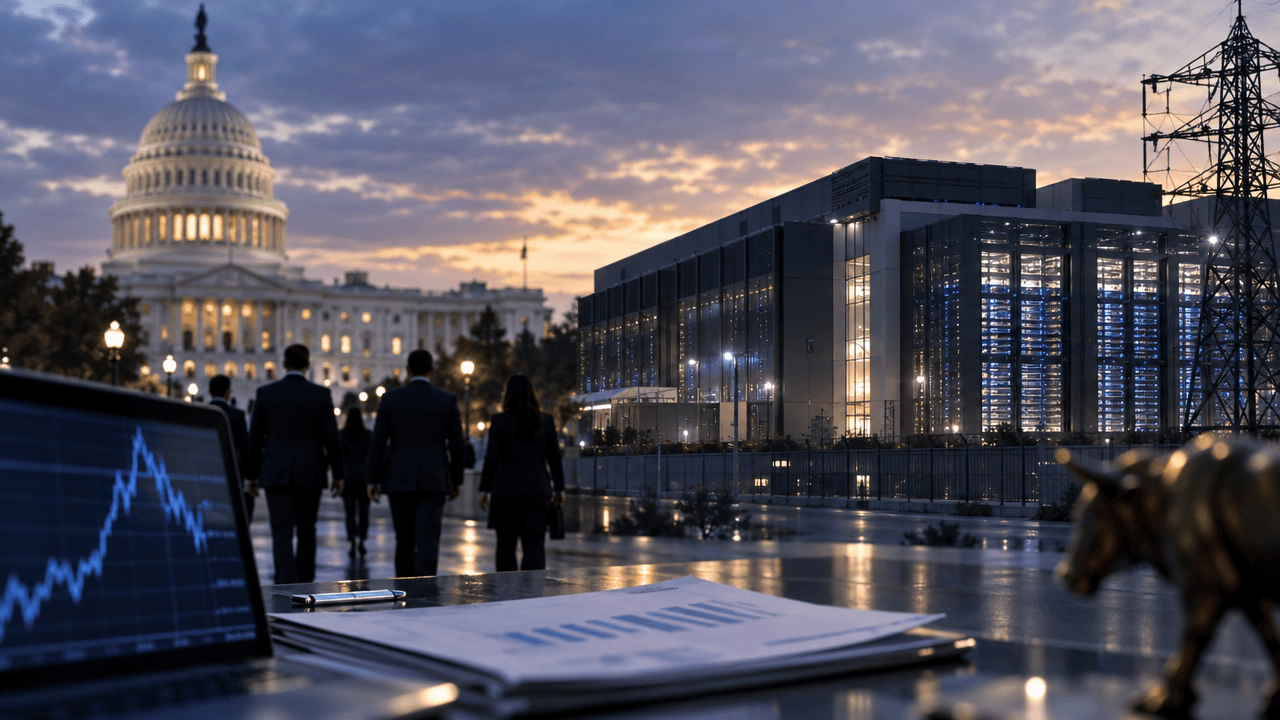
A blue wave in the U.S. midterm elections has created a fresh fault line in the artificial intelligence trade. Investors are reassessing whether the rapid expansion of data centers, semiconductor demand, and cloud-computing capacity can continue at its current pace under a Democratic-controlled Congress and new state governments.
The initial reaction was sharp. Nasdaq-100 futures fell as much as 2.4%, while S&P 500 futures declined as much as 1.4% as traders considered the possibility of tighter AI regulation and slower data-center development. Both contracts later recovered some losses, highlighting the uncertainty surrounding the election’s long-term market impact. [8][14]
Why Ai-linked Futures Came Under Pressure
The concern is not that artificial intelligence development will stop. Rather, investors are questioning whether the infrastructure supporting the AI boom can be built quickly enough—and profitably enough—to justify the enormous capital expenditures planned by technology companies.
Large cloud providers and chip companies have committed billions of dollars to data centers, advanced processors, power supplies, and networking equipment. These investments are designed to meet rapidly growing demand for AI services. However, much of the expected return lies years in the future, while the costs are being recorded today.
A change in the political environment could increase the time and expense required to complete these projects. Local governments may impose stricter permitting rules, environmental reviews, power-use requirements, or limits on water consumption. Investors are therefore revisiting revenue forecasts for companies tied to data-center construction and operation.
Strategists have specifically highlighted Texas, one of the fastest-growing centers for U.S. computing infrastructure. Democratic gains in key races there raised concerns that new rules or a temporary moratorium could slow the approval of additional facilities. One research estimate indicated that governors-elect supporting a full or conditional moratorium could influence as much as 47 gigawatts of planned data-center capacity. [4]
The Policy Channel: Regulation, Power, And Local Resistance
AI regulation can affect markets through several different channels. At the federal level, Congress may pursue greater oversight of model safety, data privacy, copyright, employment impacts, and the concentration of computing resources among a small number of technology firms.
At the state and local level, the debate is often more practical. Residents and policymakers are asking whether data centers will increase electricity bills, strain water supplies, require new transmission infrastructure, or deliver enough jobs and tax revenue to justify public subsidies.
These issues matter because data centers are not ordinary office buildings. They consume substantial amounts of electricity and often require complex connections to regional power grids. If permitting becomes slower or utility costs rise, project economics could change even without a direct ban on AI development.
That distinction is important for traders. Regulation may reduce the pace of infrastructure spending without eliminating long-term demand for AI applications. A slower construction pipeline could hurt near-term orders for chips, servers, cooling systems, and networking equipment, while still leaving room for the industry to expand over a longer period.
Why The Market Reaction May Remain Volatile
The early selloff also reflects valuation concerns that existed before the election. AI-linked equities have benefited from strong earnings expectations and substantial investor enthusiasm. As spending commitments grow, markets need evidence that AI services can generate sufficient revenue and cash flow to offset the cost of building the underlying infrastructure.
When valuations are elevated, even a modest change in assumptions can produce a large price move. If analysts reduce estimates for data-center demand, chip shipments, cloud revenue, or operating margins, investors may reassess entire groups of stocks at once.
The reaction has already demonstrated how quickly sentiment can change. Nasdaq futures initially dropped heavily, then recovered as investors concluded that regulation would more likely slow or redirect development than halt it altogether. Other reports showed Nasdaq futures later moving higher, while cloud-computing shares remained under pressure. [5][11]
This divergence suggests that the market is separating companies by exposure. Firms dependent on uninterrupted infrastructure expansion may face greater near-term risk than businesses with established AI products, diversified revenue, or strong free cash flow.
What Traders Should Watch Next
The election result is a policy catalyst, not a complete investment thesis. Traders should monitor several developments before assuming that the initial futures move will become a lasting trend.
First, watch specific legislation and state-level permitting proposals rather than relying on political headlines alone. The details will determine whether new rules create modest delays, higher costs, or meaningful limits on construction.
Second, track capital-expenditure plans from major cloud and technology companies. Any reduction in spending guidance could pressure semiconductor and equipment stocks, while continued aggressive investment could reassure markets that demand remains strong.
Third, monitor electricity prices, grid investment, and power availability in major data-center regions. Infrastructure bottlenecks may become just as important as regulation in determining how quickly new facilities can come online.
Finally, compare AI-related revenue growth with spending growth. Companies that can demonstrate rising demand, pricing power, and improving returns on invested capital may prove more resilient than those relying primarily on future expectations.
Practical Takeaways For Simulated Traders
For SimFi traders, this event offers a useful lesson in separating headline risk from fundamental risk. A sudden futures decline does not automatically mean the AI sector is structurally broken. It may instead signal that traders are repricing the timing, cost, and probability of future growth.
Avoid treating the Nasdaq-100 as a single trade. Break the index into themes: semiconductors, cloud platforms, data-center operators, power infrastructure, and software companies. Each group may respond differently to regulation and capital-spending changes.
Use scenario planning. In a moderate scenario, projects face longer approval timelines but continue moving forward. In a bearish scenario, widespread restrictions reduce infrastructure spending and lower earnings expectations. In a bullish scenario, regulation becomes clearer, permitting improves, and AI demand continues to justify major investment.
Position sizing and risk limits are especially important during politically driven volatility. Rather than reacting to the first futures move, define the evidence that would confirm or invalidate a trade thesis.
Conclusion
The U.S. midterm results have placed the AI infrastructure boom under a brighter political spotlight. The immediate pressure on Nasdaq-100 futures reflects concerns about regulation, data-center delays, and whether massive capital expenditures will produce adequate returns. [1][3]
For investors and SimFi traders, the central question is not whether AI will remain important. It is whether the industry can convert extraordinary spending into sustainable profits while navigating tighter oversight and local resistance. The answer will emerge through policy details, company guidance, project approvals, and cash-flow performance—not through one volatile trading session.