
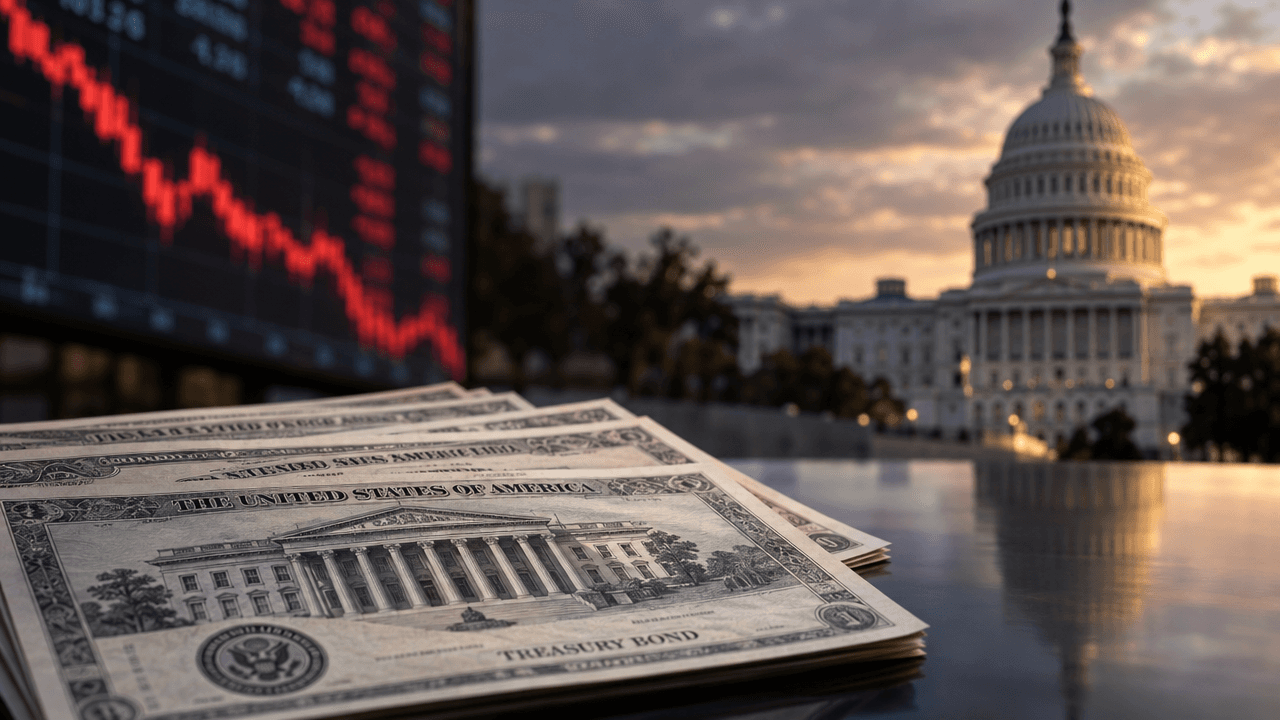
When investors lose confidence in riskier assets, the search for liquidity and capital preservation often leads them toward U.S. government debt. That pattern was evident in the latest market move, as Treasury futures advanced while equity-market stress pushed investors into one of the world’s deepest and most actively traded safe-haven markets. Across key maturities, Treasury yields fell roughly 15 to 20 basis points during the week, creating corresponding gains in futures prices. [3][4]
The move was not a simple sign of improving economic expectations. Instead, it reflected defensive positioning: investors reduced exposure to equities and other volatile assets, bought Treasuries, and maintained demand for the U.S. dollar. Understanding that distinction is important for traders, because a bond rally driven by fear can behave differently from one driven by expectations of slower inflation or an imminent change in Federal Reserve policy.
Why Treasury Futures Rallied
Treasury futures rise when traders expect the underlying government bonds to become more valuable. Because bond prices and yields move in opposite directions, falling yields generally translate into rising futures prices.
During the reported week, the two-year Treasury yield declined by approximately 20 basis points, while the 10-year yield also fell about 20 basis points. The 30-year yield dropped roughly 14 basis points. The decline in shorter-dated yields was especially notable because these securities are highly sensitive to expectations for Federal Reserve policy. [4]
The immediate catalyst was increased stress in equity markets, particularly around concerns about the sustainability of the artificial-intelligence investment cycle. As technology shares weakened, investors reassessed the risk and valuation of growth assets. That reassessment encouraged a rotation toward government bonds, which are generally viewed as more liquid and less exposed to corporate earnings uncertainty.
For Treasury futures traders, the lesson is straightforward: a sharp equity selloff can create demand for bonds even when inflation remains a concern or when the Federal Reserve has not clearly shifted toward easier policy.
The Safe-haven Mechanism
Safe-haven demand is more than a general preference for “safer” assets. It is a market response in which investors prioritize liquidity, reliability, and the return of principal over the possibility of higher returns elsewhere.
U.S. Treasuries benefit from several characteristics that support this role. They are backed by the U.S. government, trade in a highly liquid market, and are widely used as collateral across the financial system. During periods of uncertainty, institutions can often move large amounts of capital into Treasury securities more efficiently than into less liquid alternatives.
The recent rally also showed that safe-haven behavior can affect multiple markets at once. Treasury prices rose, yields declined, and the dollar remained firm as investors sought exposure to U.S. assets. Reports during the week described the dollar as benefiting from defensive flows even as lower Treasury yields placed pressure on the currency’s interest-rate advantage. [5][15]
This combination matters. A stronger dollar and lower Treasury yields do not necessarily indicate a healthy, broad-based risk-on environment. They can instead signal that investors are seeking safety, liquidity, and reduced portfolio volatility.
What The Yield Curve Is Signaling
The yield curve provides additional information about the market’s interpretation of the move. Two-year yields declined sharply because traders reduced their expectations for additional Federal Reserve tightening. By the end of the week, markets were no longer fully pricing a quarter-point rate increase by year-end. [3]
Longer-term yields also fell, showing that the bond rally was not limited to a narrow policy bet. Investors were buying duration, meaning they were increasing exposure to bonds whose prices are more sensitive to changes in interest rates.
However, traders should avoid treating every yield decline as a reliable recession forecast. In a stressed market, the yield curve can move because of forced deleveraging, portfolio hedging, or a sudden demand for liquid collateral. The move may eventually reflect weaker growth expectations, but that conclusion requires confirmation from economic data, credit markets, and central-bank communication.
Practical Lessons For Simfi Traders
First, watch the relationship between equities and Treasury futures. If stocks decline while Treasury futures rally, the market is likely expressing a flight-to-quality response. If both stocks and bonds weaken, investors may instead be raising cash or reacting to inflation and supply concerns.
Second, monitor the two-year and 10-year yields separately. A large move in the two-year yield often points to changing expectations for Federal Reserve policy. A larger move in the 10-year or 30-year sector can indicate stronger demand for duration, concerns about future growth, or portfolio rebalancing.
Third, confirm the bond signal with the dollar and credit markets. A firmer dollar alongside Treasury gains can reinforce the defensive interpretation. Widening credit spreads would provide further evidence that investors are reducing exposure to riskier borrowers rather than simply adjusting interest-rate positions.
Finally, manage duration risk carefully. Treasury futures can move rapidly when yields change by only a few basis points. A position that appears modest may carry substantial exposure if it is held through a major economic release, central-bank speech, or sudden equity reversal.
The Bigger Market Picture
The latest Treasury futures rally demonstrates how quickly sentiment can shift when confidence in a popular market theme weakens. Equities had been supported by enthusiasm around artificial intelligence and technology investment, but doubts about valuations and spending sustainability encouraged investors to seek protection. The resulting Treasury rally was significant, yet its message was defensive rather than unequivocally optimistic.
For traders, the most useful takeaway is to focus on cross-market confirmation. Falling yields alone do not explain the market. The combination of stronger Treasury futures, lower yields, equity weakness, and a firmer dollar provides a clearer picture of investors moving toward safety.
Treasury futures may continue to benefit if equity volatility remains elevated or if economic data increases expectations for slower growth. But if equities stabilize and risk appetite returns, some of the haven premium could unwind quickly. The prudent approach is to treat the rally as a signal of changing positioning, not as a guarantee that bond prices will continue rising.