
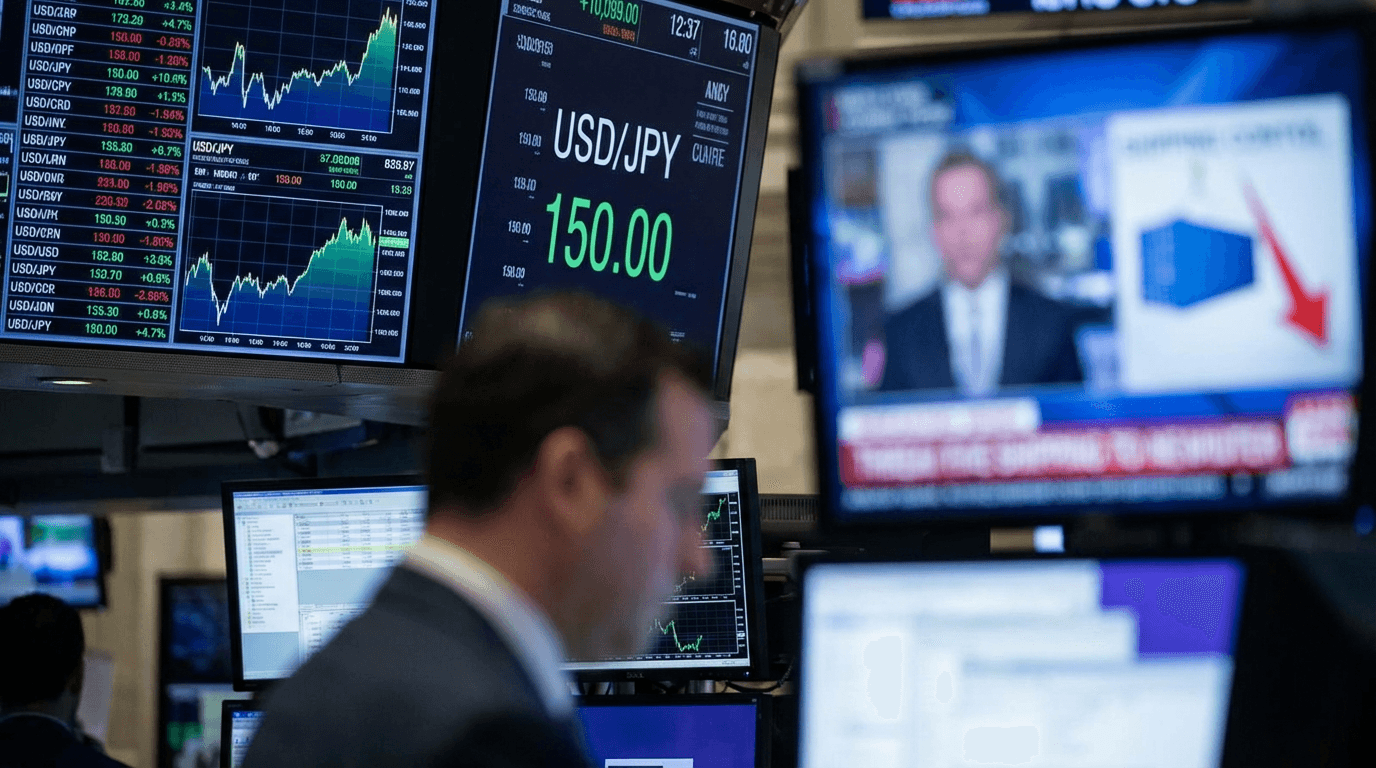
The USD/JPY currency pair continues to maintain strength above the 150.00 level, a critical technical support zone that has proven resilient even as broader US dollar strength faces headwinds from trade policy uncertainties. As of February 23, 2026, the pair is trading around 154.85-154.95, demonstrating the powerful influence of the Federal Reserve's hawkish monetary policy stance on this currency pair, even as tariff-driven concerns weigh on the wider dollar index. This divergence between USD/JPY strength and general dollar weakness represents one of the most compelling dynamics in foreign exchange markets today, offering important lessons for traders navigating an increasingly complex geopolitical and economic landscape.
Understanding The Federal Reserve's Hawkish Impact
The primary driver supporting USD/JPY above 150 is the Federal Reserve's consistently hawkish outlook and signals regarding interest rates. When US interest rates remain higher relative to Japanese rates, international investors seeking yield are naturally attracted to dollar-denominated assets. The Bank of Japan has maintained its historically accommodative monetary policy stance, with interest rates remaining near zero, creating a substantial interest rate differential that favors USD/JPY appreciation. This yield advantage has become the structural foundation supporting the pair, providing a fundamental reason for the currency to remain elevated even as other market dynamics shift. For traders, understanding this interest rate differential is essential because it suggests that USD/JPY may maintain elevated levels as long as Federal Reserve policy remains restrictive relative to the BoJ.
The hawkish Fed narrative gained additional strength from recent communications emphasizing inflation concerns and the need for sustained higher interest rates. This contrasts sharply with the BoJ's more patient approach to normalization, effectively widening the policy gap between the two central banks. The psychological impact of Fed officials maintaining hawkish rhetoric cannot be understated, as it influences capital flows and speculative positioning in the currency markets. Traders positioning for higher US rates relative to Japanese rates have contributed to consistent buying pressure on the USD/JPY pair, particularly during risk-on market conditions.
THE TARIFF PARADOX: WHY BROADER DOLLAR WEAKNESS HASN'T DERAILED USD/JPY
While USD/JPY remains resilient above 150, the broader US Dollar Index has faced considerable pressure from ongoing tariff policy debates and implementation concerns. This apparent contradiction stems from an important principle in foreign exchange markets: currency movements are relative. Even though the dollar faces headwinds against a broad basket of currencies, the yen is weaker on a fundamental basis due to Japan's low interest rates and structural economic factors. Tariff uncertainties that weigh on the general dollar also tend to reduce risk appetite globally, and when risk appetite contracts, investors often seek the relative safety of higher-yielding currencies supported by monetary policy differentials.
The tariff situation has created two competing forces. Tariff implementation threatens to slow global growth and could weaken US export competitiveness, which typically pressures the dollar. Conversely, trade tensions and growth concerns can trigger risk-off moves that reduce demand for the lower-yielding yen, even as they create broader dollar weakness. USD/JPY has benefited from this dynamic because the pair's fundamental support from interest rate differentials remains stronger than the headwinds created by tariff uncertainty. For trading implications, this suggests that USD/JPY may prove more resilient than other dollar pairs during periods of tariff-driven market anxiety.
Technical Levels And Market Psychology
The 150.00 level has emerged as a psychologically significant barrier in USD/JPY, and the pair's ability to sustain above this round number reflects genuine buying interest rather than mere technical trading. During the past week, USD/JPY has traded between a high of 155.555 on February 20 and a low of 152.655 on February 15, demonstrating that the pair is finding support above 150 and resistance in the 155-156 region. This trading range is relatively narrow compared to historical volatility, suggesting that the market has established an equilibrium between buyers focused on Fed hawkishness and any sellers concerned about US economic impacts from tariff policies.
Looking at longer-term context, the six-month average for USD/JPY stands at 153.29, slightly below current levels, indicating that the pair is trading near mid-range valuations rather than extreme levels. The January 2026 high near 159.18 represents recent resistance, while September's low near 146.39 defines medium-term support zones. These technical parameters suggest that USD/JPY has room to move in either direction depending on how Fed policy communications and tariff developments evolve.
Implications For Traders And Investors
The current USD/JPY environment presents distinct trading opportunities based on market regime. Traders with a hawkish Fed bias should consider long USD/JPY positions as a relatively clean way to express that view, since the pair's structure directly reflects interest rate differentials. Conversely, traders concerned about global growth implications from tariffs might find that USD/JPY provides more stable exposure than other dollar pairs, since the pair's fundamental supports appear robust.
Risk management remains essential, as geopolitical developments or unexpected changes in Fed communications could alter this dynamic. The confluence of hawkish Fed policy with tariff uncertainties creates an unusual market environment where traditional dollar strength is partially offset by broader risk considerations. Monitoring Federal Reserve communications and tariff policy announcements should remain central to any USD/JPY trading strategy through the remainder of 2026.