
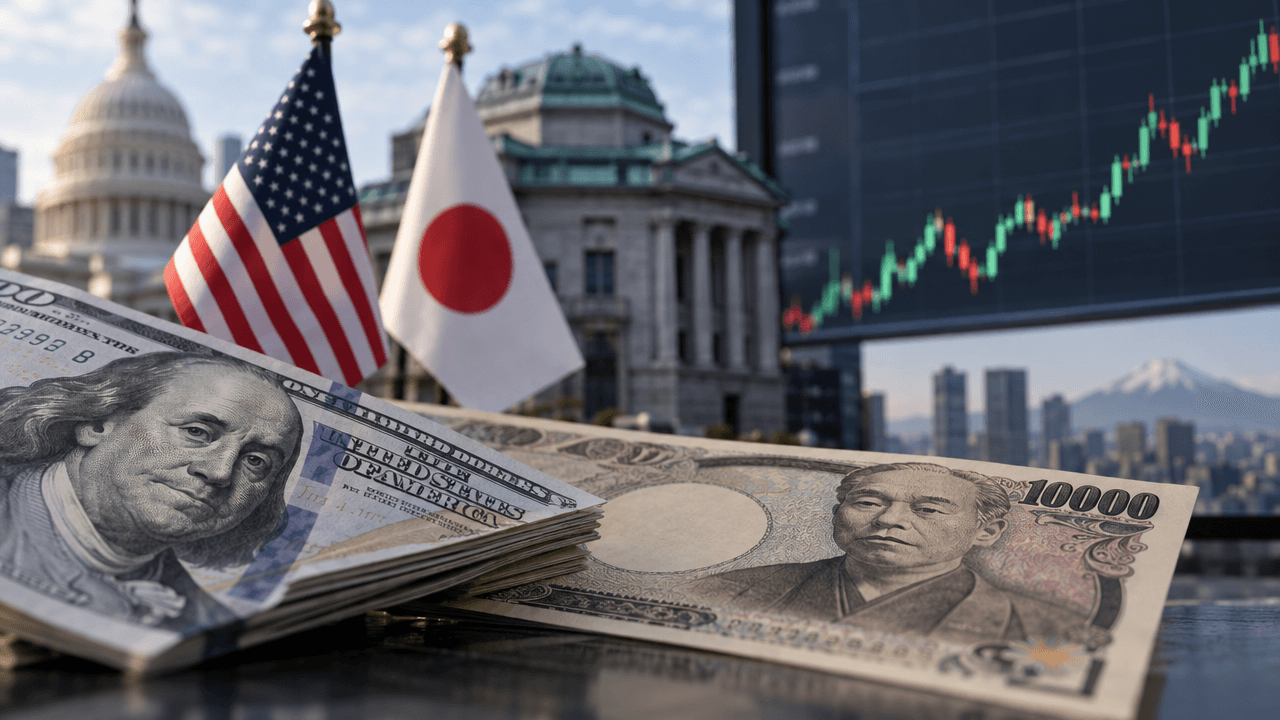
USD/JPY rose roughly 0.5% even as expectations for additional Bank of Japan tightening strengthened, highlighting an important lesson for currency traders: a hawkish central bank signal does not automatically produce a stronger currency. Exchange rates respond to relative expectations, interest-rate differentials, positioning, risk sentiment, and the behavior of bond markets. In this case, pressure on Japan’s long-term government bonds added another layer of volatility to the yen.
The Market Move
The yen weakened toward 158 per dollar as USD/JPY extended its advance. The move came after the Bank of Japan’s latest policy communication showed growing support for additional rate increases. Policymakers indicated that underlying inflation was approaching the central bank’s 2% price-stability target, while some officials argued that normalization should proceed without excessive caution. BOJ Chief Economist Seisaku Kameda also suggested that a December rate increase remained possible. [9]
Ordinarily, expectations for higher Japanese interest rates would support the yen. Higher rates can make yen-denominated assets more attractive and reduce the incentive for investors to borrow cheaply in yen to purchase higher-yielding assets elsewhere. Yet the foreign-exchange market is forward-looking. If traders have already anticipated a BOJ hike, the announcement may generate little additional demand for the currency.
The dollar also benefited from renewed expectations that US interest rates could remain elevated. Stronger US inflation data and hawkish comments from Federal Reserve officials reinforced the appeal of dollar assets. The reported policy-rate gap remained substantial, with the BOJ rate at 1.25% compared with a Federal Reserve target range of 3.75% to 4.00%. [13] That differential continues to favor the dollar, even if Japan is gradually moving toward tighter policy.
JAPAN’S BOND MARKET ADDS VOLATILITY
The latest 30-year Japanese government bond auction offered a second explanation for the yen’s uneven response. Demand was weaker than at the previous sale and below its 12-month average. The bid-to-cover ratio fell to 3.36 from 3.88 previously, compared with an average of 3.6. Following the auction, the 30-year Japanese government bond yield rose 2.5 basis points to 3.865%. [1]
Bond prices and yields move in opposite directions. Therefore, a rise in long-term yields after a weak auction indicates that investors demanded greater compensation to hold Japan’s longest-dated government debt. This can reflect concerns about fiscal conditions, uncertainty over the future path of interest rates, or losses among investors whose previous positions were built around a more stable yield curve.
The bond-market reaction is significant because it complicates the usual interpretation of higher Japanese yields. Rising yields caused by expectations of stronger growth and sustainable monetary normalization could support the yen. Rising yields caused by poor auction demand, market stress, or concerns about fiscal risk may instead increase volatility without immediately attracting foreign-exchange buyers.
Why A Boj Hawkish Signal Was Not Enough
The main issue is relative, rather than absolute, monetary policy. The BOJ may be preparing to raise rates, but the Federal Reserve may also keep US rates higher for longer. If US yields rise faster than Japanese yields, the dollar-yen interest-rate spread can remain supportive of USD/JPY.
Carry-trade dynamics also matter. Traders often compare the cost of borrowing in yen with the return available in higher-yielding currencies or assets. Even after a BOJ hike, Japan’s rates may remain low relative to those in the United States. Unless markets expect a rapid series of Japanese increases, the incentive to hold dollar assets may remain intact.
Positioning can further distort the initial response. If traders had accumulated yen ahead of the BOJ communication, they may sell the currency when the event passes and no larger-than-expected policy change occurs. This “buy the rumor, sell the fact” pattern can push USD/JPY higher despite news that appears bullish for the yen.
What Traders Should Watch Next
First, traders should monitor the relative movement of US Treasury and Japanese government bond yields rather than focusing on the BOJ in isolation. A widening US-Japan yield spread generally supports USD/JPY, while a sustained narrowing may strengthen the yen.
Second, attention should remain on the BOJ’s communication and the data behind it. Wage growth, underlying inflation, household consumption, and business investment will help determine whether officials can continue tightening without damaging domestic demand. A rate hike accompanied by cautious guidance could have a different market impact from a hike that signals several additional increases.
Third, the quality of demand at upcoming Japanese bond auctions deserves close attention. Weak demand at the long end could keep Japanese yields volatile and challenge assumptions about how smoothly policy normalization will proceed. The 20-year Japanese yield also rose after the latest auction, showing that the reaction was not limited to one maturity. [3]
Finally, traders should treat the 158 to 160 area as a zone of heightened sensitivity rather than assuming that a single technical level will determine the trend. Currency intervention risks, changing US inflation expectations, and sharp shifts in global risk appetite can all produce rapid reversals.
Practical Takeaways
A hawkish BOJ message is yen-positive only when it changes expectations more than markets have already priced in. Always compare Japanese policy prospects with the outlook for the Federal Reserve.
Use bond-market signals to understand the quality of a yield move. Higher Japanese yields caused by stronger policy expectations can support the yen; higher yields caused by weak demand can increase uncertainty instead.
Avoid relying on one economic headline. The direction of USD/JPY depends on interest-rate differentials, positioning, risk sentiment, inflation, and central-bank credibility working together.
Conclusion
USD/JPY’s rise despite expectations for further BOJ tightening is not a contradiction. It reflects the reality that currencies are priced on relative returns and future expectations, not on a single central-bank headline. Japan’s tightening cycle may eventually provide sustained support for the yen, but that outcome depends on how quickly rates rise, how US policy evolves, and whether Japanese bond markets stabilize. For traders, the most effective approach is to follow the interaction between monetary policy, yield spreads, auction demand, and price action rather than treating any one signal as decisive.