
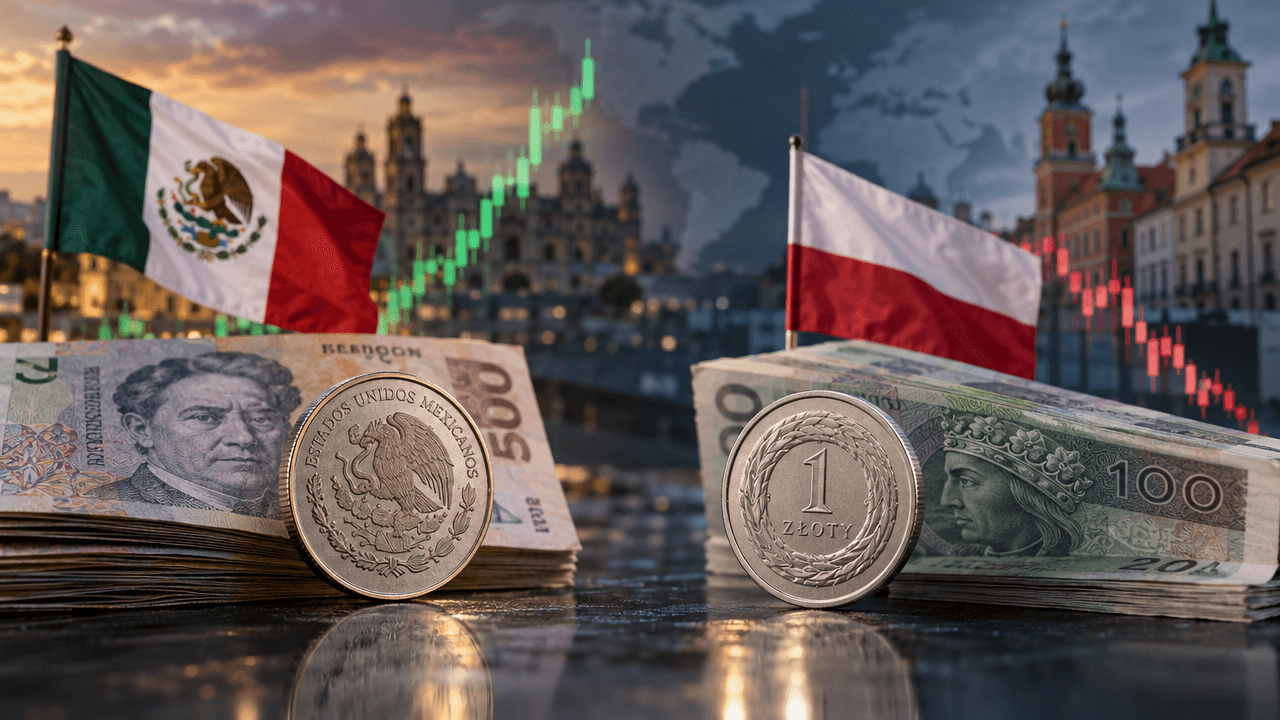
A sharp split appeared in the latest reported foreign-exchange snapshot: USD/MXN rose 1.24%, making it the strongest listed mover, while USD/PLN fell 0.54%, recording the largest decline. The contrast highlights how quickly currency markets can separate even when both pairs belong to the broader emerging-market complex. Rather than reflecting one universal risk signal, the move suggests that investors were weighing different combinations of interest rates, political uncertainty, local fundamentals, and positioning.
What The Move Means
USD/MXN measures the number of Mexican pesos required to buy one US dollar. When the pair rises, the dollar is strengthening against the peso, or the peso is weakening. A 1.24% increase is substantial for a major currency pair and indicates a meaningful repricing of Mexican assets during the period covered by the snapshot.
USD/PLN measures the dollar against Poland’s zloty. Its 0.54% decline means the zloty outperformed the dollar in that session or reporting window. The difference between the two pairs is important: a stronger dollar does not automatically produce identical results across every emerging-market currency.
Currency markets are relative markets. Investors compare expected returns, central-bank policy, economic resilience, trade exposure, and political risk across countries. A currency may weaken against the dollar while still outperforming another emerging-market currency if its domestic outlook is considered more stable.
WHY USD/MXN CAME UNDER PRESSURE
One major factor affecting the peso has been the changing interest-rate differential between the United States and Mexico. The peso has historically attracted international capital partly because Mexican interest rates offered a relatively high yield compared with developed-market alternatives. That yield advantage can support the popular carry trade, in which investors borrow or hold lower-yielding currencies and purchase higher-yielding assets.
However, the carry appeal weakens when markets expect US rates to remain higher for longer or when Mexico’s central bank is expected to ease policy. Recent market coverage has pointed to narrowing US-Mexico rate spreads and reduced incentives to hold peso exposure. [1][4]
The dollar can also benefit when investors become more defensive. During periods of elevated volatility, global investors often reduce exposure to higher-beta currencies and move toward liquid assets, including the US dollar. Reports have linked recent peso weakness to stronger US yields, renewed expectations for Federal Reserve tightening, and a broader unwind of carry-trade positions. [3][7]
Political and trade uncertainty adds another layer. Mexico’s close economic relationship with the United States creates significant opportunities through manufacturing and nearshoring, but it also makes the peso sensitive to changes in bilateral trade expectations and USMCA discussions. Any increase in perceived policy or negotiation risk can lead investors to demand a higher risk premium for Mexican assets. [5][14]
WHY USD/PLN MOVED THE OTHER WAY
The decline in USD/PLN shows that the zloty was not responding solely to the global dollar narrative. Local positioning, European market sentiment, and expectations surrounding Poland’s central bank can offset pressure from higher US yields.
Poland’s economy is closely linked to the European Union, meaning the zloty often trades alongside broader European risk sentiment. When investors become more comfortable with Central European assets, the zloty can strengthen even while other emerging-market currencies weaken.
That does not mean PLN is insulated from risk. Poland’s geographic position near the war in Ukraine gives the currency particular sensitivity to geopolitical developments. Energy prices, European growth expectations, and regional security concerns can all influence the risk premium attached to the zloty. [8][11]
The reported 0.54% decline may therefore reflect a temporary improvement in sentiment toward Poland or a relative shift in capital flows, rather than a complete reversal of the wider dollar trend. Traders should avoid treating one daily move as proof that the fundamental outlook has permanently changed.
How Traders Can Read The Divergence
The first practical lesson is to separate market direction from market leadership. USD/MXN leading the gains does not necessarily mean every emerging-market currency is under equal pressure. Comparing multiple pairs can reveal where investors see the greatest vulnerability.
The second lesson is to monitor interest-rate expectations. Traders should follow Federal Reserve communication, US inflation and employment data, Banxico guidance, and Poland’s monetary-policy decisions. Changes in expected rate differentials can move currencies before central banks actually change rates.
The third lesson is to watch risk indicators beyond the currency chart. US Treasury yields, commodity prices, equity volatility, credit spreads, and regional equity performance can help explain whether a move is driven by broad risk aversion or by country-specific developments.
Technical analysis remains useful, but it should be placed in context. A large daily candle in USD/MXN may signal a breakout, yet traders should examine trading volume, follow-through, nearby support and resistance, and whether the move is confirmed by other peso-sensitive assets. Risk controls are essential because emerging-market currencies can experience rapid reversals when headlines change.
Practical Takeaways
For beginners, remember that a rising USD/MXN quote represents peso weakness, not peso strength. Always check the quote convention before interpreting a move.
For experienced traders, the divergence between USD/MXN and USD/PLN is a reminder to avoid grouping all emerging-market currencies into one trade. Mexico and Poland have different monetary-policy paths, trade relationships, political risks, and regional exposures.
The most useful approach is to build a scenario framework. A further rise in US yields and renewed global risk aversion could keep pressure on USD/MXN. Conversely, softer US data, improved trade sentiment, or stronger demand for carry assets could support the peso. USD/PLN may respond more directly to European growth, energy markets, and regional geopolitical headlines.
Conclusion
USD/MXN’s 1.24% advance and USD/PLN’s 0.54% decline offer a concise lesson in modern FX trading: emerging-market currencies do not move as a single bloc. The peso’s sensitivity to US rates, carry-trade positioning, and Mexico-specific political and trade risks helped make it the strongest reported mover, while the zloty benefited from a different mix of regional and domestic influences.
For SimFi traders, the key is not simply to identify the biggest percentage move. It is to understand why the move occurred, determine whether the catalyst is broad or local, and manage risk if the market narrative changes. Currency leadership can shift quickly, but disciplined analysis remains valuable in every market environment.