
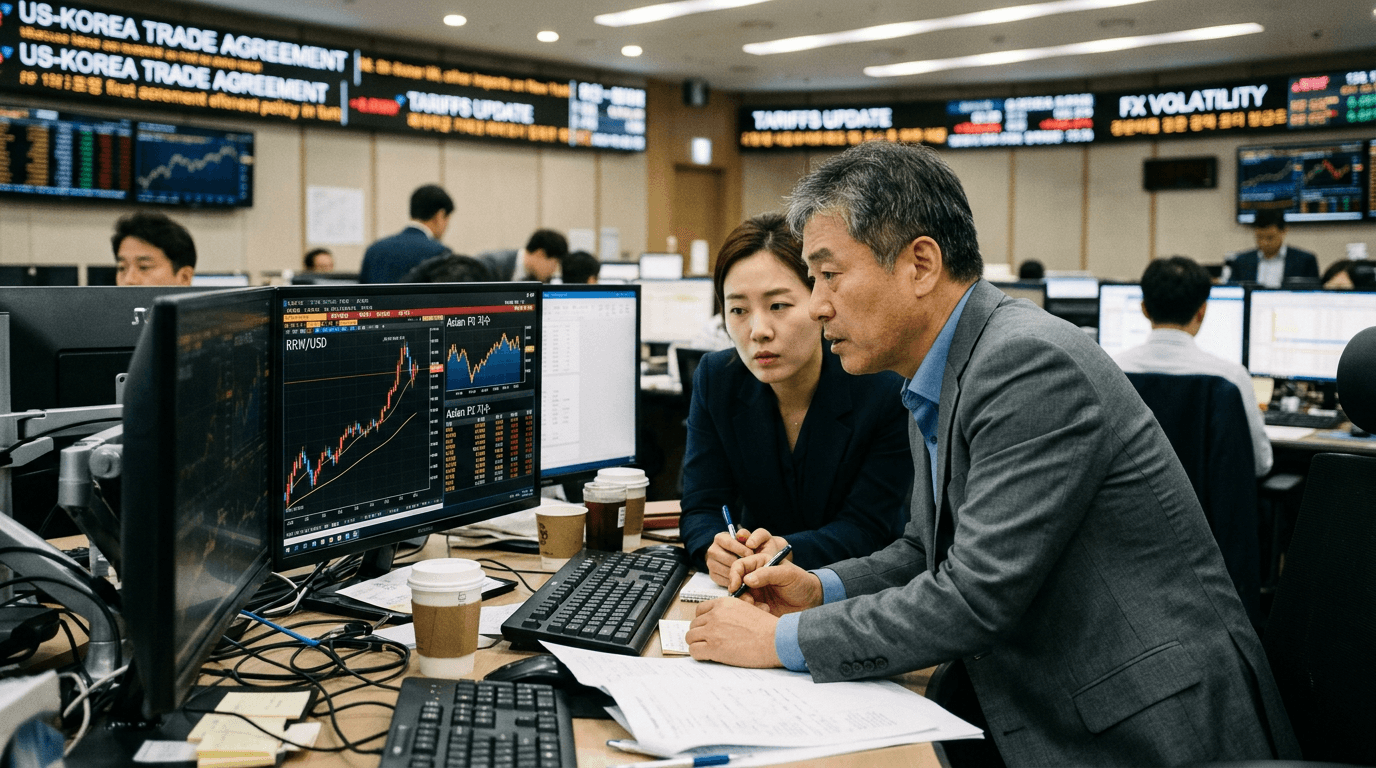
The South Korean won pushed higher against the US dollar after signals that Washington and Seoul had finalized a new trade agreement, lifting risk sentiment across parts of Asian FX even as global markets remain alert to US rate policy and geopolitical headlines.[2][9] The move marked a sharp contrast to the earlier period of uncertainty, when stalled talks had weighed on the currency and kept regional investors on the defensive.[5][8] For traders, this episode is a textbook example of how trade policy can quickly spill over into FX pricing, risk appetite, and cross-asset positioning.
Market Move: Won Leads Asian Fx Higher
Following confirmation that a Seoul–Washington tariff deal was in place, the won appreciated to around 1,421 per dollar, its strongest level in about two weeks and extending gains from the over six‑month low near 1,440 seen earlier.[1][2][8] This rebound came after months in which the currency had flirted with multi‑month lows as weak data and policy uncertainty drove expectations for further easing by the Bank of Korea.[8]
Earlier in the negotiation process, the won had slipped to around 1,408 per dollar as talks appeared to stall and markets worried that higher US tariffs could erode South Korea’s export competitiveness.[5] The turnaround underscores how quickly FX markets can reprice once a clear policy outcome replaces uncertainty, particularly in a trade‑dependent economy like South Korea.
The positive market reaction has not been limited to USD/KRW alone. While the move is most visible in the won, the reduction in trade risk around a key Asian exporter has helped stabilize sentiment in selected emerging Asian currencies, even as the broader dollar trend remains anchored to expectations for US interest rates.[3][8] This blend of local good news and global macro caution is exactly the kind of nuanced backdrop active traders need to understand.
Why This Trade Deal Matters For Currencies
At the core of the story is a strategic trade and investment deal that reshapes tariff structures and capital flows between the US and South Korea.[2][6][9][12][13] Under the agreement, Washington will lower tariffs on Korean automobiles and auto parts to 15% from 25%, aligning them more closely with duties faced by key competitors such as Japan.[2][6][9][12] Reciprocal tariffs between the two countries are also set at roughly 15%, creating a clearer and more predictable framework for trade.[6][13]
In exchange, Seoul has pledged a substantial investment package in the United States totaling around $350 billion, split into $200 billion in cash installments and $150 billion earmarked for shipbuilding cooperation and related industry projects.[2][7][9][12] The cash component is capped at about $20 billion per year, a design feature specifically intended to avoid a sudden spike in capital outflows and FX volatility.[2][7][12]
Initially, news of the agreement sparked concerns that such large overseas commitments could weaken the won as capital exited the country.[7] However, by phasing the investments and setting annual limits, policymakers sought to manage the FX impact while still securing tariff relief and strategic industrial cooperation.[4][12] The Bank of Korea has reinforced this message, stressing that the won remains misaligned with fundamentals and signaling a willingness to support FX stability, including monitoring outbound investments linked to the trade deal.[4]
For FX markets, this combination—tariff cuts that support exports and a gradual, managed investment outflow—tilts the balance toward a more positive medium‑term outlook for the won than a simple headline about “$350 billion leaving Korea” might suggest.
Improving Risk Sentiment In Asian Fx
The deal removes a major source of uncertainty for South Korean exporters in autos, chips, and shipbuilding, sectors that are central both to domestic growth and to regional supply chains.[2][8][14] With tariff rates clarified at 15% and implementation moving ahead, Korean firms now have better visibility on pricing, margins, and capacity planning for the US market.[2][14] That reduced uncertainty feeds directly into equity valuations, credit spreads, and, crucially, the currency.
US trade authorities have started formal implementation of the tariff reductions, which has further reassured markets that this is not just political signaling but a real, operational change in trade conditions.[14] As those details emerged, analysts highlighted that the agreement not only protects South Korea’s export competitiveness but also helps stabilize financial markets by giving investors a more durable framework for cross‑border trade and investment.[9][14]
This is happening against a backdrop where the Federal Reserve has kept rates steady, and the dollar remains relatively strong, yet the won has shown an ability to post modest gains or hold its ground when supported by constructive policy and domestic data.[3] Episodes of stronger retail sales and industrial output have added to the sense that South Korea’s economy is more resilient than many had feared, which in turn reinforces support for the currency.[3][8]
As a result, regional risk sentiment has improved selectively: exporters and currencies most directly tied to the Korea–US supply chain story have seen the biggest benefit, while markets remain sensitive to other global risks such as US‑China trade relations and broader geopolitical developments.[8][9] For active traders, this means differentiating between currencies with direct positive catalysts and those still primarily driven by global macro headwinds.
What Traders Should Watch Next
First, the pace and composition of capital outflows tied to the investment pledge will be critical.[2][7][12] The annual $20 billion cap on cash installments matters: if flows stay on schedule and within that limit, FX markets may treat them as manageable and largely anticipated.[2][7][12] Any sign of accelerated or front‑loaded outflows, by contrast, could reignite pressure on the won.
Second, implementation milestones on the US side—such as additional regulatory confirmations or sector‑specific tariff schedules—will shape how durable the current optimism is.[14] Delays or disputes could reintroduce risk premium into KRW and related assets.
Third, the policy stance of the Bank of Korea remains a key anchor. Officials have openly framed the won as misaligned and reiterated their focus on FX stability, including oversight of US‑bound investments under the trade framework.[4] Deviations from this stance, or a sharp shift in interest‑rate expectations, could alter the balance of forces supporting the currency.
Finally, traders should monitor data from trade‑sensitive sectors—autos, semiconductors, and shipbuilding—to see whether the tariff relief translates into real export gains.[2][8][14] A positive follow‑through in volumes and earnings would justify a stronger medium‑term bid for KRW; disappointment could cap the rally.
Practical Takeaways For Simulated Traders
For traders using simulated finance environments, this episode offers several concrete lessons.
It is a clear example of how a single policy catalyst can flip the narrative on a currency from “pressure and uncertainty” to “stability and opportunity.”[5][8][14] Building scenarios around trade‑policy paths—deal, delay, breakdown—can help you stress‑test positions and understand how quickly risk sentiment can shift.
It also illustrates why you should look beyond the headline numbers. A $350 billion outward investment pledge sounds bearish for a currency at first glance, but the structure (phased, capped, and tied to tariff relief that boosts exports) changes the net impact.[2][7][9][12] In a simulated account, you can experiment with different assumptions: What if the cap were removed? What if tariffs stayed at 25%? How would that alter your KRW bias?
The case reinforces the value of tracking implementation, not just announcements. The won’s support strengthened as US authorities moved ahead with formal tariff reductions, reducing doubts about whether the deal would truly materialize.[14] In a trading plan, that can translate into scaling into positions as confirmation builds, rather than going all‑in on the first headline.
Finally, the broader Asian FX response shows why relative value strategies matter. Even when the macro backdrop is dominated by US rates, local catalysts can create dispersion within a regional basket. Simulated traders can practice expressing views via currency pairs, spreads, or hedged baskets that go long beneficiaries like KRW while staying mindful of global dollar risk.