
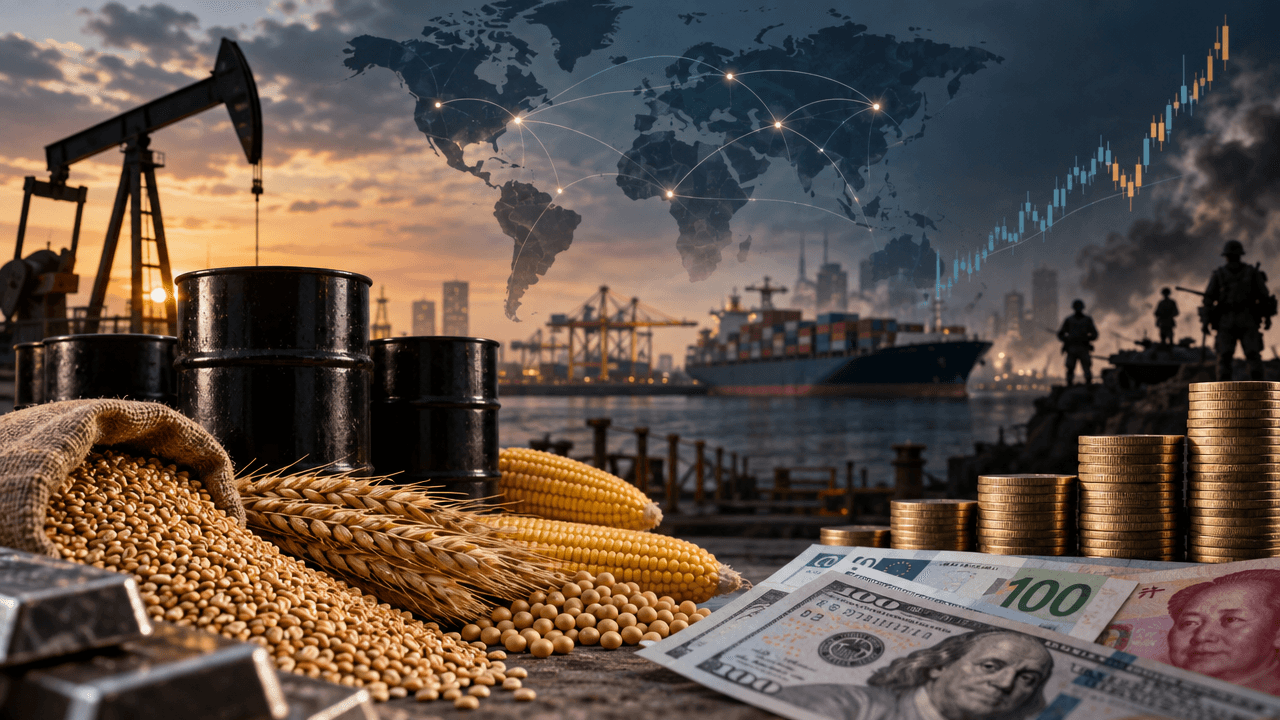
A commodity shock is no longer a distant risk on the economic horizon. The World Bank now projects its global commodity price index will rise 23% in 2026, reaching its second-highest level since 2013. The warning matters because energy, food, metals and agricultural inputs sit at the foundation of nearly every economy. When those costs jump, inflation can spread from factories and farms to transport, household budgets and financial markets. [1]
What The World Bank Is Warning About
The sharpest move is expected in energy. The World Bank forecasts energy prices will increase 32% in 2026, reversing three consecutive years of declines and pushing the category to a four-year high. Brent crude is projected to average about $91 per barrel, compared with $69 in 2025, before easing toward $79 in 2027 if supply conditions improve. [3][9]
This outlook reflects a combination of geopolitical and logistical risks. Conflict in the Middle East has disrupted shipping and energy flows, while ongoing instability around major production and transit regions has increased the premium investors place on supply security. Oil and gas markets can react quickly when traders fear that even a temporary disruption could reduce available inventories.
Food commodities are also under pressure. The World Bank expects food prices to rise approximately 10% in 2026 and another 7% in 2027, representing a cumulative increase of about 18%. Disruptions to Black Sea grain shipments, high fuel and fertilizer costs, and a potentially severe El Niño are all contributing to the outlook. [3][8]
Why This Could Reignite Inflation
Commodity prices affect inflation through several channels. Higher crude oil prices raise the cost of gasoline, diesel, aviation fuel and freight. Those expenses eventually appear in the prices of manufactured goods, restaurant meals, deliveries and public transportation.
Food inflation can be even more politically and socially sensitive. Households may reduce discretionary spending when groceries become more expensive, while lower-income families face a larger impact because food represents a greater share of their budgets. For businesses, rising grain, fertilizer, packaging and energy costs can squeeze margins or force price increases.
The challenge for central banks is that commodity inflation is often supply-driven. Raising interest rates cannot produce more oil, repair damaged ports or improve a harvest. Yet policymakers may still tighten monetary policy if they believe higher commodity costs are becoming embedded in wages, services and consumer expectations.
That creates a difficult balance. Moving too aggressively could weaken economic growth and employment. Waiting too long could allow a temporary energy shock to become persistent inflation. Markets will therefore pay close attention not only to headline inflation data, but also to measures of underlying price pressure and central-bank communication.
The Impact On Currencies And Emerging Markets
The commodity shock will not affect every country in the same way. Exporters of oil, gas, metals or agricultural products may benefit from higher foreign revenues, stronger trade balances and increased fiscal income. Their currencies can receive support if investors expect the commodity boom to improve economic growth.
Import-dependent economies face a more difficult position. Higher energy and food bills can widen trade deficits, weaken household purchasing power and increase government spending on subsidies. If investors become concerned about external financing needs, emerging-market currencies may come under pressure.
A weaker currency can intensify the problem by making imported commodities even more expensive in local-currency terms. Central banks in these economies may be forced to maintain higher interest rates despite slowing growth. That combination—expensive imports, weaker currencies and tighter financial conditions—can become a serious drag on investment.
For traders, the key lesson is that commodity exposure is not limited to futures markets. Energy prices can influence currencies, bond yields, equity sectors and inflation expectations simultaneously. A move in crude oil may affect an oil exporter’s currency, an airline’s costs, a transport company’s margins and the interest-rate outlook within the same trading session.
What Could Change The Outlook
The World Bank’s baseline assumes that conflicts affecting commodity supplies do not intensify materially. If hostilities expand, shipping disruptions worsen or critical infrastructure suffers additional damage, prices could rise beyond the current forecast. Food markets face an additional weather risk: a record-strength El Niño could damage crops and push food prices substantially above expectations. [7][11]
There is also a more constructive scenario. Improved shipping conditions, greater production, demand destruction and the eventual easing of geopolitical tensions could help energy prices retreat in 2027. The World Bank currently forecasts overall commodity prices will decline 7% next year, while energy prices are expected to moderate. [1][8]
However, a forecasted decline does not necessarily mean consumers will quickly return to previous price levels. Prices can rise sharply, then stabilize without falling back to their old baseline. Traders should distinguish between the rate of inflation and the overall price level.
Practical Takeaways For Traders
First, monitor the energy complex and shipping developments as leading indicators of broader inflation risk. Oil, natural gas and freight costs can move before official inflation reports reflect the change.
Second, watch the relationship between commodities and the U.S. dollar. A stronger dollar can cushion the effect of higher commodity prices for U.S. buyers, while making dollar-denominated commodities more expensive for many emerging markets.
Third, avoid treating every commodity rally as a one-way trend. Supply shocks can create dramatic price spikes, but demand destruction, policy responses and changing inventories can produce equally rapid reversals.
Finally, manage risk across correlated positions. A trader holding long energy exposure, an emerging-market currency position and inflation-sensitive bonds may be taking more of the same risk than the portfolio appears to show. Position sizing, stop levels and scenario planning are particularly important when geopolitical headlines can move markets outside normal trading ranges.
The World Bank’s warning is significant because it connects several pressures at once: energy disruption, food insecurity, climate risk and monetary-policy uncertainty. Whether the shock becomes a temporary spike or a prolonged inflationary cycle will depend on supply repairs, weather conditions and the path of global demand. For market participants, preparation matters more than prediction. Understanding how commodities transmit risk across currencies, rates and equities can help traders respond with discipline rather than react to the next headline.