
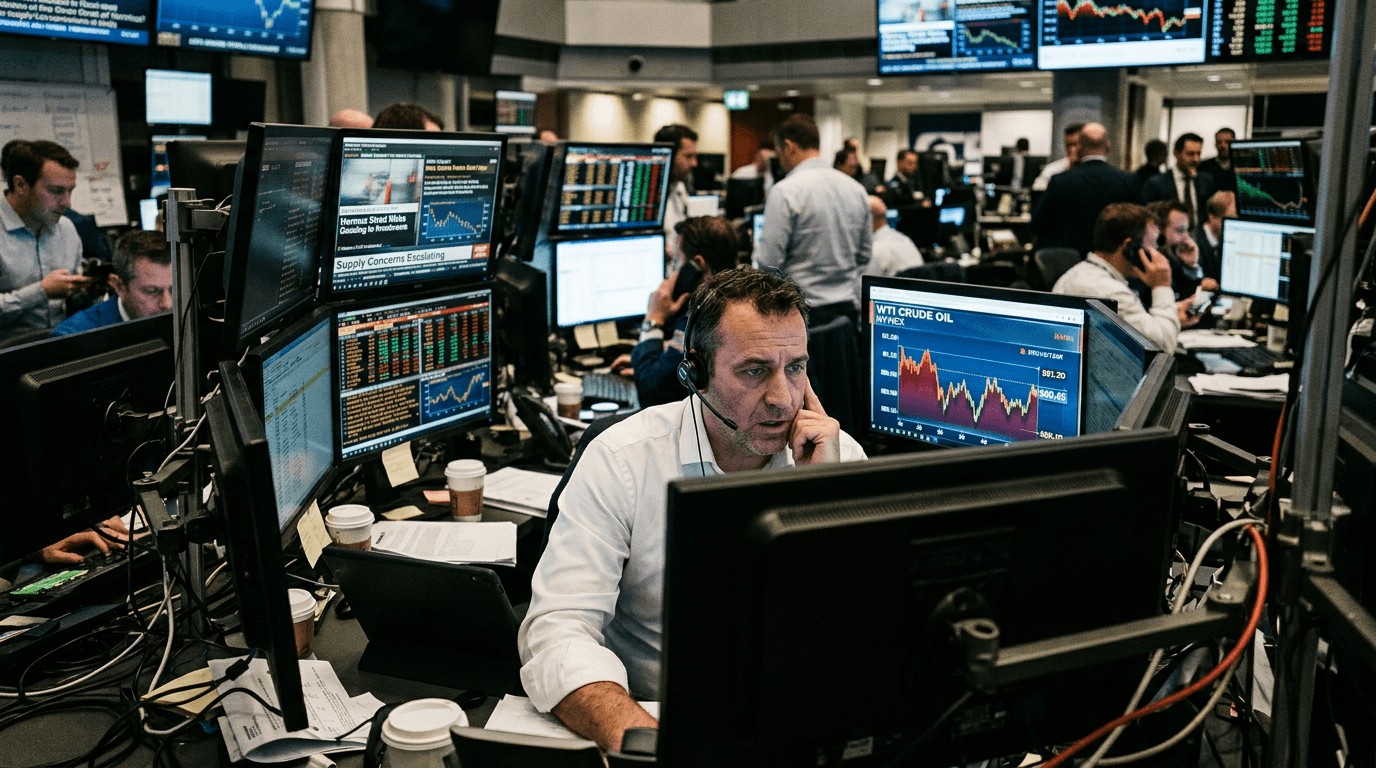
WTI crude is holding near one‑month highs around the $80–82 range, signaling that energy markets are increasingly pricing in geopolitical risk rather than purely supply‑demand fundamentals.[2][7] After a sharp rally driven by Middle East tensions and US‑Iran headlines, prices have consolidated just above the psychologically important $80 level, suggesting traders are in “wait and see” mode ahead of potential weekend developments.[1][2][8] For active traders and portfolio managers, this is a classic environment where news flow, risk premia, and cross‑asset reactions matter as much as the underlying barrels.
MARKET SNAPSHOT: WTI ABOVE $80 AND WHAT IT SIGNALS
Breaking back above $80 per barrel for the first time in about a year marks a notable shift in market sentiment toward oil.[2] The latest move was fast and decisive, with WTI gaining multiple dollars in a short window as headlines around the Middle East and Iran intensified.[1][2] Technically, the contract has pushed above key moving averages and prior resistance zones, reinforcing a bullish short‑term bias even as momentum begins to look stretched.[1]
The consolidation in the $80–82 band tells us the market is now debating the sustainability of this risk premium. On one hand, traders see ongoing supply constraints and the possibility of further disruption; on the other, some participants are wary of chasing prices higher if tensions do not escalate further.[1][6] Trading volumes and open interest data suggest that discretionary capital has re‑engaged in crude futures, with systematic and macro funds using oil as a proxy hedge for geopolitical risk and inflation.
For traders, the price behavior around $80 is important: it is a round number, recent resistance, and a sentiment barometer. Holding above it into the weekend points to persistent anxiety about the news cycle. A failure back below it would hint that the market is willing to fade the fear and refocus on broader macro fundamentals like growth and demand.
Why The Strait Of Hormuz Matters
The focus on the Strait of Hormuz is not just headline drama; it is about a key chokepoint for global energy flows. A significant share of the world’s seaborne oil exports passes through this narrow waterway, so any threat of blockade, disruption, or military escalation can quickly translate into higher risk premia in crude benchmarks.[5] Statements from US officials and Iranian responses, together with any hint of military or sanctions escalation, are being scrutinized for clues on whether shipping risks could rise meaningfully.
Historically, markets have tended to price Hormuz risk via sudden spikes in front‑month futures, widening time spreads, and increased volatility in options on crude and related products. Even if actual physical flows are not yet affected, traders anticipate the possibility of tighter supply and adjust positions accordingly. That dynamic appears to be at play now, with WTI’s rally occurring even before evidence of material disruption to exports has emerged.[1][2]
For risk managers, this type of environment demands scenario thinking rather than simple point forecasts. The range of outcomes is wide: from diplomatic de‑escalation that unwinds the risk premium, to localized incidents that keep prices supported, to more serious disruptions that could push crude significantly higher. Monitoring shipping data, official statements, and weekend developments becomes as important as watching standard economic indicators.
IMPLICATIONS FOR COMMODITY‑LINKED FX
The recent strength in WTI is feeding into broader moves in commodity‑linked currencies and energy‑sensitive FX pairs.[2][8] Currencies of major oil exporters—such as CAD and NOK—tend to benefit when crude prices jump, as higher export revenues support growth, fiscal balances, and terms of trade. Conversely, large net importers often see pressure on their currencies and current accounts as energy costs rise.
This relationship is not mechanical, but in periods of sharp oil moves linked to geopolitics, the oil‑FX linkage often tightens. Macro funds and systematic strategies may express views on oil not just via futures, but via FX baskets that overweight producers and underweight importers. That makes WTI’s price range around $80–82 relevant far beyond the energy complex.
Traders who focus on FX but ignore commodities can miss important drivers of short‑term moves. An oil‑driven rally in CAD or NOK, for example, may not be fully explained by domestic data releases. Conversely, an easing of Hormuz tensions could see crude retrace and commodity FX give back recent gains, even if local economic prints remain strong.
Inflation Expectations And Central Bank Watch
Higher oil prices inevitably raise questions about inflation, especially after a period in which many central banks have worked hard to bring price growth under control. When WTI trades well above recent averages, markets start to reassess fuel, transportation, and broader input costs in the months ahead.[2][8] This can show up in breakeven inflation rates, inflation swaps, and the pricing of future policy paths.
If crude were to sustain levels significantly above $80, the impact on headline inflation in major economies could become material, particularly if it coincides with tight labor markets and firm demand. That, in turn, could complicate central banks’ ability to ease policy as quickly as markets once anticipated. Traders already sensitive to every nuance in central bank communication will be watching whether officials reference energy costs more prominently in upcoming speeches.
For bond and equity investors, this adds a layer of complexity. Rising energy prices can be supportive for oil‑linked equities and sectors, but negative for rate‑sensitive assets if inflation concerns resurface. In cross‑asset portfolios, crude at one‑month highs becomes both a driver of sector rotation and a variable in macro risk management.
What Traders Can Do Now
In this kind of environment, preparation and risk discipline matter more than prediction. Rather than trying to guess every headline, traders can focus on building robust frameworks to navigate weekend and event risk.
First, define key levels. For WTI, many technical analysts are watching the $80 area as near‑term support and the low‑$80s as resistance.[1] Knowing where your strategy expects momentum to accelerate or reverse helps structure entries, exits, and hedges.
Second, consider cross‑asset relationships. Monitor how commodity‑linked FX, energy equities, and inflation‑sensitive instruments respond to oil’s moves. This can reveal whether the market is treating the current rally as a short‑term scare or a more durable shift in the macro landscape.
Third, use simulated environments and paper trading to stress‑test ideas. Practicing in a SimFi setting lets traders experiment with position sizing, stop placement, and scenario analysis around geopolitical risk, without the pressure of real capital. That can be particularly valuable when headlines are fast, complex, and emotionally charged.
Finally, stay agile. Geopolitical narratives can flip quickly, especially over weekends. A disciplined process—clear levels, pre‑defined risk limits, and an understanding of cross‑asset linkages—allows traders to respond rather than react. With WTI holding near $80–82 on Hormuz concerns, the next few news cycles may prove as important as the charts themselves.