
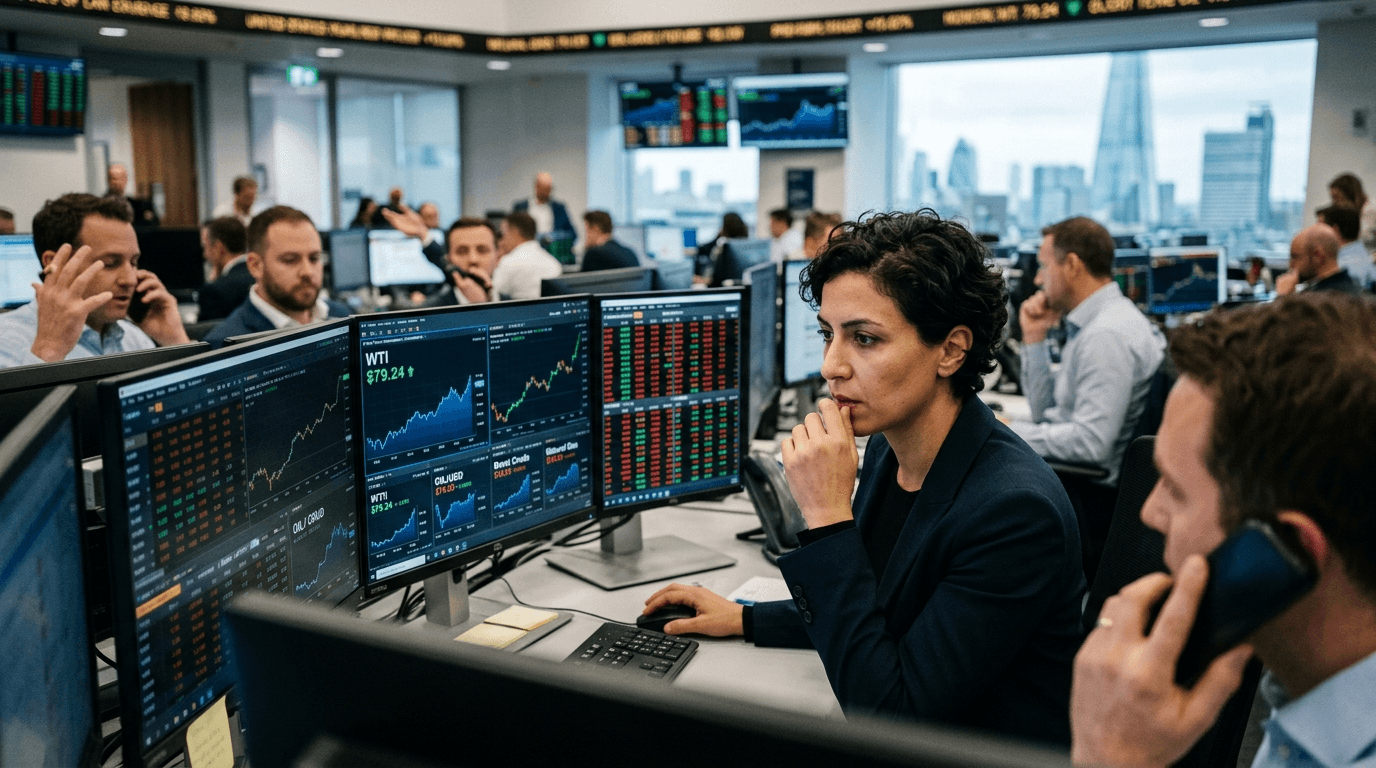
Oil markets have snapped back into focus as West Texas Intermediate (WTI) crude futures rebound above $79 per barrel, reigniting debates about inflation, interest rates, and global risk appetite.[2][3] In a market already conditioned by years of geopolitical shocks, this latest move is a reminder that energy remains the fulcrum of global macro dynamics.
Global Oil Market At A Turning Point
The latest rebound in WTI comes on the back of escalating conflict in the Middle East, particularly renewed confrontation between the United States and Iran and the risk of broader regional spillover.[2][3] Recent news of intensified military strikes, a reinstated naval blockade on Iran, and retaliatory attacks around the Strait of Hormuz has pushed oil to its highest level in weeks, with WTI trading around $79–80 and Brent near $85 per barrel.[2][3]
These levels may not look extreme compared with the triple‑digit prices seen earlier in the decade, but they mark a meaningful shift from the more benign price action seen in prior months.[1][7] The market is once again pricing in a geopolitical risk premium, reflecting fears that physical supply could be disrupted if shipping lanes or export infrastructure are directly targeted.[3]
For traders, this is a classic reminder: it is not only barrels produced that matter, but barrels reliably delivered. Whenever that certainty is questioned, prices adjust—often abruptly.
Geopolitical Flashpoints And Shipping Risks
The core concern driving this rally is the vulnerability of strategic maritime chokepoints, especially the Strait of Hormuz, through which a significant portion of the world’s seaborne crude flows.[2][3][9] History shows how sensitive prices are to disruptions in this corridor. Earlier in 2026, the outbreak of the Iran war and effective closure of parts of the Strait pushed international benchmarks above $100, with Brent spiking as high as $119.50 intraday.[9]
Today’s situation is different in scale but similar in nature. Markets are not only reacting to current disruptions, but also to the probability of further escalation. Naval blockades, insurance costs for tankers, rerouting of cargoes, and potential attacks on infrastructure all translate into higher perceived risk and tighter effective supply, even if headline production numbers remain stable in the near term.[2][3]
In practical terms, this means traders should pay close attention to:
– Shipping insurance premiums and rerouting patterns – Announced or implied changes in export volumes from key Gulf producers – Any signs of sanctions tightening or enforcement shifts
These factors often show up in physical markets before they fully register in futures pricing, offering an information edge for those tracking them closely.
Inflation, Central Banks, And Commodity-linked Currencies
Higher oil prices feed directly into global inflation expectations, especially in economies where energy costs remain a large component of consumer and producer baskets.[3][9] The recent rebound above $79 comes at a time when central banks are delicately balancing the desire to ease policy with the need to keep inflation anchored. A sustained move higher in crude could complicate that calculus.
If energy prices remain elevated, markets may start to price in:
– Slower or smaller interest rate cuts than previously expected – Higher terminal rates in emerging economies with fragile currencies – Greater dispersion in inflation outcomes across regions
Commodity‑linked currencies such as the Canadian dollar (CAD), Norwegian krone (NOK), and, to a lesser extent, Australian dollar (AUD), typically react positively to rising oil prices, reflecting improved terms of trade for resource‑heavy economies. Conversely, large net importers in Asia and Europe may see pressure on their currencies, widening performance gaps in FX markets.
For macro and multi‑asset traders—whether live or in a SimFi environment—this oil move is not just a commodity story. It is a cross‑asset narrative touching rates, FX, equities (particularly energy and transportation), and even credit spreads.
What Traders Should Watch Next
From a technical perspective, the $80 level in WTI has emerged as a key psychological and chart resistance area following the recent breakout above $79.[3] Some analysts note that the market staged nearly a 10% rally in a single session earlier this month, the strongest daily advance since 2020, underlining the volatility embedded in current pricing.[3]
Short‑term traders will be focused on whether WTI can decisively hold above $79 and break through $80 with strong volume, or whether profit‑taking triggers a pullback toward prior support zones.[3] Longer‑term participants will be watching for confirmation that the fundamental backdrop—geopolitical risk, shipping constraints, OPEC+ policy, and demand trends—supports a sustained higher price regime.
Key catalysts to monitor include
– Any escalation or de‑escalation in US‑Iran tensions and regional conflict – Statements from OPEC+ on production quotas and spare capacity utilization – Updated inflation data and central bank communication on energy‑driven price pressures – Inventory reports and refinery utilization, especially in the US and Asia
For those operating on simulated platforms, these events offer opportunities to test playbooks and stress‑test strategies in a controlled environment.
Practical Takeaways For Simulated Traders
In a SimFi setting, the current oil backdrop is ideal for practicing robust macro and risk management frameworks without capital at stake. Several practical exercises stand out:
Scenario building: Construct best‑case, base‑case, and worst‑case scenarios for Middle East tensions and shipping disruptions. Translate each scenario into assumed ranges for WTI and Brent, then map knock‑on effects to FX, indices, and rates.
Correlation analysis: Examine how energy equities, airline stocks, transportation indices, and commodity‑linked currencies respond when WTI trades above versus below key thresholds like $75, $80, and $85. This helps identify potential hedges and diversification tools.
Volatility and position sizing: Rapid 8–10% moves in crude underscore the importance of position sizing and stop‑loss discipline.[3] Use simulated trading to calibrate how much exposure your strategy can tolerate under conditions of elevated implied and realized volatility.
News‑driven trading: Develop a structured approach to trading around geopolitical headlines—clearly defined rules for when to act, when to stand aside, and how to avoid overreacting to unconfirmed reports. The aim is to distinguish between genuine structural shifts and short‑lived sentiment swings.
By treating the current WTI rebound as more than a single data point—as a live case study in how geopolitics, shipping, inflation, and central bank expectations intersect—traders can build skills that remain valuable long after prices move on to the next regime.