
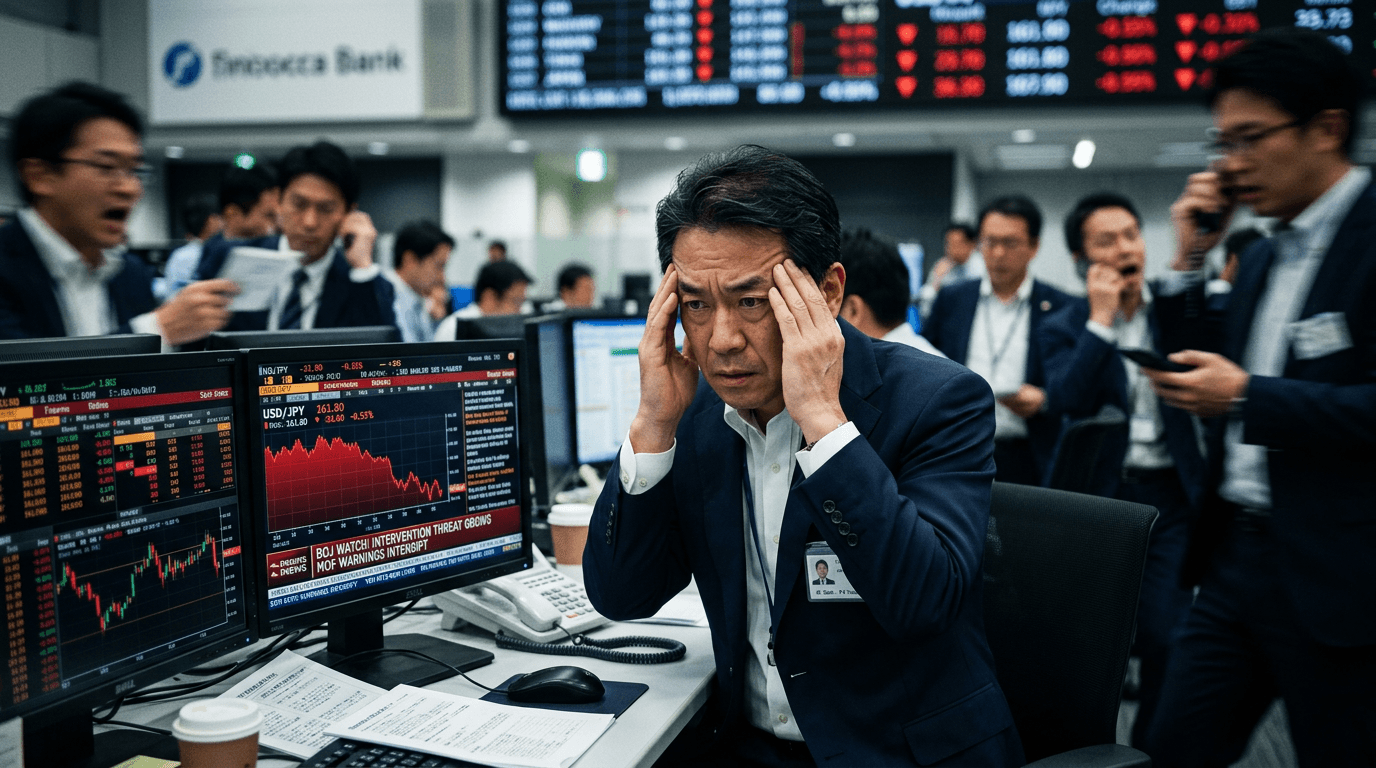
When a major economy’s currency trades at levels last seen in the 1980s, markets pay attention—and that is exactly what is happening with the Japanese yen as USD/JPY hovers near multi‑decade highs around the 160 zone.[1][10][16] Japanese authorities have shifted from mild concern to increasingly explicit threats of “decisive action,” keeping FX traders on edge and injecting fresh volatility into spot, futures, and options markets.[1][3][7][9]
WHAT IS HAPPENING WITH THE YEN?
The yen has weakened to around 40‑year lows against the U.S. dollar, revisiting levels last seen before Japan’s previous rounds of large‑scale interventions.[10][13][16] A wide interest‑rate gap between ultra‑low Japanese rates and much higher U.S. yields has encouraged investors to borrow in yen and buy higher‑yielding assets abroad, a classic carry trade dynamic that pressures the currency.[7][14]
Authorities have responded with a clear escalation in messaging. Finance Minister Satsuki Katayama has repeatedly warned that Tokyo is prepared to take “decisive” or “bold” action against excessive or speculative FX moves and says the government can intervene “at any time as needed.”[1][3][10][12][15][16] Officials emphasize that they are in close, ongoing contact with U.S. authorities, underscoring that any major intervention would likely be coordinated.[1][9][10][12]
This verbal pressure alone has periodically lifted the yen off its weakest levels, leading to sudden intraday reversals as traders cut short‑yen positions and scale back leverage.[4][9][13]
Why Japan Cares About A Weak Currency
A weaker yen has mixed effects for Japan. On one hand, it boosts the overseas earnings of exporters when they are translated back into yen, supporting corporate profits and equity prices.[2] On the other, it raises import costs—especially for energy and food—putting upward pressure on inflation and squeezing households.[12]
Japanese officials have repeatedly argued that recent yen moves “do not reflect fundamentals” and are driven by speculation rather than macroeconomic reality.[12][14] Prime Minister Sanae Takaichi has warned that the government will take “all necessary measures” against “speculative and highly abnormal movements,” signaling that political tolerance for sharp FX swings is low.[8]
This is not just about currency optics. Persistent yen weakness can undermine confidence in Japan’s policy framework, complicate the Bank of Japan’s gradual exit from ultra‑easy monetary policy, and import more inflation than policymakers are comfortable with.[6][12] That combination explains why the finance ministry is now leaning harder on the threat of intervention.
How Fx Intervention Works In Practice
Japan has a long history of stepping into FX markets when yen moves become extreme, usually by selling dollars and buying yen to support the currency.[2] In April, authorities carried out their first confirmed intervention in almost two years, triggering a yen spike of up to 3% in a single session.[5][14] Analysts estimate that operation cost several trillion yen, underlining the scale of resources Tokyo is willing to deploy.[14]
The toolkit typically includes
Verbal intervention Officials first escalate their language, warning of “excessive” or “disorderly” moves and hinting that “decisive action” is coming if markets do not adjust.[1][3][7][9][18] This stage is where we are now: repeated warnings, high‑urgency comments from FX chief Atsushi Mimura, and explicit references to the possibility of intervention.[4][7][9][14][18]
Actual market intervention When words are not enough, the Ministry of Finance instructs the Bank of Japan to enter the market, usually via the New York and Tokyo desks, to buy yen using its foreign‑currency reserves.[2][5] These operations are often unannounced in real time, but they can be inferred from abrupt price spikes and later confirmed by official data.[5][14][17]
Coordination with the United States Japanese officials stress that they are in regular contact with the U.S. Treasury and that any action will align with the Japan‑U.S. understanding on exchange‑rate policy.[1][6][9][10][12] While Japan can act alone, historical episodes show that coordinated signals with Washington tend to be more effective in calming markets.[2]
For traders, the key point is that intervention risk is highest when the yen hits round‑number “danger zones,” volatility rises, and official rhetoric turns both frequent and explicit—as is currently the case around the 160 per dollar area.[1][7][10][16]
Impact On Traders, Futures And Carry Trades
Sharp yen moves driven by intervention fears can have outsized effects across global markets. When the yen suddenly strengthens on a warning or suspected operation, short‑yen positions can be squeezed, forcing traders to buy back yen quickly.[5][13][14] This often triggers:
- Rapid repricing in USD/JPY spot and futures as traders reduce leverage and tighten stops.[7][9][13]
- Higher implied volatility in options markets as hedging demand spikes.[9]
- Strain on popular carry trades that rely on a stable, weak yen funding leg.[7][14]
Even verbal intervention can move markets. After what officials described as a “final warning” to speculators, the yen saw its largest one‑day gain in years, underlining how sensitive positioning had become to policy headlines.[14][18] Ministry of Finance data also show periods where authorities relied solely on warnings without deploying actual funds, yet markets still reacted visibly.[17]
For systematic or algorithmic strategies, these episodes can be especially challenging: headline‑driven moves may not be fully captured by macro or rate‑differential models, leading to sudden drawdowns if risk controls are not robust.
How Traders Can Navigate This Environment
For both discretionary and systematic traders, a heightened intervention regime in Japan calls for a more tactical approach to yen risk.
First, position sizing and leverage need to reflect headline risk. When officials repeatedly signal that “decisive action” is on the table and USD/JPY is sitting near historically sensitive levels, running maximum‑size short‑yen positions becomes asymmetric: the downside from a surprise 3–5% yen spike in a day can outweigh the slow carry earned over weeks.[1][5][7][14][16]
Second, scenario testing becomes critical. Traders should model how their portfolios would respond to:
- A sudden multi‑percentage‑point yen rally over hours.
- A series of smaller, intervention‑driven pullbacks within a broader uptrend in USD/JPY.
- A regime shift where the Bank of Japan gradually tightens policy, narrowing the rate gap.[6][12]
Simulated trading environments are useful for rehearsing these scenarios without real capital at risk. By replaying past intervention episodes and stressing current positions under hypothetical yen shocks, traders can refine entries, exits, and hedging strategies before facing live markets.
Finally, traders need a clear information framework. That means tracking:
- Official comments from the finance ministry, the FX chief, the prime minister, and the Bank of Japan.[1][3][6][8][9][10][12][18]
- Key levels highlighted by market participants and media as potential trigger zones.[7][9][13][16]
- U.S. policy developments, given the emphasis on Japan‑U.S. coordination.[1][6][9][10][12]
The yen’s slide to multi‑decade lows has turned Japan’s FX policy into a central macro theme rather than a local story. For traders, the message is clear: respect the intervention threat, treat carry trades with more caution, and use both analysis and simulation to prepare for abrupt regime shifts that can reprice USD/JPY in a matter of hours.