
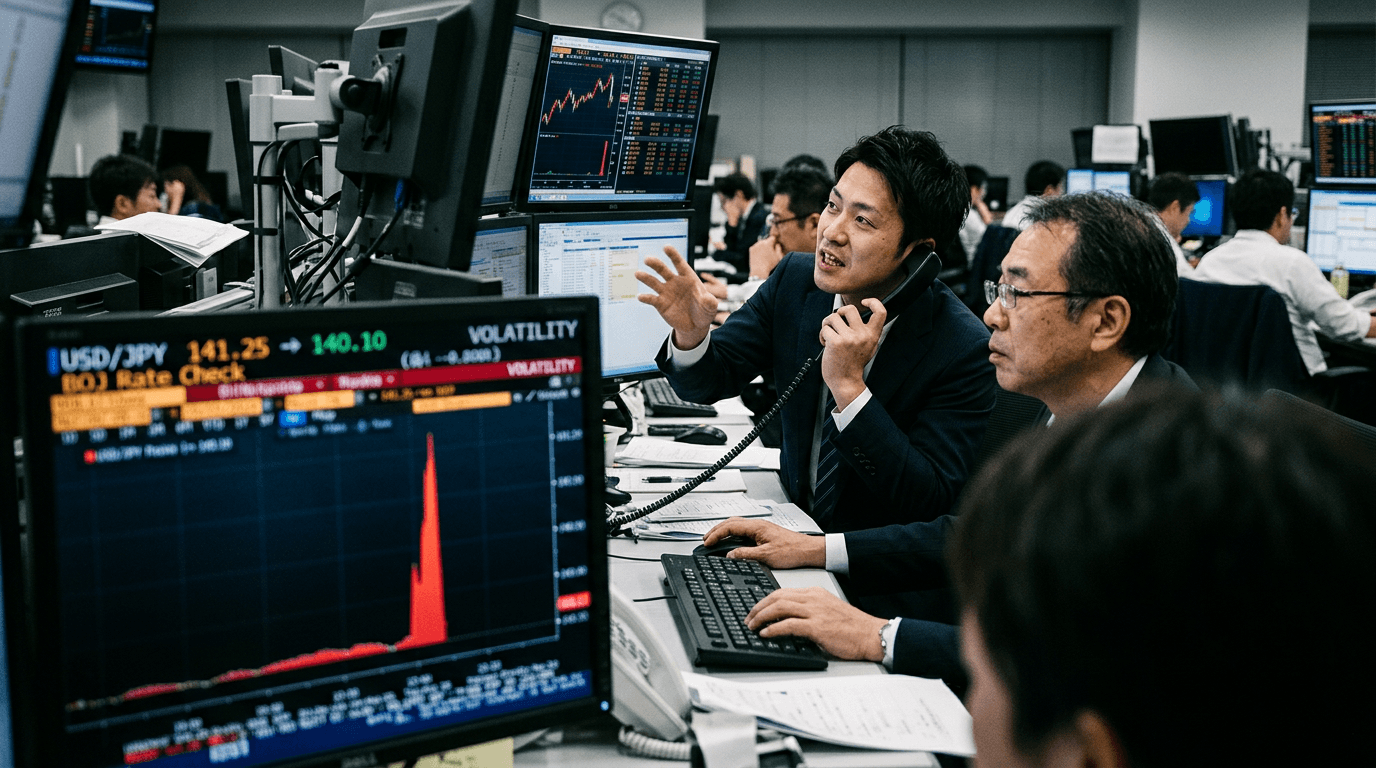
The Japanese yen’s latest surge, driving USD/JPY briefly below the 158 level, is a textbook example of how policy signals can trigger rapid repricing across FX and derivatives markets.[14] For traders on both live and simulated platforms, the move underlines a simple reality: in yen, what officials say and do can matter as much as data and charts.[5][13]
Current Move: Yen Surge Puts Policy Back In Focus
Reports of suspected Bank of Japan “rate checks” with market participants prompted a sharp drop in USD/JPY as traders rushed to reduce short-yen exposure.[12][14] The mere hint that authorities were actively checking prices was interpreted as a warning shot that outright intervention could follow if depreciation were judged “excessive” or “chaotic.”[5][8]
This reaction reflects how sensitive the market has become to the 155–160 range, an area already associated with previous intervention talk and official action.[9][13] Analysts and option markets have increasingly treated the high-150s as a danger zone, where authorities may escalate from verbal warnings to actual yen-buying operations.[5][13]
For yen futures and options, the spike in realized volatility around the rate-check headlines forced traders to reassess path probabilities for USD/JPY and the size of potential policy moves.[5][9] In SimFi environments, that kind of regime shift is precisely what stress scenarios aim to capture: one catalyst, multiple assets adjusting in seconds.
WHAT “RATE CHECKS” SIGNAL TO MARKETS
“Rate checks” are informal inquiries by authorities or central-bank-linked institutions into prevailing market prices, typically conducted with major dealers.[12][14][15] They are not interventions by themselves, but they signal that officials are actively monitoring conditions and gathering intelligence on liquidity and order flow.[12][14]
Historically, rate checks in dollar/yen have often been perceived as a prelude to FX intervention, especially when accompanied by tougher language from Japan’s finance ministry or prime minister.[12][14] In earlier episodes, checks by the New York Federal Reserve on USD/JPY at Tokyo’s request sparked speculation about joint U.S.–Japan action to support the yen.[12][14]
However, rate checks do not guarantee that intervention will occur, nor do they disclose its timing or scale.[12][14] Authorities may decide that the warning effect alone is enough to cool speculative positioning and restore more orderly trading without deploying capital.
For traders, the nuance is crucial. A rate check is a signal, not a promise, but the market tends to treat it as a high-alert regime where headline risk and gap risk both increase.[12][14] In practical terms, it encourages tighter risk limits, more conservative leverage, and closer monitoring of intraday news flow.
JAPAN’S INTERVENTION TRACK RECORD AND POLICY BACKDROP
Japan has a long history of intervening in FX markets to counter what it views as excessive yen weakness or strength, with episodes often concentrated around sharp moves rather than gradual trends.[9][13] In recent years, authorities have already spent tens of billions of dollars defending the yen, including an estimated sum near $73 billion in one intervention campaign when the currency traded close to 160 per dollar.[9]
These FX operations sit alongside a shifting domestic policy backdrop. The Bank of Japan has lifted its short-term policy rate to 1.0%, the highest level since the mid-1990s, and kept it there at recent meetings while warning that underlying inflation could exceed its 2% target.[2][11][15] Even so, real rates remain low, and yield differentials with the United States and Europe still encourage funding trades that sell yen to buy higher-yielding assets.[7][9]
This combination—gradual monetary normalization, persistent rate gaps, and intermittent intervention—creates a complex narrative for USD/JPY.[7][9][11] Fundamentals may argue for a weaker yen over time, but policymakers are unwilling to tolerate disorderly moves or one-way speculation that undermines domestic confidence.[8][13]
For the SimFi world, this history offers rich material for scenario design: how does a market behave when fundamentals and policy tactics point in different directions? How should simulated portfolios respond when a central bank uses both rates and FX operations to influence the currency?
TRADING IMPLICATIONS FOR USD/JPY AND YEN FUTURES
When intervention fears rise, USD/JPY price action often shifts from trend-like to fragmented and headline-driven, with sharp reversals on relatively modest news.[9][11][14] Traders who rely solely on momentum or carry may find their strategies whipsawed as policy signals override short-term technical setups.[7][9]
In spot FX, the risk is asymmetric for those short yen. Sudden, large-scale yen-buying by authorities can knock several big figures off USD/JPY in minutes, triggering margin calls and forced position cuts.[9][13] Options markets typically price this “gap risk” through higher implied volatility and richer premiums for downside USD/JPY protection.[5][9]
Yen futures and related derivatives respond by repricing both front-end volatility and longer-dated expectations. Contracts tied to the policy rate and yield curve also adjust when intervention headlines coincide with changes in the perceived path of BoJ tightening or global rate differentials.[2][9][11]
For traders using SimFi platforms, these dynamics highlight three key lessons. First, FX is not only about economic data; it is also about the reaction function of policymakers.[8][11] Second, tail events in currencies can be policy-driven, not just macro-driven. Third, risk management must account for the possibility that liquidity thins and spreads widen during intervention chatter.
Practical Takeaways For Simfi And Live Traders
The latest yen move offers several actionable insights that can be practiced in a simulated environment and applied in real markets. One is the value of mapping “policy zones” for major FX pairs—levels where authorities are more likely to speak, check, or act.[5][9][13] For USD/JPY, the high-150s have clearly emerged as such a zone.
Another takeaway is the importance of aligning leverage with policy risk. In periods where intervention odds are rising, carrying large short-yen exposure without protection is effectively a bet against the Japanese authorities.[8][9] On a SimFi platform, traders can test different leverage and stop-loss configurations to see how their P&L behaves under sudden 2–5% currency swings.
A third lesson is the role of options and structured trades as hedging tools. Buying downside USD/JPY puts or constructing limited-risk structures can help cushion the impact of a surprise intervention, though these strategies come at a premium that needs to be evaluated against the probability of policy action.[5][9] Simulation allows traders to compare hedged versus unhedged portfolios under identical shocks.
Finally, the yen story reinforces the value of continuous learning about central-bank and fiscal communication. Statements from Japan’s finance ministry, BoJ policy decisions, and cross‑border coordination efforts all feed into currency pricing.[2][8][11][14] Traders who track these signals systematically—and rehearse responses in SimFi environments—are better positioned to handle real-time volatility.
In essence, the suspected rate checks and the resulting sharp JPY move are a reminder that currency trading sits at the intersection of macroeconomics, policy, and market psychology.[7][9][14] For those willing to study that intersection and practice their playbook, intervention fears are not just noise—they are opportunities to refine edge, discipline, and resilience.