
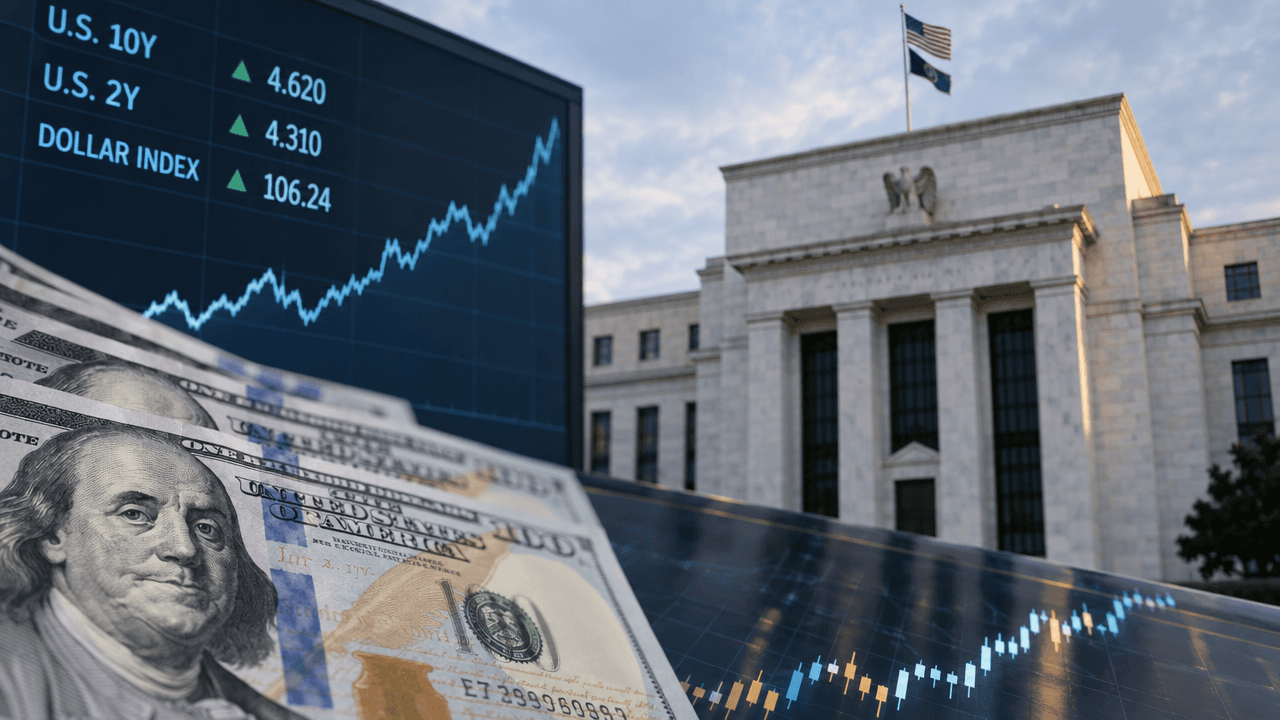
U.S. Treasury yields are pushing toward the 5% threshold while the dollar index climbs to its strongest levels since mid‑summer, signaling that markets are rapidly repricing a more hawkish Federal Reserve path.[1][4][12][15] Persistent inflation, solid growth data, and higher energy prices are reinforcing expectations that policy will stay restrictive for longer—and possibly tighten further—shifting the risk landscape across rates, FX, equities, and credit.[1][4][8][10][15]
Markets Reprice A More Hawkish Fed
The 10‑year U.S. Treasury yield has moved up toward 4.98%–4.99%, hovering just below the psychologically important 5% mark and reaching levels last seen in late 2023.[1][3][4][6] This move caps a multi‑month climb in long‑term yields as investors digest stronger inflation prints and higher oil prices, both of which challenge the narrative of a smooth disinflation.[1][2][9] At the same time, futures markets are increasingly pricing the 10‑year yield to trade around 4.99% by quarter‑end, reflecting expectations that elevated rates will persist rather than quickly mean‑revert.[4]
On the policy side, the Fed recently raised the federal funds target range by 25 basis points to 3.75%–4.00%, framing the move as part of an ongoing effort to curb inflation that remains above its 2% objective.[10][15] Updated projections signal one more hike by end‑2026 and no rate cuts in 2027, underscoring that the Fed sees both inflation pressures and economic resilience persisting.[10] Fed commentary has also emphasized that financial conditions are not yet “overly restrictive,” implying limited appetite to pivot toward easing unless growth clearly softens or inflation falls more decisively.[10][15]
Higher Yields And What They Mean For Traders
Higher long‑term yields directly raise discount rates used to value future cash flows, compressing price‑to‑earnings multiples and pressuring growth and duration‑sensitive assets. That tends to hit sectors like technology, utilities, and REITs harder, while providing a more attractive income profile for bonds and cash‑like instruments. For income‑oriented traders, a 10‑year yield near 5% reshapes the opportunity set: risk‑free returns look compelling relative to dividend yields and credit spreads, incentivizing a rotation toward quality and away from lower‑grade, long‑duration exposure.
In fixed income strategies, the steepening at the long end increases interest‑rate risk for portfolios heavily concentrated in long‑maturity bonds. Duration management becomes critical: tools such as barbell strategies, interest‑rate futures, and options can be used to hedge against further yield upside. For macro and multi‑asset traders, the interplay between real yields, breakeven inflation, and nominal rates offers signals on market expectations of future price dynamics and growth, which can be incorporated into scenario‑based positioning.
Dollar Strength And Global Capital Flows
The U.S. dollar index has climbed toward roughly 100.96, near its highest level since mid‑July, supported by rising Treasury yields and expectations of additional Fed tightening.[8][12][13][15] A stronger dollar reflects both higher relative U.S. interest rates and safe‑haven demand as investors reassess global risks, including energy price volatility and geopolitical tensions.[8][13][15] For FX markets, this environment generally favors long‑USD positions against lower‑yielding or more cyclical currencies, while raising the bar for carry trades funded in dollars.
Dollar strength has broader macro implications. It tightens global financial conditions by increasing the cost of servicing dollar‑denominated debt, particularly in emerging markets and highly levered corporates. It can also weigh on commodity prices in local currency terms, affecting producers’ revenues and importers’ costs. For cross‑asset traders, monitoring how dollar moves correlate with equities, credit spreads, and volatility indices helps identify regime shifts—for instance, a phase where dollar strength coincides with risk‑off sentiment versus one where it reflects pure rate differentials.
Implications For Simulated Traders In A Simfi Environment
For traders using simulated finance platforms like E8 Markets, this is a rich environment to stress‑test strategies without real capital at risk. Elevated yields and a strong dollar create clear, observable trends in rates and FX, ideal for practicing macro, relative‑value, and cross‑asset approaches. SimFi environments allow users to model how a sustained 10‑year yield near 5% and a firm dollar index influence portfolio value, margin usage, and drawdown profiles over time.[4][12][15]
One practical application is building scenarios around different Fed paths: “higher for longer,” “late pivot,” or “surprise dovish shift.” In each scenario, traders can simulate how yield curves reposition, how the dollar responds, and how equity sectors rotate, then test hedging techniques such as rate futures, options on indices, or FX hedges. Because simulated accounts mirror market dynamics without financial loss, they are particularly useful for experimenting with duration hedging, macro trend‑following, or mean‑reversion strategies around key policy events and data releases.
Practical Takeaways For Active Traders
First, anchor macro views around the 10‑year yield and the Fed’s reaction function. When the long end hovers near 5%, it signals that markets expect restrictive policy and resilient nominal growth—a backdrop that prioritizes risk management and disciplined position sizing over aggressive leverage.[1][4][10] Second, treat dollar strength as both an opportunity and a risk. It can provide clean trend setups in major FX pairs, but also magnifies moves in global assets tied to U.S. funding and trade flows.[8][12][15]
Third, refine strategy selection to the regime. Trend‑following and breakout strategies often perform well when policy expectations are shifting and yields are moving steadily, while mean‑reversion may require tighter stops and more selective deployment. Fourth, integrate macro catalysts—Fed meetings, inflation prints, labor data, and energy headlines—into trade planning. Mapping positions and exposure ahead of such events helps avoid being unintentionally over‑levered into high‑volatility windows.
Finally, use simulated trading to build a “macro playbook.” Test how your strategies behave under different combinations of rates, dollar levels, and volatility, and record what works across regimes. That systematic learning process becomes invaluable when transitioning to live trading or scaling risk, especially in environments where policy and markets are moving quickly.
Conclusion
The simultaneous rise in U.S. yields and the dollar is a clear signal that markets are reassessing the Fed’s stance and pricing a longer period of restrictive policy.[1][4][8][10][15] For traders, this is not just a headline—it changes the discount rate, reshapes cross‑asset correlations, and alters the risk‑reward balance across portfolios. By focusing on the 10‑year yield, the Fed’s evolving guidance, and dollar dynamics, and by rigorously testing strategies in simulated environments, market participants can turn a complex macro shift into a structured learning and trading opportunity.