
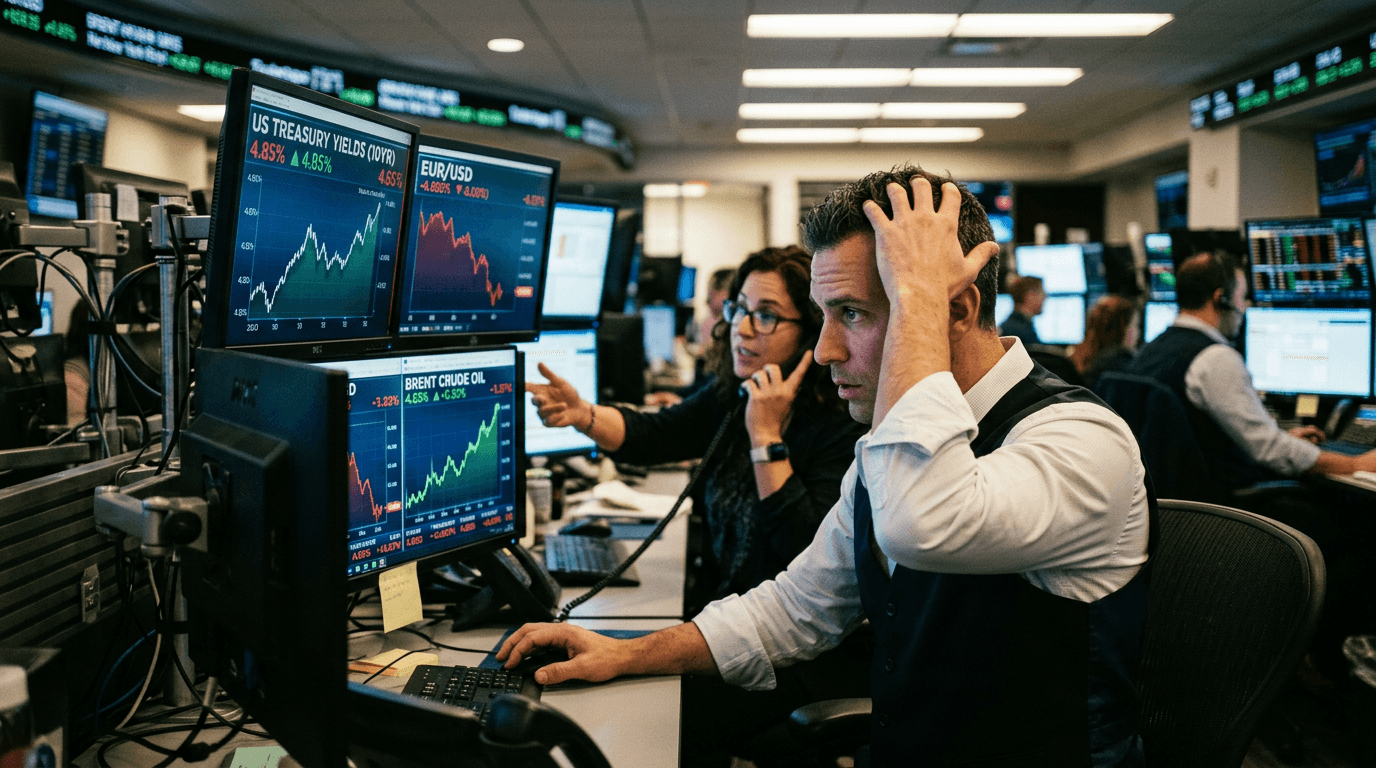
Heightened volatility across foreign exchange and commodity markets is being driven by a powerful combination of rising U.S. bond yields and persistent Middle East tensions, with every new headline forcing traders to reassess inflation, interest-rate, and safe‑haven dynamics in real time.[2][3][8][16] The result is a market environment where oil, gold, and major FX pairs are swinging sharply, and hedging activity in futures and options has become central to risk management.[9][10][13]
Market Backdrop: Yields, Inflation Fears And Geopolitics
The core macro story begins with the surge in global bond yields as investors reprice inflation and policy expectations in response to higher oil prices and war risk in the Middle East.[3][6][8][14] Renewed conflict involving the U.S., Israel, and Iran, including threats to shipping through the Strait of Hormuz, has pushed crude sharply higher and reopened concerns about an energy‑driven inflation spike.[1][3][14][16]
U.S. Treasury yields have moved up across the curve as markets shift from pure safe‑haven buying into a focus on future inflation and rate hikes.[3][10][14] Benchmark 10‑year yields have traded around multi‑month highs near or above 4.6–4.7%, with 30‑year yields climbing above 5%—levels that force investors to reconsider the “higher for longer” rate narrative.[2][4][14] Short‑dated yields, which track expected Federal Reserve policy, have also pushed higher as Fed hike probabilities are brought forward in response to the combination of strong data and higher energy prices.[3][10][12]
At the same time, the relationship between yields and risk sentiment remains fluid. When hostilities temporarily ease and oil retreats, Treasury yields can fall back several basis points, reminding traders that both inflation and geopolitical risk are in play and can flip the tone of markets quickly.[5] This tug‑of‑war between safe‑haven demand and inflation‑driven yield repricing helps explain why volatility remains elevated rather than trending in one direction.
FX: SAFE‑HAVENS CLASH WITH YIELD AND CARRY TRADES
Foreign exchange markets are reflecting this tension between risk aversion and rate expectations in a pronounced way. The U.S. dollar has generally strengthened as yields rise and inflation worries intensify, extending gains even against traditional safe‑havens like the yen and Swiss franc at times.[3][7][16] Fresh turmoil in the Middle East and higher oil prices have pushed the dollar index higher, with the currency riding the surge in Treasury yields and sitting near multi‑decade highs against the yen in some episodes.[7][10]
Safe‑haven currencies are still in demand, but the hierarchy is fluid. Recent commentary notes strong interest in the Swiss franc and Japanese yen whenever conflict headlines escalate, alongside renewed buying of the dollar as both a safe‑haven and a yield play.[11][16] That means USDJPY, USDCHF, and cross‑yen pairs can see sharp, intraday swings as traders rotate between pure risk‑off positioning and trades that seek to capture the yield differential in favor of the dollar.[3][7][11]
Commodity‑linked and high‑beta currencies—such as those tied to global growth and risk appetite—tend to underperform in these episodes, as investors shy away from exposure to regions and sectors most vulnerable to an energy shock and trade disruptions.[11][16] For traders, the message is clear: FX volatility is not only about the direction of yields, but also about how markets interpret each new geopolitical development in terms of inflation, growth, and central‑bank reaction functions.
Commodities: Oil And Gold In The Crosshairs
Commodity markets sit at the center of this story. Crude oil has surged repeatedly on fears that conflict in the Gulf and potential closure or disruption of the Strait of Hormuz could choke off a key channel for global energy supply.[1][3][15][16] Brent crude has traded back toward the $100 per barrel level in recent spikes, while U.S. benchmarks have also reached multi‑week highs as traders price in disruption risk and higher geopolitical risk premia.[4][5][15]
Options markets in energy have been signalling rising concern about supply interruptions, with implied volatility and risk‑reversal structures showing increased demand for upside protection in crude.[9] These moves ripple through broader markets: higher oil prices feed directly into inflation expectations, which lift yields and, in turn, influence FX, equity valuations, and rate‑sensitive assets.[3][8][14][16]
Gold, traditionally the go‑to geopolitical hedge, has also benefited from periodic safe‑haven flows as Middle East tensions flare, although its upside has been constrained at times by higher yields and a stronger dollar.[3][9][15] Precious metals have tended to consolidate within ranges, supported by geopolitics but capped by the twin headwinds of elevated bond yields and a cautious Federal Reserve outlook.[9] That leaves gold and silver as tactical, rather than one‑directional, trades—requiring active management rather than passive hedging.
VOLATILITY, POSITIONING AND CROSS‑ASSET LINKAGES
Across the board, recent price action underscores the importance of cross‑asset linkages. Rising oil prices and Middle East tensions spill over into government bond markets, repricing yields and rate expectations.[3][6][8][14][16] Those yield moves then filter into FX via interest‑rate differentials, while simultaneously affecting equity valuations and the appeal of carry trades.[3][7][13]
Market data show that bond yields have risen persistently through conflict periods as traders reassess the likelihood of central‑bank tightening in response to inflation risks.[3][13][14] Equity markets, meanwhile, have seen bouts of weakness as higher discount rates and geopolitical uncertainty weigh on risk appetite, particularly in energy‑sensitive sectors like airlines and travel.[13][16]
In this environment, futures and options activity has intensified. Traders are using bond futures and interest‑rate options to hedge against further yield spikes, while oil and gold options volumes rise as market participants seek protection against both upside and downside price shocks.[9][13][15] FX options have also become a key tool, allowing traders to manage exposure to dollar strength, yen volatility, and potential gap moves around data releases or geopolitical developments.[11][13]
Practical Takeaways For Simfi And Active Traders
For traders operating on simulated finance platforms and in live markets alike, the current backdrop offers both opportunity and risk. Elevated volatility in FX and commodities means larger intraday ranges, more frequent trend reversals, and a greater need for disciplined risk management.
First, it is critical to track the three main drivers that have been dominating recent commentary: U.S. jobs data and broader macro releases, bond yield moves, and Middle East geopolitical headlines.[2][8] Together, these shape expectations for inflation and central‑bank policy, which in turn drive the dollar, yields, and commodity prices.
Second, scenario planning deserves more emphasis. Traders can map out paths such as “escalating conflict and higher oil,” “de‑escalation and lower yields,” or “strong data and hawkish central‑bank signals,” then test how key FX pairs and commodities behave under each scenario using SimFi tools. This approach helps refine strategies for hedging and directional positioning in futures, options, and spot markets.
Third, position sizing and diversification become even more important when volatility is high. Concentrated bets on a single outcome—such as a rapid resolution in the Middle East or an immediate policy pivot by the Fed—carry elevated risk. Spreading exposure across FX, energy, and metals, and using options to define downside, can help manage drawdowns while still allowing participation in large moves.
Finally, active traders should respect the feedback loop between markets: an oil spike is not just a commodity story, it is a bond and FX story; a sharp move in yields is not just a rate story, it is a risk‑asset story. Building a routine that links these markets—monitoring yields, crude, gold, and the dollar index together—can improve timing and reduce the chance of being surprised by cross‑asset reactions.
In short, the combination of elevated U.S. yields and persistent Middle East risks is keeping volatility high across FX and commodities, ensuring that macro awareness and robust risk management remain essential for anyone navigating today’s markets.[3][8][9][14][16]