
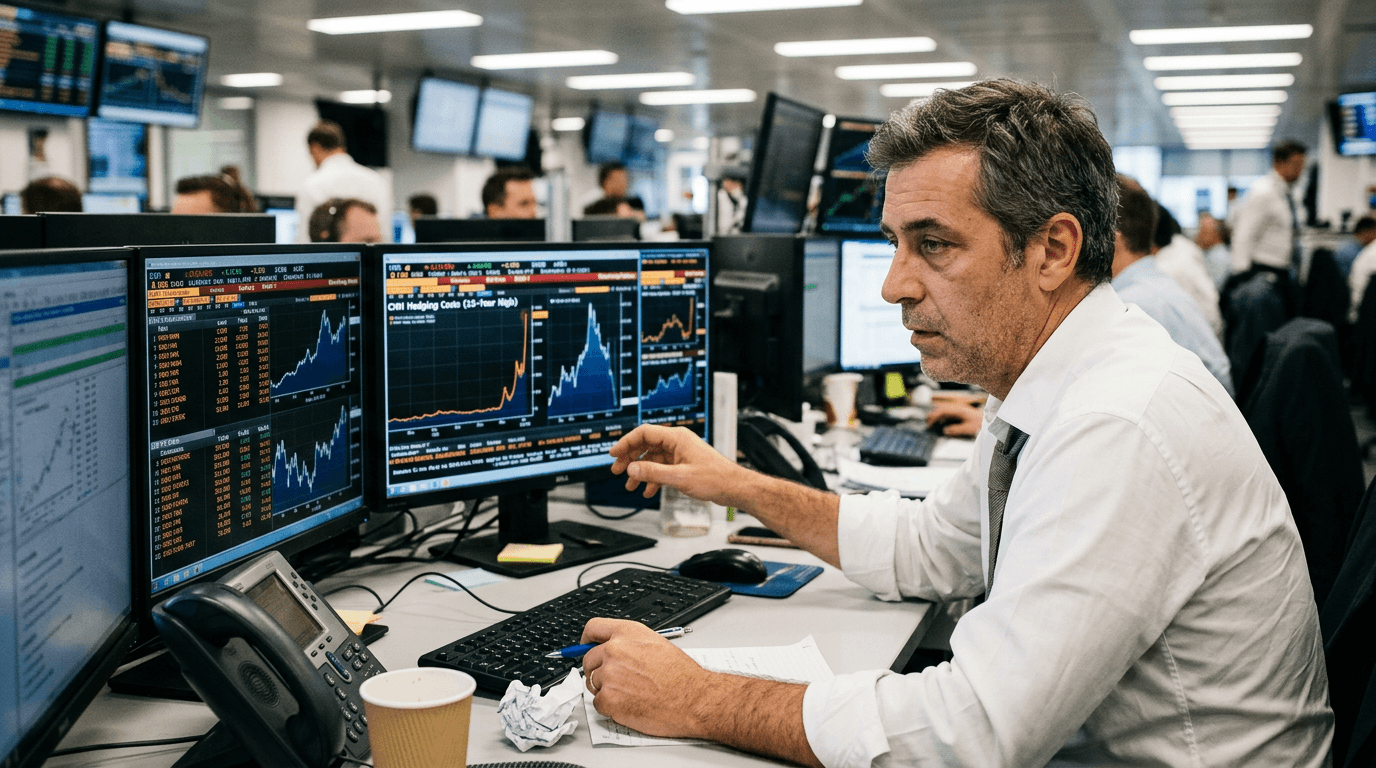
Option traders are paying the highest premium in 15 years to hedge against a weaker yuan, underscoring how sensitive global markets have become to China’s policy choices and growth trajectory[1]. For traders across FX, rates, and equities, this spike in hedging cost is more than a technical detail—it is a real-time stress test of confidence in the world’s second-largest economy.
What The Yuan Hedging Spike Signals
The key gauge in focus is the skew in yuan options that measures the relative cost of protection against currency weakness versus strength[1]. When this gauge reaches a 15-year high, it means investors are disproportionately demanding downside protection on the yuan, pushing up the price of options that pay off if the currency falls[1].
This shift is happening in both the onshore CNY and offshore CNH markets, but the offshore segment tends to react faster because it is less tightly managed and more accessible to global investors[14]. Elevated hedging costs reflect expectations of larger or more frequent swings in the yuan, even if spot moves remain relatively contained day to day.
These dynamics matter because yuan volatility does not stay “local.” With China deeply embedded in global supply chains, commodity demand, and capital flows, any perceived instability in its currency quickly feeds into broader emerging-market sentiment and risk pricing.
Policy And Growth Worries Behind The Move
The surge in hedging cost is rooted in a mix of macro and policy concerns rather than a single catalyst. Slower domestic demand, property-sector strains, and questions around productivity and demographics have all contributed to a more cautious view on China’s medium-term growth outlook[5]. When growth visibility deteriorates, investors naturally question how aggressively policymakers may use the exchange rate as a shock absorber.
At the same time, uncertainty around the People’s Bank of China (PBOC) reaction function—how it balances supporting growth, controlling capital outflows, and maintaining currency stability—adds another layer of risk premium[5]. The authorities have taken steps to deepen offshore yuan liquidity and broaden the supply of yuan-denominated assets, signalling a desire for a more resilient global role for the currency even as volatility rises[11].
Chinese corporates are responding too. A record number of listed companies have adopted currency hedging strategies to manage swings in the yuan, with over 1,400 firms reporting FX risk measures and a double‑digit increase year on year[3]. Net outstanding forward settlement contracts have reached the highest level since 2010, showing that real-economy players are actively transferring FX risk into the derivatives market[9]. Their demand for hedges contributes to the elevated pricing that traders are now observing.
How High Hedging Costs Ripple Through Markets
When downside protection on the yuan becomes expensive, the impact radiates through multiple asset classes. CNH and CNY pairs see wider implied volatility, prompting market makers to widen spreads and reduce leverage for clients trading yuan crosses[1][14]. Offshore yuan liquidity can tighten episodically as dealers manage their own risk books, with the PBOC’s efforts to deepen the market helping but not fully offsetting stress during peak episodes[11].
Emerging-market FX tends to trade in sympathy with the yuan. A spike in yuan risk premium often leads investors to reassess exposure to currencies closely linked to China via trade or commodity channels, such as Asian export economies and resource producers. This can trigger higher hedging demand across EM FX, even for currencies whose fundamentals are relatively sound, simply because they share the “China narrative” in global portfolios.
The knock‑on effects extend into emerging‑market bond and equity futures tied to China exposure. When investors anticipate larger currency swings, they may demand higher yields to hold EM debt or use index futures to quickly adjust exposure to China‑sensitive sectors. Equity futures on indices with heavy China or China‑proxy weightings can see increased volume and intraday volatility as systematic strategies incorporate yuan options signals into their risk models.
For global derivatives infrastructure, this environment accelerates the yuan’s rise as a major options currency. Clearing houses and exchanges project that yuan options trading could surpass traditional benchmarks like the yen, reflecting rapid growth in both hedging and speculative activity[13]. In other words, the current spike in hedging costs is part of a broader structural trend: the yuan is becoming a central node in the global volatility complex.
Implications For Simulated Finance Traders
For traders using simulated environments such as E8 Markets, the yuan hedging dynamic offers a rich case study in how macro themes translate into option pricing and multi‑asset correlations. Elevated skew and implied volatility in USD/CNH options create scenarios where directional views on the currency and volatility views can diverge, forcing more nuanced strategy design.
One practical implication is that simple short‑dated directional bets on the yuan become more expensive when downside protection is richly priced. In a SimFi setting, this encourages exploration of relative value structures—such as spreads between yuan volatility and volatility in other EM currencies, or trades that pair FX options with equity index futures to express views on China’s growth channel.
Another key lesson is the importance of understanding liquidity regimes. Periods of tight offshore yuan liquidity can magnify slippage and execution risk in high‑leverage strategies, even in a simulated environment that mirrors real‑world market mechanics. Practicing risk management under different liquidity assumptions helps traders build robust frameworks for sizing positions and setting stop‑loss levels.
Practical Takeaways For Risk Management
For both new and experienced traders, the spike in yuan hedging cost highlights several actionable principles:
1) Treat currency risk as a core part of macro and cross‑asset analysis, not an afterthought. Large moves in hedging gauges often precede broader shifts in EM risk appetite.
2) Focus on volatility, not just direction. Elevated implied volatility can create opportunities in options structures that benefit from price swings regardless of whether the yuan ultimately strengthens or weakens.
3) Monitor policy signals. Changes in PBOC communication, liquidity tools, or capital‑flow measures can quickly alter the balance of risks priced into the yuan and related EM assets[11].
4) Use simulated trading to stress‑test portfolios. Running scenarios that incorporate extreme but plausible currency moves helps reveal hidden leverage and correlation risks before they become an issue in live markets.
Conclusion
The fact that the cost to hedge against yuan weakness has climbed to a 15‑year high is a clear message from markets: China’s currency is entering a more volatile, policy‑sensitive phase that investors cannot ignore[1]. This episode is reshaping pricing in CNH/CNY pairs, offshore yuan liquidity, EM FX, and China‑linked bond and equity futures, reinforcing the yuan’s role as a central driver of emerging‑market risk.
For traders, the opportunity lies in turning this complexity into an edge—by understanding how growth worries, policy uncertainty, and institutional hedging demand interact to set the price of protection. In a SimFi environment, these conditions provide a powerful training ground to refine volatility, correlation, and liquidity risk techniques before deploying capital in real markets. The yuan hedging spike may be temporary, but the skills required to navigate such episodes will remain valuable well beyond this cycle.