
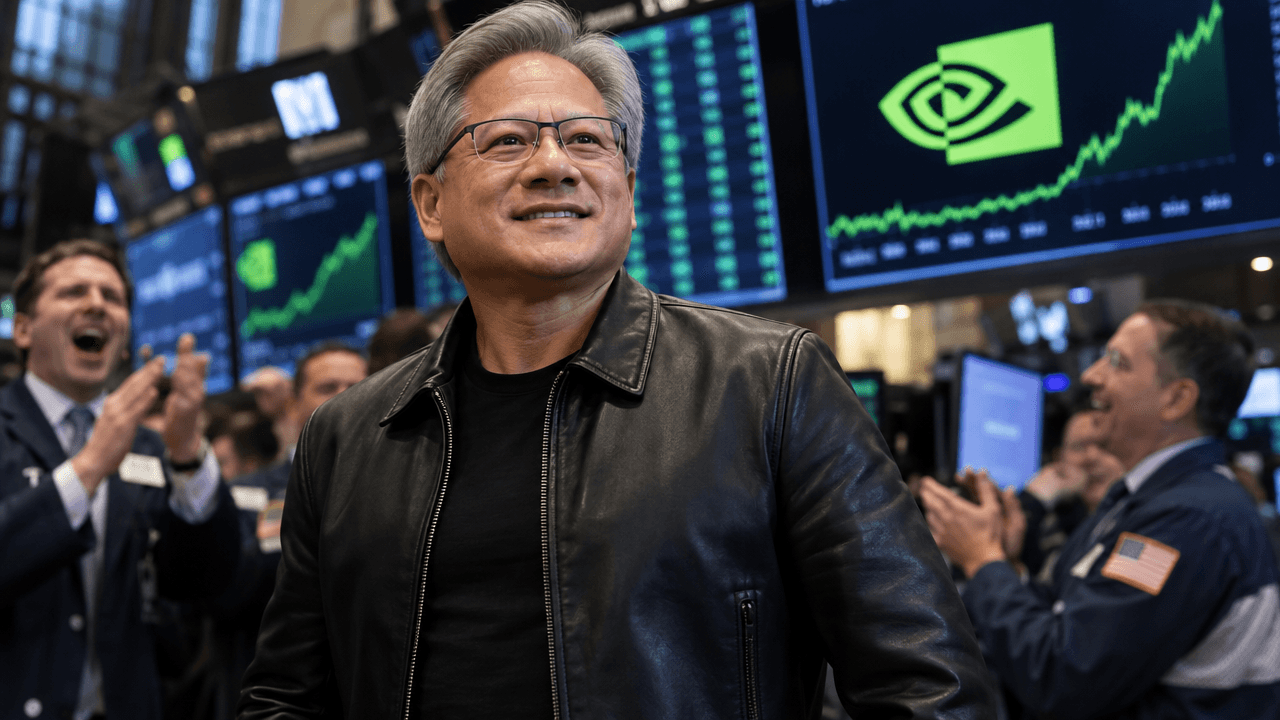
U.S. equity markets delivered a dramatic rebound as renewed confidence in artificial intelligence lifted technology shares and helped reverse much of the previous week’s sell-off. The S&P 500 gained approximately 4.7%, while the Nasdaq 100 rose roughly 6.5%, signaling a powerful return of risk appetite across growth-oriented assets. The rally followed Nvidia’s decision to reinstate Jensen Huang as chief executive, a development investors interpreted as a renewed vote of confidence in the company and the broader AI expansion. [1][6]
What Drove The Rebound
Nvidia stood at the center of the market’s turnaround. Shares of the semiconductor company surged more than 30% after the announcement, making it one of the strongest single-day performances in the stock’s history. Because Nvidia is deeply connected to data centers, advanced computing, and generative AI infrastructure, its leadership news carried significance far beyond one company. [6]
Investors had recently grown concerned that the AI trade was losing momentum. Heavy selling in AI-linked shares had pushed major U.S. indexes into correction territory, raising questions about whether valuations had moved too far ahead of business fundamentals. Huang’s return helped ease those concerns, at least temporarily, by restoring confidence in Nvidia’s strategic direction.
The move also reinforced the importance of leadership credibility in fast-growing industries. Huang is closely associated with Nvidia’s transformation from a graphics-chip manufacturer into one of the most important infrastructure providers for artificial intelligence. His reinstatement encouraged market participants to reassess the company’s long-term growth prospects and the durability of AI-related demand.
Why Ai Has Such A Broad Market Impact
Artificial intelligence has become a major investment theme because its potential economic effects extend across multiple industries. Semiconductor designers and manufacturers may benefit from increased demand for processing power, while cloud providers, data-center operators, software companies, and industrial firms may gain from expanding AI infrastructure.
That interconnectedness explains why a leadership announcement at one company can influence indexes, exchange-traded funds, and unrelated sectors. Stocks associated with AI infrastructure, including Oracle, CoreWeave, Nebius, and Caterpillar, also moved higher as traders anticipated continued spending on data centers and supporting construction. [9]
The rally demonstrated how concentrated market leadership can amplify both gains and losses. A relatively small group of large technology companies now has an outsized influence on major indexes. When those companies rise together, index performance can accelerate rapidly. When they fall, broad benchmarks can decline even if many other businesses remain stable.
For traders, this creates both opportunity and risk. Strong momentum can produce profitable breakouts, but it can also encourage traders to chase prices after a large move. A sharp rebound does not automatically confirm that a new sustained uptrend has begun.
Reading The Market Signals
The size of Monday’s advance suggests that investors were not simply responding to Nvidia’s announcement. They were also covering short positions, buying stocks that had become technically oversold, and seeking exposure after a steep decline. The Nasdaq Composite gained 6.5%, while the Dow Jones Industrial Average rose about 3%, showing that the rebound spread beyond the technology sector. [10]
However, a one-day rally should be evaluated in context. Markets often produce powerful recovery sessions after periods of forced selling. The next test is whether buyers can maintain momentum over several sessions, whether trading volume remains strong, and whether other market groups participate.
Traders should also monitor bond yields, corporate earnings expectations, and economic data. If interest rates remain elevated, high-growth companies may continue to face valuation pressure even when their long-term outlook is attractive. Conversely, stable or declining yields could make future earnings more valuable and provide additional support for technology stocks.
Practical Takeaways For Simfi Traders
The rebound offers several useful lessons for participants in simulated finance markets.
First, identify the catalyst before analyzing the chart. Price action becomes easier to interpret when traders understand whether a move is driven by earnings, leadership changes, economic data, interest rates, or broader sentiment.
Second, separate momentum from confirmation. A 6.5% index gain can create strong short-term momentum, but traders should wait for evidence that the market can hold key support levels and establish higher highs rather than assuming the first rally will continue indefinitely.
Third, manage exposure around concentrated themes. AI-related assets can move together, increasing correlation risk. Holding several technology positions may appear diversified while still creating significant exposure to the same underlying catalyst.
Finally, use the event to test a plan rather than an impulse. SimFi traders can compare breakout strategies, pullback entries, stop placement, and position sizing without risking real capital. The goal is to understand how a strategy performs during high-volatility sessions, not simply to predict the next headline.
What Comes Next
The immediate question is whether renewed AI optimism can develop into a broader, sustainable market advance. Nvidia’s leadership news has improved sentiment, but investors will still need evidence that AI spending, corporate earnings, and productivity gains justify current expectations.
The rebound is therefore best viewed as a significant change in sentiment, not a guarantee of a permanent trend reversal. Traders who combine fundamental context with disciplined risk management will be better positioned than those who react solely to the day’s strongest percentage gain.
For the SimFi community, this episode is a valuable reminder that markets price expectations as much as present results. Leadership, innovation, valuation, and investor psychology can converge in a single session, producing extraordinary movement. The most effective response is not to chase the excitement, but to study the catalyst, measure the risk, and execute a clearly defined plan.