
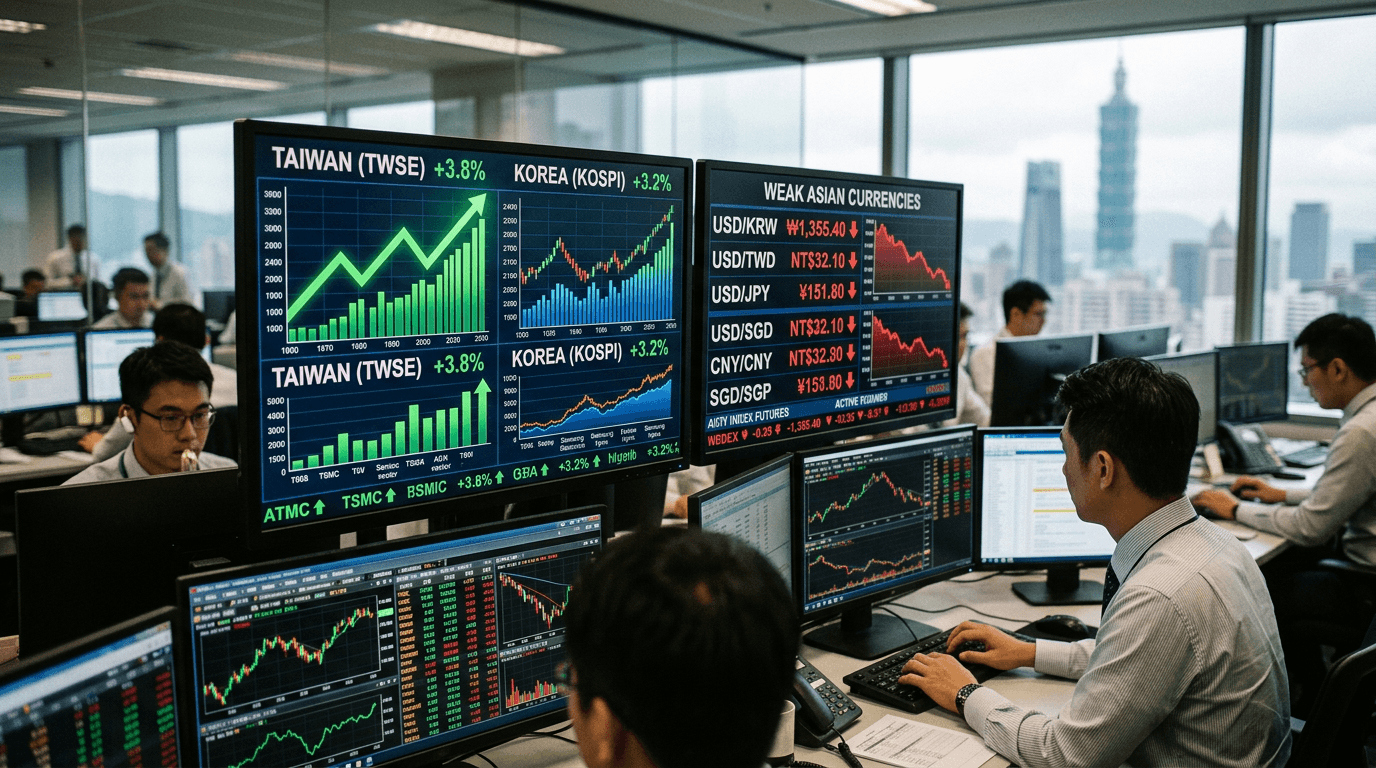
Asian equity markets delivered a familiar but still striking picture: risk-on in stocks, risk-off in currencies. Tech-heavy benchmarks in Taiwan and South Korea climbed as investors piled back into artificial intelligence (AI) and semiconductor names, even as most regional currencies slipped on renewed uncertainty around a potential U.S.-Iran peace deal and its broader geopolitical implications.[1][2][3] This kind of divergence between equity and FX markets is a classic reminder that “Asia” is not a single trade—and it creates both opportunity and complexity for active traders.
Ai Rally Powers Taiwan And Korea
The standout story on the equity side is once again AI. Technology shares, particularly chipmakers and AI-supply-chain names, led the advance in Asia, echoing the powerful AI-driven rallies seen in U.S. markets.[1][2] Benchmarks in Taiwan and South Korea, both heavily weighted toward semiconductors and electronics, saw outsized gains as investors sought exposure to companies positioned at the heart of global AI infrastructure.[1][2][7]
In Taiwan, the main index pushed toward or beyond record territory, supported by strong demand for high-end chips, servers, and networking equipment used in AI data centers.[1][2] South Korea showed a similar pattern, with large-cap semiconductor and hardware names driving index-level performance as global investors rotated into the region’s AI supply chain.[2][7] Analysts have been steadily upgrading earnings expectations for tech, with estimates for sector earnings growth moving close to or above 20% for upcoming reporting seasons, underscoring the fundamental backing behind the narrative.[9]
Crucially, this is not just short-term momentum chasing. The AI trade in Asia is anchored in structural themes: the build-out of data centers, increasing cloud and edge computing capacity, and rising demand for specialized chips. That said, the pace of the rally and lofty valuations mean any disappointment in earnings or guidance could trigger sharp pullbacks—making disciplined risk management essential for index and single-stock traders.
Geopolitical Clouds Over Regional Currencies
While equities leaned into optimism, regional FX told a more cautious story. Most Asian currencies weakened as investors digested the still-uncertain trajectory of U.S.-Iran peace efforts and their potential impact on oil markets, risk sentiment, and safe-haven flows.[3][4]
Ongoing doubts about whether negotiations can deliver a durable agreement have kept geopolitical risk premia alive, supporting demand for the U.S. dollar and other perceived havens.[3][4] At the same time, expectations that U.S.-Iran talks could break down—or at least stall—have fed into volatility in crude oil prices, a key driver for energy-importing Asian economies.[3][4] Higher or less predictable oil prices can weigh on current accounts and inflation in these countries, often translating into pressure on their currencies.
For many emerging Asian FX pairs, this means a familiar pattern:
- Elevated geopolitical risk tends to curb inflows into local bonds and equities, or at least slow them, as global investors seek to avoid tail risks.
- The U.S. dollar benefits from safe-haven demand, pushing EM currencies lower even when their stock markets are performing well.
- Central banks in the region may feel compelled to balance growth support with currency and inflation stability, adding policy uncertainty to the mix.
The result is a market where an AI-led equity rally coexists with weaker local currencies—a divergence that can be disorienting if you expect all risk assets to move in sync.
What This Means For Em Fx And Index Futures Traders
For traders in emerging market FX and index futures, this environment creates a nuanced playbook rather than a one-directional bet.
First, equity index futures linked to Taiwan and Korea may continue to benefit from AI enthusiasm as long as global tech earnings and guidance remain supportive.[1][2][7][9] However, given stretched valuations in some names, futures markets can also be vulnerable to sudden de-risking if sentiment toward AI capital expenditure or margins shifts.
Second, in FX, traders need to separate structural stories (like AI and long-term tech competitiveness) from cyclical and geopolitical ones (like U.S.-Iran peace talks and oil volatility). Equity strength does not automatically translate into FX strength when geopolitical risk is elevated and the U.S. dollar is in favor.
Third, cross-asset relationships matter. For example:
- A positive surprise on U.S.-Iran negotiations that reduces geopolitical tension and oil risk premia could support Asian currencies, compress dollar strength, and extend the equity rally.
- Conversely, headlines suggesting talks are failing could trigger a “risk-off” move that hits EM FX first, potentially spilling over into equities and futures if the shock is large enough.
For traders operating in simulated environments, this is an ideal setup to practice building and testing cross-asset strategies: long tech-heavy index futures while hedging with FX, or vice versa, and stress-testing portfolios against varying geopolitical scenarios.
Risk Management In A Divergent Market
A key lesson from the current backdrop is that bullish equity narratives can coexist with macro and geopolitical uncertainty. That demands a more granular approach to position sizing and risk management.
Some practical considerations for traders
- Separate timeframe and thesis: You might be structurally bullish on AI-linked equities over the next 3–5 years, yet tactically cautious on EM FX over the next few weeks as geopolitical headlines play out.
- Use hedges where sensible: Equity exposure in markets like Korea and Taiwan can be partially hedged using EM FX pairs or dollar index proxies when geopolitical risk rises, especially into major news events.
- Watch volatility, not just direction: Implied volatility in FX options or index futures often reacts before spot prices. Rising vol can signal that markets are pricing in higher event risk, even if spot remains relatively calm.
- Avoid over-reliance on a single driver: AI may be the dominant equity theme today, but macro variables—rates, inflation, oil, and geopolitics—still set the broader risk backdrop, especially for currencies.
SimFi platforms are particularly useful here: they allow traders to experiment with these combinations in a risk-free setting, test how portfolios behave under stress, and refine playbooks for when similar conditions recur in live markets.
Looking Ahead: Key Takeaways For Traders
The simultaneous rise in Asian AI-led tech stocks and the softening of regional currencies captures a central reality of today’s markets: narratives can differ sharply across asset classes. On one side, the long-term growth story for AI and semiconductors continues to attract capital into North Asian equity markets.[1][2][7][9] On the other, unresolved geopolitical risks around the U.S.-Iran peace process are nudging investors toward safety, weighing on EM FX and reinforcing the dollar’s role as a haven.[3][4]
For traders, the opportunity lies in understanding and actively trading this divergence rather than assuming it will quickly close. Those who can read both micro-level technology trends and macro-level geopolitical dynamics—and express those views through index futures, FX, and cross-asset hedges—are better positioned to navigate the next phase of this market.
In short, AI is powering the upside story, geopolitics is shaping the downside risk, and the edge belongs to those who can manage both in a disciplined, data-driven way.