
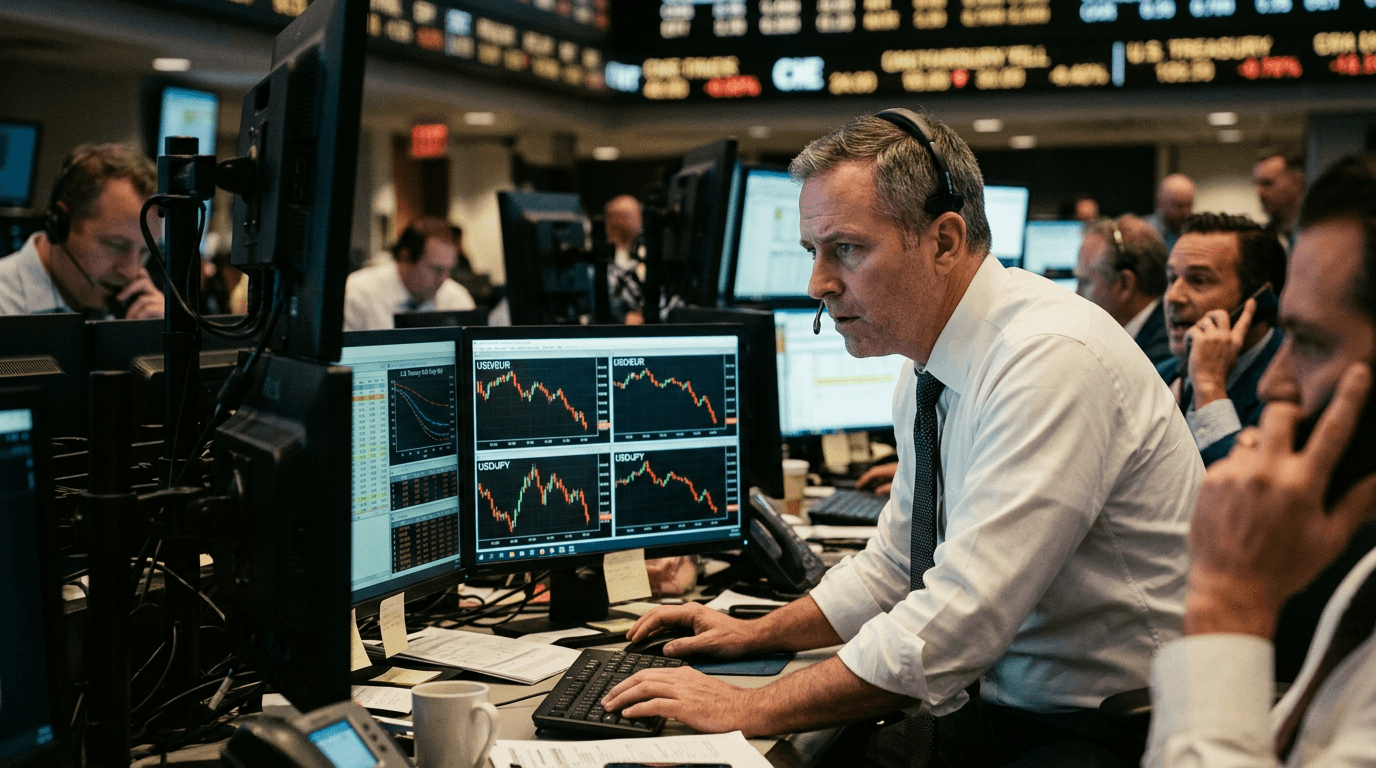
A softer U.S. dollar after the latest Federal Reserve minutes has reminded traders just how quickly the policy narrative can shift – and how fast that shift can ripple through FX markets, rate futures, and risk assets tied to U.S. real yields.[1][2][7] For anyone trading currencies, bonds, or simulated strategies, this kind of move is a textbook example of how “tone” in central bank communication can be as market-moving as an actual rate decision.[7]
Market Snapshot: Dollar Softens On Fed Minutes
The immediate catalyst was a set of Fed minutes interpreted as less hawkish than markets had braced for, prompting a modest but meaningful pullback in the dollar against a basket of major currencies.[1][2][7] Instead of signaling an urgent need for renewed aggressive tightening, the minutes painted a more balanced picture: policymakers acknowledged inflation risks but emphasized uncertainty and a data‑dependent approach rather than a clear push toward higher rates at any cost.[5][6][9]
At the same time, falling oil prices helped temper inflation concerns, reinforcing the impression that the Fed may have slightly more room to be patient.[1][2] With the U.S. dollar index edging lower and safe‑haven demand easing, traders began to reassess the likelihood of rapid policy tightening and reprice risk across FX, U.S. Treasuries, and rate futures.[1][2][7] That repricing is critical, because it influences not just spot prices, but also forward curves, volatility, and cross‑asset correlations.
WHAT “LESS-HAWKISH” REALLY MEANS
To understand this move, it helps to unpack what “less hawkish” means in practice. Hawkish monetary policy refers to a preference for tighter conditions – higher interest rates and a stronger stance against inflation, even at the cost of slower growth.[6][9] Dovish policy leans toward easier money, prioritizing growth and employment with lower rates and more accommodative measures.[6][9]
The latest minutes did not signal a full pivot to dovish territory, but they were notably short of the aggressively hawkish tone some traders feared.[1][2][5] Rather than telegraphing a series of rapid hikes, the Fed emphasized elevated uncertainty, mixed data, and a willingness to let incoming information guide the pace of policy changes.[5] Historically, research shows that the sentiment embedded in FOMC minutes has a statistically significant association with both fed funds futures and the valuation of the U.S. dollar.[7] When the tone shifts from “we may need to do more” to “we’ll wait and see,” markets often scale back expectations for tightening, pushing yields and the dollar lower.
For traders, the nuance matters. A less‑hawkish tone does not necessarily mean imminent rate cuts; it can simply mean the bar for additional hikes is higher, and the Fed is more open to a slower, more conditional path.[5][9] That subtle shift is enough to change how markets price the trajectory of policy over the next several meetings – and that repricing is what showed up in FX and rate futures.
Ripple Effect Across Fx Pairs
Once the dollar started to ease, the effects spread quickly across major currency pairs. The euro, which had been under pressure from strong U.S. yields and dollar strength, found some relief as the greenback slipped, pushing EUR/USD higher.[1][2][7] The Japanese yen, long weakened by wide rate differentials, saw a rare day of strength versus the dollar as traders pared back expectations of further U.S. tightening, even though it remained structurally weak on a longer‑term basis.[2][7]
The Chinese yuan also firmed modestly against the dollar, helped by the combination of softer U.S. currency and local factors, including mixed but stable inflation data.[2] In each case, the mechanics were similar: lower implied U.S. real yields reduce the dollar’s carry advantage, making it less attractive relative to peers and shifting flows into other currencies and risk assets.[6][9]
Beyond spot FX, the move in the dollar and yields fed into assets that are highly sensitive to U.S. real rates – from growth equities to crypto. When markets start to believe that the Fed is less inclined to slam on the brakes, the discount rate on future earnings (and future cash flows more broadly) falls, supporting higher valuations in risk assets.[6][9] That is why a seemingly modest adjustment in the wording of Fed minutes can spark broad‑based repositioning, even without a single basis point change in the policy rate.
Rate Futures And Real Yields: Where The Big Signals Are
The most important read‑through from the minutes arguably came in rate futures and Treasury markets. Fed funds futures, which embed expectations for the path of policy rates, adjusted to reflect a slower pace of potential tightening and an increased likelihood that upcoming meetings could be “on hold” rather than automatic hikes.[5][7] U.S. Treasury yields, particularly at the front end of the curve, eased as traders marked down the probability of back‑to‑back aggressive moves.[5][7]
Academic work and market experience both show that minutes sentiment tends to move these instruments directly: a more cautious tone generally weighs on the implied path of future rates and the dollar, while a more forceful, inflation‑focused tone does the opposite.[7][9] Because real yields – nominal yields adjusted for inflation expectations – are a key driver for everything from FX to equities to crypto, even incremental shifts in rate futures can have outsized effects across portfolios.[6][9]
For traders on simulated platforms as well as in live markets, this is where the signal is richest. Watching how fed funds futures and short‑maturity Treasuries react to the minutes provides a real‑time gauge of whether the market sees the Fed as leaning hawkish, dovish, or, as in this case, cautiously neutral.
How Traders Can Position In A Choppy Policy Landscape
One practical takeaway is that central bank communication risk is now a core part of FX and rates trading, not a side narrative. Traders can respond in several ways:
First, incorporate policy tone into scenario planning. Because minutes can shift expectations without changing rates, stress‑testing strategies against different sentiment outcomes – more hawkish, neutral, or more dovish – helps avoid being caught offside.[7]
Second, focus on relative moves rather than absolute forecasts. A less‑hawkish surprise tends to favor currencies with improving growth stories and manageable inflation over those dependent on high carry alone.[2][6][9] Positioning in pairs like EUR/USD or USD/JPY around these inflection points can be more about the pace of repricing than the ultimate level of rates.
Third, use rate futures and short‑term yields as confirmation tools. If the dollar reacts but rate futures barely move, the FX move may be short‑lived. When both reprice in the same direction, the signal is stronger and more likely to persist.[5][7]
Finally, for multi‑asset traders, remember that risk assets often respond faster and more violently than cash FX to perceived changes in policy stance. Equity index futures and crypto can overshoot on both optimism and fear when the Fed’s tone shifts.[6][9] That creates opportunity, but also demands clear risk limits and predefined exit rules.
Conclusion: Why Minutes Matter More Than Ever
The latest dollar slip after less‑hawkish Fed minutes is a clear reminder that in modern markets, central bank communication is itself a policy tool – and a tradable event.[1][2][7] Even when the Fed keeps its benchmark rate unchanged, the nuance of how it describes inflation risks, growth, and uncertainty can move FX, rates, and risk assets in meaningful ways.[5][6][9]
For traders, the lesson is straightforward: treat FOMC minutes as a primary data release, not a footnote. Track how the tone diverges from expectations, watch how rate futures and real yields respond, and be ready to adjust FX and cross‑asset positioning accordingly. In a world where policy is more about guidance than shock moves, the words between the decisions are often where the next trend begins.