
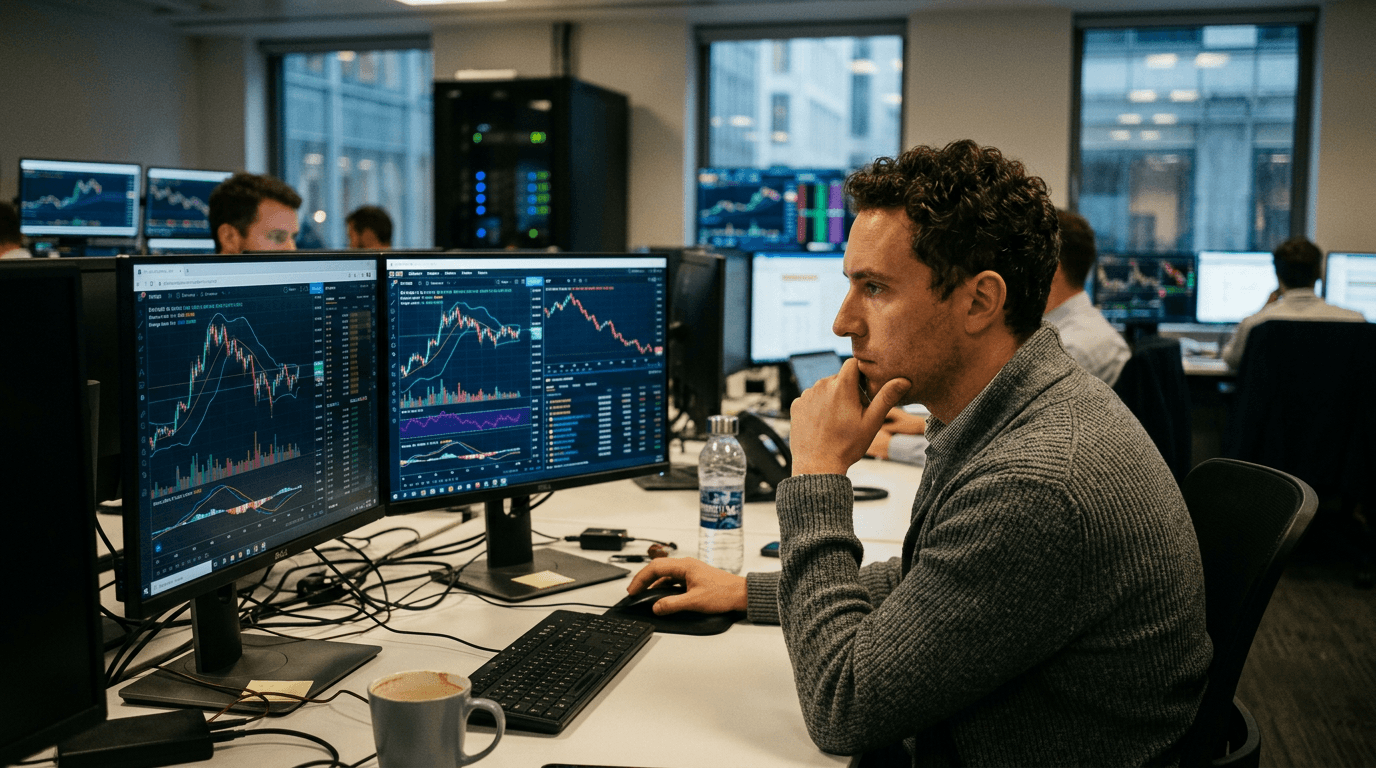
Crypto markets are catching their breath after a volatile stretch, with major tokens trading in choppy but increasingly stable ranges as the U.S. dollar eases following recent Federal Reserve communications.[3][10] A softer dollar and calmer Treasury yields have taken some pressure off risk assets, allowing futures activity and liquidation rates in crypto to normalize after prior spikes.[3][10] For traders, this environment is less about breakneck momentum and more about managing range-bound price action while staying alert to the next macro catalyst.
Market Snapshot: Choppy, Not Chaotic
After weeks of sharp swings, large‑cap cryptocurrencies like Bitcoin and Ethereum are seeing more two‑way, intraday volatility rather than sustained directional trends.[8][10] Recent price action has featured moves that look dramatic on lower timeframes but often leave daily closes not far from where they started, a classic hallmark of a market consolidating after stress.[8][9]
In previous episodes of turbulence, Bitcoin has oscillated around key psychological levels while altcoins diverged—some outperforming on idiosyncratic news, others lagging on liquidity and sentiment factors.[1][9] The current backdrop is similar: rotation within the majors and top altcoins, but without the broad risk‑off capitulation that characterized heavier dollar‑driven selloffs earlier in the year.[6][12]
Key takeaway: this is a market digesting prior volatility, not one in full risk‑on mode. Range trading, rotations, and quick reversals are more prevalent than clean trends, which has implications for both strategy selection and risk management.
Why A Softer Dollar Matters For Crypto
The easing in the U.S. dollar is a central piece of the current story. Historically, a strong dollar tends to pressure dollar‑priced assets like Bitcoin by making them more expensive for global investors and reinforcing flows into traditional safe havens.[6][11][12] Conversely, periods of dollar weakness often coincide with rising risk appetite across assets, including crypto, as overseas investors find it more attractive to hold dollar‑denominated positions.[8][13]
Recent moves reflect that pattern to a degree. As the dollar index slipped toward short‑term lows amid shifting expectations for Fed policy and cross‑currents from other central banks, analysts flagged potential relief for risk assets and DeFi activity.[3] Softer inflation expectations and lower energy prices have also weighed on the dollar, helping support the case for higher appetite in growth and speculative assets.[8]
However, the relationship is no longer one‑dimensional. Several recent episodes have shown that a weaker dollar does not automatically translate into sustained crypto gains, with Bitcoin sometimes falling despite the textbook macro tailwinds.[2][13] In other words, dollar direction remains important, but flows, positioning, and crypto‑specific factors—like ETF demand or regulatory headlines—can override the macro script in the short run.[17][18]
Key takeaway: traders should treat dollar moves as a key input, not a single trigger. A soft dollar tends to reduce headwinds, but it needs to align with supportive crypto‑specific flows and sentiment to drive a durable trend.
Futures, Liquidations And Normalization After The Spike
The recent volatility cycle did not just impact spot markets; it also produced a surge in futures liquidations as leveraged traders were caught on the wrong side of rapid price moves.[3][10] When funding rates swing and open interest builds up around crowded levels, relatively modest spot moves can cascade into outsized liquidations, amplifying intraday price action.
With the dollar easing and headline risk temporarily lower, futures volumes and liquidation activity have started to normalize, suggesting that excessive leverage has been partially flushed out.[3][10] This normalization matters because highly leveraged conditions tend to increase the probability of sharp wick‑type moves—price spikes or crashes that reverse quickly once forced liquidations run their course.
For traders in a simulated finance (SimFi) environment, this is a valuable learning moment. Practicing how leverage, margin, and liquidation thresholds behave in choppy but stabilizing conditions helps build intuition for real‑world risk. Simulated futures trading can illustrate:
- How quickly unrealized P&L can swing in a range market.
- Why setting conservative leverage and clear stop‑loss levels matters.
- How funding, basis, and open interest signals can warn about crowded trades.
Key takeaway: in calmer conditions after a liquidation spike, there is an opportunity to study and refine leverage and risk frameworks—before the next volatility wave hits.
Macro And Geopolitics: What Traders Are Watching Next
Even as day‑to‑day price action cools, markets remain highly sensitive to upcoming U.S. macro data, Fed communications, and geopolitical headlines, particularly from the Middle East.[3][8] Recent de‑escalation in regional tensions helped drive a pullback in oil prices, easing immediate inflation concerns and contributing to the softer dollar backdrop.[8] But that calm is fragile; any renewed escalation could reverse the moves in energy, inflation expectations, and yields.
On the macro side, traders continue to watch data releases that could shift expectations for the Fed’s next steps—employment, inflation, and growth prints that feed into rate path probabilities.[3][14][17] Dovish‑leaning signals tend to reinforce dollar weakness and support risk assets, while hawkish surprises can quickly restore pressure on crypto, especially if they drive a repricing in yields.
This backdrop encourages a more tactical approach. Instead of assuming trend continuation, many participants are treating each major data release or geopolitical development as a potential catalyst for short‑term trades in both directions.[10][17] For crypto markets, that often translates into higher volumes around event windows, followed by periods of consolidation.
Key takeaway: macro and geopolitical events remain the main potential “trend breakers” in an otherwise choppy environment. Building a trading plan around key calendar dates and scenario analysis is essential.
How Simulated Finance Traders Can Navigate Choppy Markets
For traders using platforms like E8 Markets to practice and refine strategies, choppy, range‑bound conditions are not a bug—they are a realistic training ground. Many live‑market periods look exactly like this: macro uncertainty, modest dollar moves, stabilization after volatility, and no clear long‑term direction.
Practical ways to use this environment
- Focus on range and mean‑reversion strategies. Identify well‑tested support and resistance zones on major tokens and practice entries, exits, and position sizing around those levels.
- Integrate macro signals into your playbook. Track the dollar index, key yield levels, and high‑impact economic releases. Use the simulated environment to test how your strategies perform when macro surprises hit.
- Stress‑test leverage. Run scenarios where price spikes briefly through your levels, triggering simulated margin calls and liquidations. Adjust your leverage, stop placement, and position sizing until your system can withstand realistic volatility.
- Separate noise from signal. Not every headline moves markets. Use periods of calmer dollar and normalized futures activity to define what truly qualifies as a tradeable event in your process.[17][18]
Key takeaway: choppy, stabilizing markets are ideal for building disciplined, rules‑based trading habits. The goal is not to predict every wiggle, but to design strategies and risk frameworks that can survive and adapt to a wide range of macro and market conditions.