
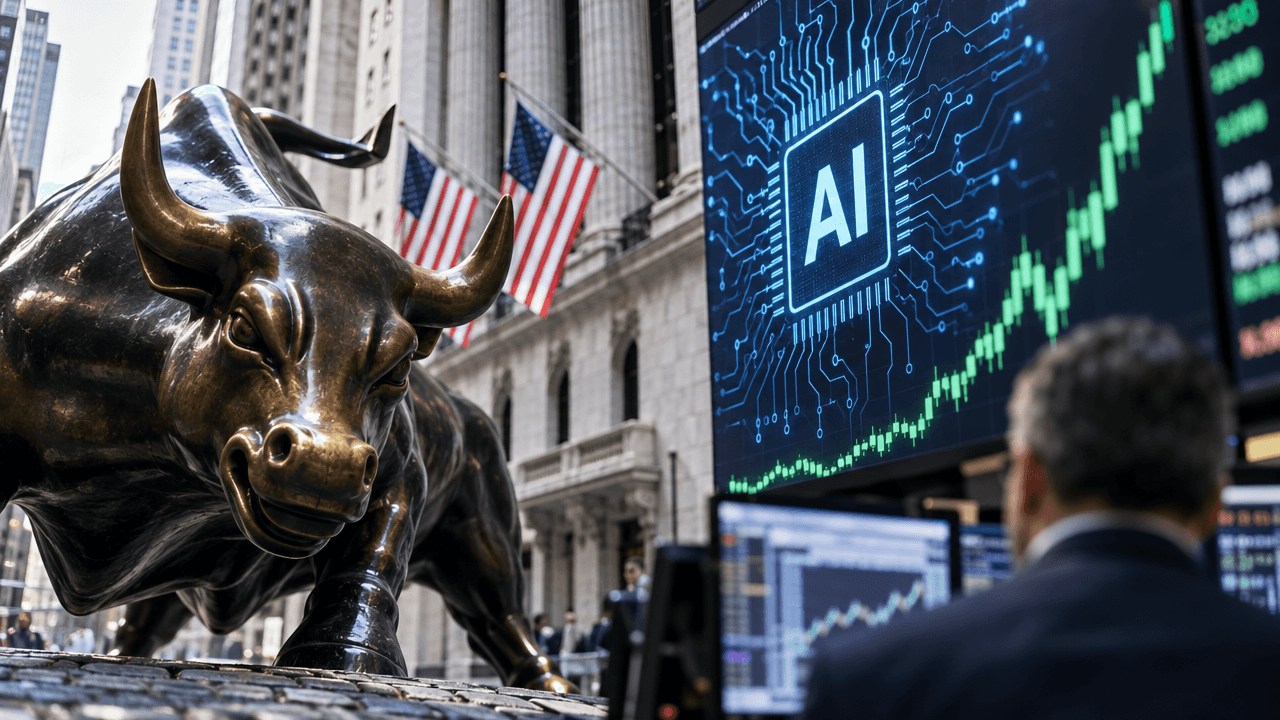
AI-led risk appetite is back in focus across U.S. equity markets, with technology shares pushing indexes higher after Anthropic filed paperwork for a public offering. The latest session saw the Nasdaq rise 0.8%, the S&P 500 gain 0.7%, and the Dow add 0.3%, as investors renewed their interest in artificial intelligence companies and the businesses supplying their infrastructure. [1][4]
The move is important because it arrives after two consecutive weekly declines for the S&P 500 and Nasdaq. Anthropic’s filing offered investors a fresh catalyst, but it also exposed the tension at the heart of today’s AI trade: enormous growth potential alongside substantial costs, demanding valuations, and heightened sensitivity to earnings results.
WHY ANTHROPIC’S IPO FILING MATTERS
An IPO filing does more than signal that a company intends to list its shares. It gives investors a detailed look at revenue growth, losses, capital requirements, risk factors, and management’s strategy. Anthropic’s filing therefore provided a new reference point for valuing the rapidly expanding AI industry.
The company plans to list on the Nasdaq under the ticker symbol ANT. Its filing reportedly showed revenue of more than $16 billion during the first half of 2026, a sharp increase from the same period a year earlier. [7][10] That level of growth helped reinforce the view that demand for advanced AI models is developing into a major commercial opportunity.
The filing also highlighted the financial strain involved in building frontier AI systems. Developing and operating these models requires vast investments in data centers, specialized chips, electricity, research, and engineering talent. Investors were encouraged by the growth story, but the disclosures also reminded markets that revenue expansion does not automatically translate into near-term profitability.
How The Ai Trade Spread Through Markets
The initial reaction was strongest in semiconductor and infrastructure stocks. Companies connected to AI computing benefited as investors interpreted Anthropic’s growth as evidence of continuing demand for processing power, networking equipment, cloud capacity, and advanced memory.
Nvidia, Broadcom, Micron, and other AI-linked shares were among the companies receiving renewed attention. The Philadelphia Semiconductor Index gained 2.8% during the session, while Nvidia rose 2.4%, according to market commentary. [15] These gains helped lift the broader technology sector and gave the Nasdaq its strongest relative performance among the major U.S. indexes.
This pattern illustrates how a development involving one private AI company can influence a wide range of publicly traded businesses. Investors often treat leading AI laboratories as demand indicators for the entire technology ecosystem. If model providers continue to expand, the reasoning goes, their suppliers may see increased orders for chips, servers, data centers, and cloud services.
However, this relationship is not guaranteed. A strong AI narrative can lift shares quickly, but any evidence of slower customer spending, weaker monetization, or delayed infrastructure returns could reverse those gains just as rapidly.
Why Futures Sentiment Remains Fragile
The improved risk appetite does not mean market risk has disappeared. Futures sentiment can change quickly when investors are concentrated in a small group of high-profile technology stocks. That concentration makes index performance especially sensitive to earnings surprises, guidance revisions, interest-rate expectations, and changes in valuation multiples.
The timing is also significant. Markets are approaching a busy stretch of major technology earnings and central-bank decisions. Investors will be watching whether the largest technology companies can justify the capital being committed to AI infrastructure. Strong earnings and optimistic guidance could extend the rally. Disappointing results, weaker margins, or caution about future spending could trigger a sharp reversal.
Early signs already suggest that enthusiasm is not uniform. While Asian technology shares followed Wall Street higher, later reports indicated that Nasdaq 100 futures were little changed and European markets were expected to open lower. [6][8] That divergence shows why traders should distinguish between a positive one-day reaction and a durable change in market direction.
Practical Takeaways For Traders
First, monitor breadth rather than focusing only on index gains. A rally supported by many sectors is generally more resilient than one driven almost entirely by a handful of AI and semiconductor stocks. Traders should compare technology performance with financials, industrials, consumer companies, and smaller-cap shares.
Second, watch earnings guidance closely. The most important question for many AI-related companies is not whether demand exists, but whether spending can generate attractive returns. Management commentary on orders, capacity, margins, and customer commitments may have greater influence than a single quarterly revenue figure.
Third, manage volatility around scheduled events. Major earnings releases and policy announcements can produce rapid price gaps, particularly when positioning is crowded. Using smaller position sizes, predefined exit levels, and realistic expectations for overnight risk can help reduce the impact of sudden reversals.
For SimFi traders, this environment is useful for practicing scenario planning. One plan might assume that strong AI earnings extend the rally. Another might account for a disappointment that sends semiconductor shares lower and pulls the Nasdaq with them. Building both scenarios before the event encourages disciplined execution instead of emotional reactions.
The Bigger Market Message
Anthropic’s IPO filing has revived enthusiasm for the AI trade and demonstrated how powerful a new corporate catalyst can be. The immediate gains in the Nasdaq, S&P 500, and Dow show that investors remain willing to support growth assets when they see evidence of expanding commercial demand. [3]
Still, optimism should not be confused with certainty. AI is becoming an increasingly important economic and market theme, but its investment case must continue to be supported by revenue growth, sustainable margins, responsible capital spending, and credible returns on infrastructure.
The current rally may continue if upcoming earnings validate the bullish narrative. If they do not, the same concentration that accelerated the advance could amplify the decline. For traders, the most constructive approach is to respect the opportunity while preparing for both outcomes.