
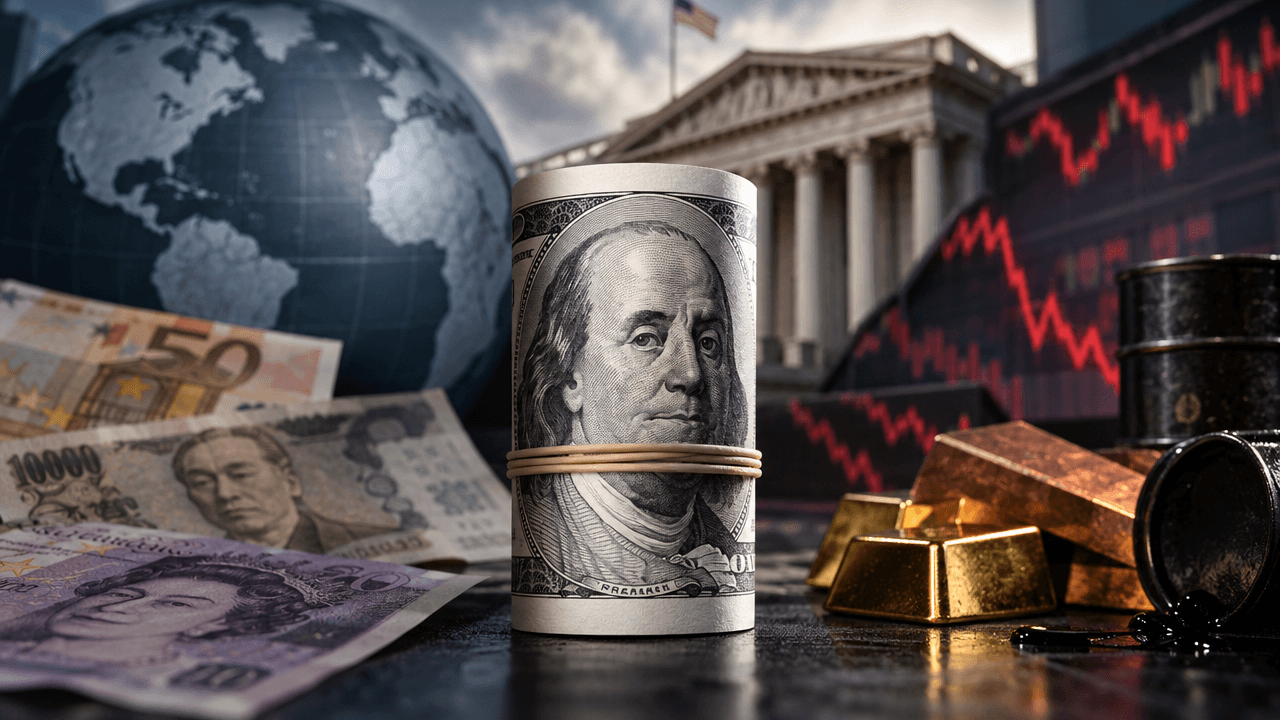
The US dollar is holding near its strongest level since spring 2025 as investors reassess the path of inflation, interest rates, and economic growth. Persistent price pressures have pushed Treasury yields sharply higher, reinforcing the dollar’s yield advantage over many competing currencies. At the same time, expectations that the Federal Reserve may keep policy restrictive for longer are weighing on risk assets, precious metals, and currencies linked to lower interest rates.
The Dollar Index recently traded near the 103–104 area, supported by resilient US economic data and elevated Treasury yields. The benchmark 10-year Treasury yield moved above 5%, while yields also climbed across shorter maturities as traders increased expectations for additional Federal Reserve tightening. [2][3][4]
Why Treasury Yields Matter For The Dollar
Treasury yields are central to the dollar’s appeal because they influence the return available from holding US-denominated assets. When yields rise, global investors may be more willing to buy US government bonds, money-market instruments, and other dollar-based investments. That additional demand can strengthen the currency.
The relationship is particularly important when yields rise because of stronger economic expectations rather than weakening conditions. A robust economy can support corporate earnings, attract foreign capital, and give the Federal Reserve more flexibility to maintain higher interest rates. Recent market commentary has pointed to stronger activity, elevated financing needs, and persistent energy-related cost pressures as factors contributing to the repricing of US rates. [1]
Short-term Treasury yields are especially influential for currency traders because they reflect expectations for upcoming Federal Reserve decisions. Two-year yields reportedly rose 34 basis points over two sessions, their sharpest such move in several years, as markets considered the possibility of further rate increases. [5] The larger the expected interest-rate gap between the United States and other major economies, the stronger the incentive to hold dollars.
Inflation Keeps The Federal Reserve In Focus
Inflation remains the market’s main policy variable. Recent data showed core inflation rising 0.3% month over month, above expectations for a 0.2% increase. Producer prices also accelerated to an annual rate of 6.5%, the strongest reading since late 2022. [6][8]
These figures do not automatically guarantee a rate increase, but they make it more difficult for policymakers to declare victory over inflation. If businesses continue passing higher input costs to consumers, price growth could remain above the Federal Reserve’s 2% objective. Investors must then consider whether interest rates need to stay high for longer or rise further to slow demand.
Federal Reserve officials have also emphasized that inflation has not cooled sufficiently. Markets have continued to price in the possibility of another 25-basis-point increase, while uncertainty has grown over whether policymakers could choose a larger move if price pressures intensify. [1][9]
For the dollar, even the expectation of tighter policy can be supportive. Currency markets often react before a central bank acts, especially when investors adjust positions based on economic data and official comments.
Pressure On Other Currencies And Risk Assets
A stronger dollar creates challenges for other currencies. The euro, British pound, Japanese yen, and emerging-market currencies can all come under pressure when US yields rise and capital flows toward dollar assets. Countries with lower interest rates or weaker economic growth may become less attractive by comparison.
The impact extends beyond foreign exchange. A stronger dollar makes commodities priced in dollars more expensive for international buyers. Gold and silver can also face pressure because higher yields increase the opportunity cost of holding assets that do not pay interest. Silver recently fell below $50 as rising yields and the stronger dollar weighed on precious metals. [2]
Risk assets may also struggle. Higher interest rates raise the discount rate applied to future corporate earnings, potentially reducing the valuation of growth stocks. They can also increase borrowing costs for companies, households, and governments. Investors may respond by reducing exposure to highly leveraged businesses, speculative assets, and markets that depend heavily on cheap financing.
However, dollar strength does not guarantee a one-way market. If higher yields eventually damage economic activity, investors could begin pricing in slower growth and future rate cuts. That shift could reverse the dollar’s momentum, particularly if inflation shows convincing signs of easing.
Practical Takeaways For Simfi Traders
Simulated finance traders should treat the dollar as part of a broader macroeconomic system rather than trading it in isolation. A useful first step is to monitor the US Dollar Index alongside the two-year and 10-year Treasury yields. If both the dollar and yields are rising together, the market is often expressing stronger expectations for restrictive Federal Reserve policy.
Second, pay attention to the difference between headline and core inflation. Energy and food prices can create short-term volatility, but core inflation may have a greater influence on expectations about persistent price pressures. A hotter-than-expected core reading can strengthen the dollar, while a softer figure may reduce rate-hike expectations.
Third, watch for divergence between yields and the dollar. If Treasury yields continue rising but the dollar fails to strengthen, the market may be questioning the durability of the move. Conversely, a falling dollar despite softer yields could signal that investors are positioning for an eventual policy shift.
Risk management remains essential. Rather than entering trades solely because the dollar is strong, define the invalidation level, consider position size, and avoid excessive exposure around inflation releases or Federal Reserve announcements. Correlated positions can magnify risk: a long-dollar trade, short gold position, and short emerging-market currency trade may all lose simultaneously if yields suddenly fall.
Conclusion
The dollar remains supported by a powerful combination of elevated Treasury yields, persistent inflation concerns, and expectations for a Federal Reserve that may keep interest rates restrictive. The recent rise in the 10-year yield above 5% and the dollar’s move near a 19-month high show how quickly markets can reprice when inflation data challenges expectations. [3][8]
For now, the dollar’s direction depends on whether US price pressures continue to surprise higher or begin to moderate. Traders should focus on the interaction between inflation, Treasury yields, Federal Reserve communication, and broader risk sentiment. In SimFi, the objective is not simply to predict the next dollar move, but to build a disciplined process that responds to changing evidence while controlling downside risk.