
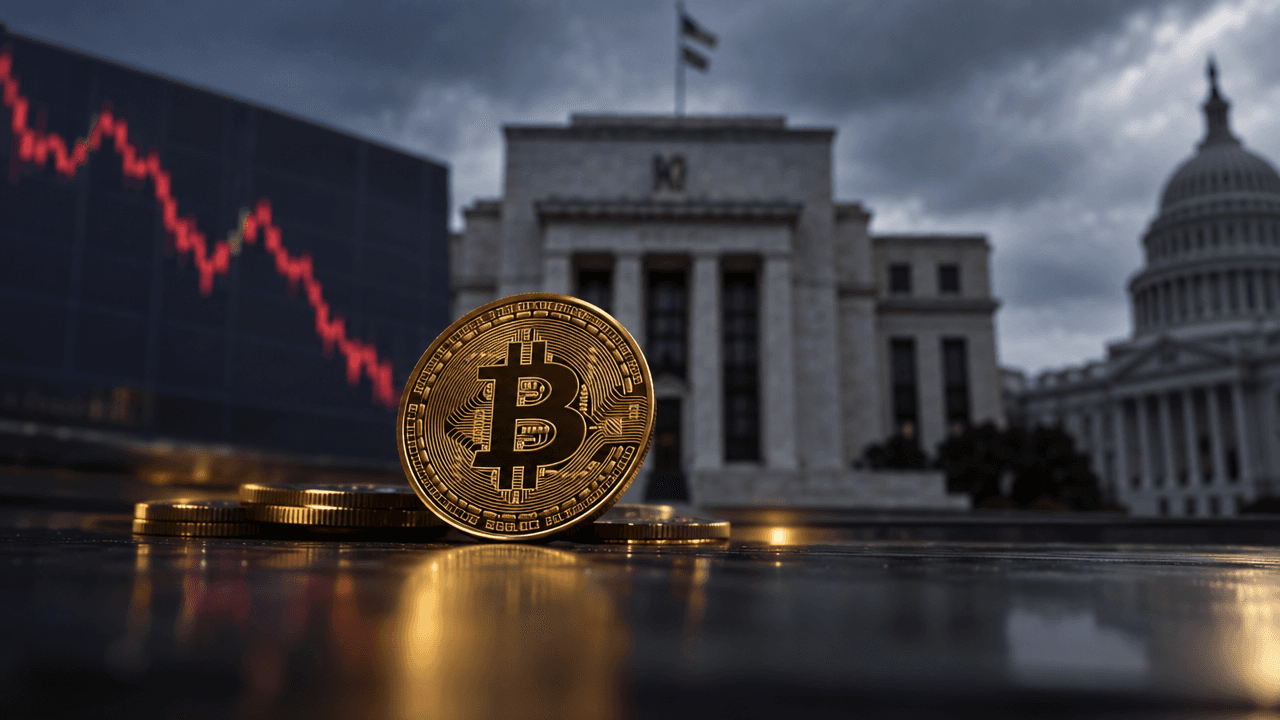
Bitcoin remains below $65,000 as investors respond to two increasingly important risks: the possibility of another Federal Reserve interest-rate hike and uncertainty surrounding the future of cryptocurrency regulation in the United States. The world’s largest digital asset traded near $64,485.40 on Monday, November 16, after touching an intraday low of $64,238 and hovering close to a three-month low. [2]
The decline reflects more than a single day of selling. It illustrates how quickly macroeconomic policy, election outcomes, market liquidity, and investor positioning can combine to pressure digital assets. Ethereum also weakened, trading near $1,805, while the broader cryptocurrency market capitalization declined as traders reduced exposure to riskier assets. [4]
Why Interest-rate Expectations Matter
The Federal Reserve’s interest-rate policy is one of the most important forces influencing Bitcoin and other speculative investments. When interest rates rise, cash and government bonds generally become more attractive because they offer higher yields with less perceived risk. At the same time, higher borrowing costs can reduce liquidity throughout financial markets.
Bitcoin does not generate interest or dividends. Its valuation depends largely on demand, adoption, liquidity, and expectations about future use. When investors can earn more from relatively lower-risk assets, they may become less willing to hold volatile assets such as cryptocurrencies.
Recent US inflation data has strengthened expectations that the Federal Reserve could raise its policy rate again in December. Market participants have reportedly treated a 25-basis-point increase as highly likely, while some bets have also emerged around a larger 50-basis-point move. [3] This has contributed to higher Treasury yields and a stronger US dollar, both of which can create additional headwinds for Bitcoin.
For traders, the key issue is not simply whether rates rise. The market is also evaluating the language used by Federal Reserve officials, the persistence of inflation, employment data, and whether additional hikes could follow. A rate increase that is already fully anticipated may cause limited disruption. A larger-than-expected move or a more aggressive policy outlook could produce another wave of volatility.
Regulatory Uncertainty Adds Pressure
Monetary policy is only one part of the current market story. Investors are also reassessing the outlook for US cryptocurrency regulation following major changes in the country’s political landscape.
The recent Democratic sweep in the US midterm elections has raised concerns among some market participants that crypto businesses could face closer scrutiny. Specific areas of concern include anti-money-laundering requirements, consumer protection, stablecoin oversight, exchange supervision, and the classification of digital assets. [2]
Regulation can have two opposing effects on the market. Clear, consistent rules may encourage institutional participation by reducing legal uncertainty. However, the possibility of stricter requirements, enforcement actions, or delays to legislation can make investors more cautious in the short term.
The CLARITY Act, intended to establish a federal framework for digital-asset markets, passed the House of Representatives in 2025 but has stalled in the Senate. That delay leaves businesses and investors without a fully settled regulatory framework and reinforces concerns that future rules may depend heavily on political negotiations. [1]
From a market perspective, uncertainty can be more damaging than regulation itself. Traders can often adjust to known requirements. They have more difficulty pricing an environment in which the treatment of exchanges, tokens, stablecoins, and decentralized finance remains unclear.
What The Market Decline Signals
Bitcoin’s move below $65,000 is a warning that sentiment has weakened, but it is not automatically proof that a long-term bear market has begun. Price levels should be assessed alongside trading volume, derivatives positioning, exchange flows, ETF activity, and the behavior of long-term holders.
Ethereum’s decline and the drop in total crypto-market capitalization suggest that selling pressure is broad rather than limited to Bitcoin. When major altcoins weaken alongside Bitcoin, it often indicates that investors are reducing overall risk rather than rotating aggressively into another digital asset. [7]
Traders should also be cautious about treating round numbers as guaranteed support or resistance. The $65,000 level is psychologically important, but markets can move through such thresholds quickly when leveraged positions are liquidated. A sustained recovery above the level would be more meaningful if supported by improving liquidity and stronger spot demand. Conversely, repeated failures to reclaim it could encourage additional selling.
The most important near-term catalysts include upcoming inflation data, Federal Reserve communications, Treasury-yield movements, regulatory announcements, and changes in digital-asset fund flows. Each can influence Bitcoin independently, but their effects may be amplified when they point in the same direction.
Practical Takeaways For Traders
First, avoid relying on a single narrative. Bitcoin’s weakness is being shaped by both macroeconomic and regulatory developments, so a chart-based strategy should be tested against changing economic conditions.
Second, manage leverage carefully. Rate-sensitive markets can experience sharp moves when expectations change, even if no official policy decision has been announced. Smaller positions, wider awareness of liquidation levels, and predefined stop-loss rules can help limit unnecessary damage.
Third, distinguish volatility from opportunity. A lower price does not automatically mean an asset is undervalued. Traders should examine whether demand is returning, whether selling volume is fading, and whether the broader market is stabilizing before assuming that a reversal is underway.
Finally, SimFi traders can use this environment to practice scenario planning without risking live capital. One scenario could involve a 25-basis-point hike with relatively calm guidance. Another could involve a larger hike, rising yields, and deeper Bitcoin weakness. A third could feature regulatory clarity that improves sentiment despite restrictive monetary policy.
Conclusion
Bitcoin’s position below $65,000 reflects a market caught between long-term digital-asset adoption and immediate macroeconomic pressure. Higher-rate expectations increase the opportunity cost of holding non-yielding assets, while regulatory uncertainty encourages investors to wait for greater clarity.
The next phase of the market will depend on whether inflation cools, how firmly the Federal Reserve responds, and whether US policymakers move toward clearer cryptocurrency rules. Until those questions become easier to answer, disciplined risk management and scenario-based analysis may be more valuable than attempting to predict the exact next price move.