
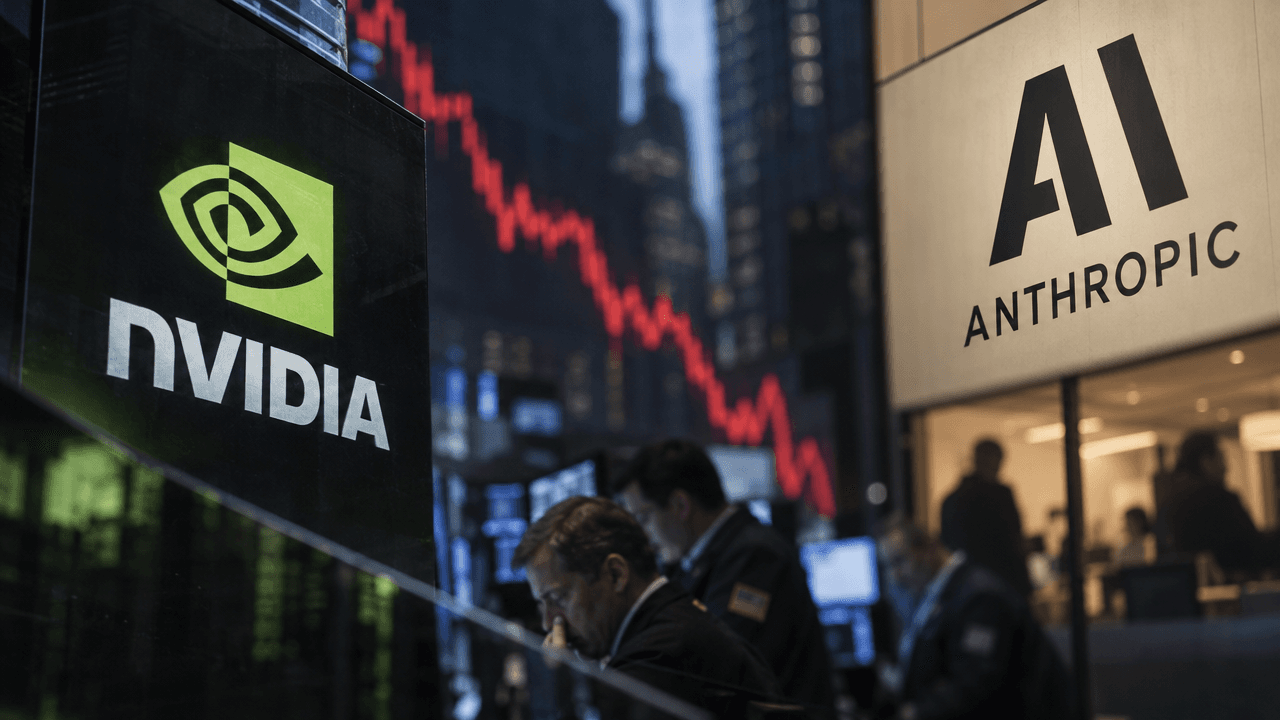
US equity futures weakened on Monday as investors reassessed the strength of the artificial-intelligence trade ahead of Nvidia’s earnings report and Anthropic’s planned public debut. Nasdaq-100 futures fell more sharply than broader-market contracts, while Nvidia shares declined in premarket trading, reflecting the unusually high expectations surrounding the chipmaker’s results. [15]
The market’s reaction matters because Nvidia has become more than a large technology company. Its chips, data-center systems and software are central to the infrastructure supporting generative AI. As a result, its revenue growth, profit margins and forward guidance can influence valuations across semiconductors, cloud computing, software and other growth-oriented sectors.
THE MARKET’S IMMEDIATE CONCERN
Weakness in Asian technology shares helped put pressure on U.S. futures. Technology stocks across South Korea, Japan and China came under renewed selling pressure after a difficult week for U.S. chip stocks, suggesting that investor concerns are spreading across global markets rather than remaining isolated to one company. [9]
The decline highlights the sensitivity of AI-related assets to changes in sentiment. For much of the recent rally, investors have been willing to pay elevated valuations because they expect AI-related earnings to grow rapidly for years. That optimism has supported major stock indexes, but it has also increased the consequences of disappointing guidance or evidence that corporate spending is slowing.
Nvidia’s leadership transition has added another layer of uncertainty. The company is preparing to report its first quarterly results following the abrupt departure of CEO Jensen Huang, according to market reports. Investors are therefore examining not only the headline numbers but also how the new management structure communicates its strategy and future outlook. [3]
For traders, the key lesson is that market-moving events often involve expectations rather than absolute performance. A company can report strong results and still see its stock fall if those results do not exceed the forecasts already reflected in the share price.
What Investors Expect From Nvidia
Analysts are expecting Nvidia to report approximately $109 billion in fiscal third-quarter revenue, with earnings growth estimated at about 90% compared with the prior year. [6] Those figures illustrate the extraordinary scale of the AI investment cycle, but they also set a demanding hurdle.
Investors will be watching several areas closely. The first is data-center revenue, which remains the clearest measure of demand for AI computing infrastructure. The second is gross margin, since supply constraints, product mix and rising competition can affect how much of each dollar of revenue becomes profit. The third is the company’s outlook for the next year, particularly whether large cloud providers continue expanding capital expenditure.
Supply availability will also remain important. Nvidia’s performance depends on the ability of manufacturing partners and advanced-packaging suppliers to deliver high-end processors at scale. Strong demand is less valuable to investors if production constraints prevent the company from converting orders into reported revenue.
Finally, the market will scrutinize customer concentration and the durability of AI spending. If a small number of major technology companies are responsible for a large share of demand, any adjustment in their capital budgets could create an outsized impact on Nvidia and its suppliers.
ANTHROPIC’S IPO AS A VALUATION TEST
The planned Anthropic IPO gives investors a second, near-term test of enthusiasm for artificial intelligence. The Claude chatbot developer is expected to price shares between $70 and $78, potentially raising as much as $64.35 billion and reaching a fully diluted valuation of approximately $1.405 trillion at the top of the range. Trading is expected to begin on November 19. [12]
That would make the offering one of the largest technology listings ever. Its performance could provide a real-time measure of whether investors are still willing to fund fast-growing, loss-making AI companies at ambitious prices.
A strong debut could reinforce confidence in the sector, improve sentiment toward other AI-linked businesses and encourage additional companies to pursue public listings. A weak debut, however, could have the opposite effect. Investors might begin demanding clearer paths to profitability, lower entry valuations or stronger evidence that AI revenue can justify massive infrastructure costs.
The IPO also creates a useful comparison with Nvidia. Nvidia represents the established infrastructure supplier already producing substantial earnings, while Anthropic represents a private-sector AI application company seeking to convert rapid growth into public-market value. The market will be comparing both businesses, even though their operating models are very different.
Practical Takeaways For Traders
Volatility is likely to remain elevated around the earnings release and IPO pricing. Traders should avoid treating an initial price move as a complete verdict. A stock may rise or fall immediately after earnings and then reverse when investors study the guidance, margins and conference-call commentary.
Position sizing is especially important when implied expectations are high. A smaller position with a predefined risk level can help limit the damage from a gap move, while traders using leveraged products should account for the possibility that stop orders may execute at worse prices during fast markets.
It is also useful to separate company-specific risk from broader market risk. Nvidia’s results may affect chip stocks directly, but they can also influence the Nasdaq, growth stocks and investor appetite for risk more generally. Monitoring index futures, semiconductor exchange-traded funds, Treasury yields and the U.S. dollar can provide additional context.
Longer-term investors should focus on fundamentals rather than attempting to predict a single earnings reaction. Important questions include whether AI demand is translating into recurring revenue, whether margins remain sustainable and whether customers are earning attractive returns on their infrastructure spending.
The Bigger Picture
Monday’s weaker futures do not prove that the AI cycle is ending. They show that the market has entered a more demanding phase, in which extraordinary growth must continue to justify extraordinary valuations. Nvidia’s results will test the durability of the sector’s earnings engine, while Anthropic’s debut will test how much speculative enthusiasm remains.
The most constructive outcome would be evidence of strong demand, disciplined investment and credible long-term profitability. The more concerning outcome would be slowing orders, cautious guidance or an IPO valuation that investors reject. Either way, this week’s developments may help define whether the next stage of the AI trade is driven by expanding fundamentals or by increasingly fragile expectations.