
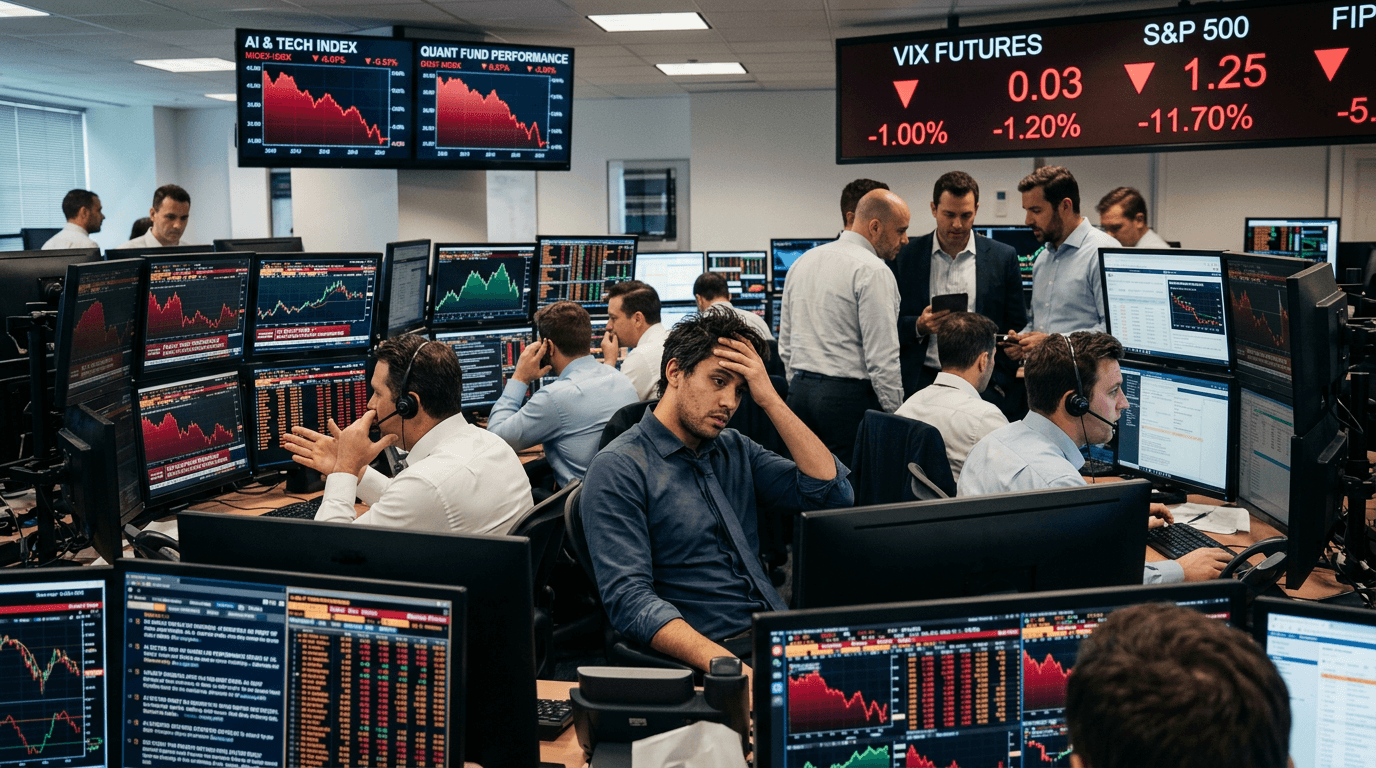
The artificial intelligence trade just reminded markets that even the hottest theme can turn cold in a hurry. A sharp selloff in AI‑linked equities has triggered the worst run of performance for major quant funds since last August, and the resulting risk‑off cascade is now rippling through equity index and volatility futures as systematic strategies scramble to de‑risk.[1][4][2] For traders of all sizes—from institutional funds to SimFi participants—the episode is a live case study in crowding risk, leverage, and the mechanics of modern market unwinds.
WHAT JUST HAPPENED IN THE AI TRADE – AND WHY IT MATTERS
For much of the year, AI‑related stocks and semiconductors were the epicenter of market leadership, attracting both discretionary investors and algorithmic trend‑followers.[1][7] As prices marched higher, quant strategies that box markets into factors like momentum, growth, and quality increasingly leaned into AI winners, building large, correlated exposures across U.S. and Asian equity markets.[4][2]
That setup made the sector vulnerable to any sharp reversal. When AI stocks finally corrected, the move was not just a routine dip—it was a concentrated shock to a heavily crowded theme.[4][3] Systematic managers, often called quant funds, saw about a quarter of their year‑to‑date returns erased in a matter of weeks, with aggregate gains dropping from around 14.4% in late June to roughly 10.8%, marking their worst stretch since last August even though performance remains positive for the year.[1][4][2]
This matters beyond the immediate P&L hit. Quant funds are significant liquidity providers across cash equities and derivatives. When they de‑risk in unison, they can turn a sector correction into a cross‑asset event, amplifying short‑term swings in broader indices and volatility products.[4][7]
Why Quant Funds Were So Vulnerable To The Ai Shakeout
The core problem was not “AI” as a technology story; it was crowding around a single narrative. Goldman Sachs had previously flagged AI momentum positioning at the 100th percentile of its five‑year dataset—effectively the maximum crowding it had recorded.[7] Many systematic strategies, from trend‑following futures funds to statistical arbitrage equity books, were leaning in the same direction at the same time.
Several dynamics compounded the vulnerability
First, factor and trend models reinforced the bubble. As AI stocks outperformed, momentum and growth signals kept adding exposure, often with leverage, until the trade became structurally over‑owned.[7][2]
Second, correlations shifted. When the AI sector rolled over, it dragged related chipmakers, hardware suppliers, and broader tech indices with it, creating a correlated drawdown that hit multiple quant “buckets” simultaneously.[3][6]
Third, risk models reacted procyclically. As volatility in AI names spiked, quant risk engines demanded position cuts to stay within limits. That forced selling into a falling market, further pressure on prices, and negative feedback into other parts of the book.[2][5]
The result was an accelerated performance slump: in some regions, such as China, quant funds posted their worst week in more than two years as local AI‑linked stocks joined the global reversal.[3][6]
From Stocks To Futures: How The Unwind Spread
Once systematic managers decide to reduce risk, they do not sell only cash equities. They typically reach for the most liquid instruments available—equity index futures and volatility futures—and that is where the AI selloff’s footprint has grown wider.[1][4]
Equity index futures became the primary tool for fast de‑risking. To cut beta exposure and sector concentration efficiently, funds short broad indices or reduce long futures positions rather than liquidate every single stock.[1][2] This can pull major benchmarks lower even if the original shock is concentrated in one sector, translating an AI correction into a wider equity selloff.
Volatility futures felt the impact through hedging and speculative flows. As realized and implied volatility jumped in AI names, demand for volatility exposure rose, and systematic strategies adjusted their volatility targets and convexity hedges.[4][5] Some funds increased long volatility futures to protect against further downside, while others had to unwind short volatility positions, adding fuel to the move.
For discretionary traders and SimFi participants, this is a critical lesson: sector‑specific narratives can have derivative consequences. A theme that begins in AI stocks can affect S&P 500 or Nasdaq futures, volatility indices, and even cross‑asset risk appetite in credit and commodities as portfolio‑level risk is recalibrated.[4][2]
Practical Lessons For Traders And Simfi Participants
This kind of episode is not just headline noise; it offers concrete risk‑management lessons you can apply in live markets and simulated environments.
1) Stress‑test theme reversals. If most of your performance depends on a single narrative—AI, clean energy, biotech—model what happens if that theme drops 15–20% quickly.[2] Ask how your equity, index futures, and volatility exposures behave under that scenario. Stress tests help reveal hidden concentration and liquidity risks before the market does.
2) Monitor crowding, not just price. Look beyond returns and track how “consensus” your trades have become.[7] In practice, that means watching:
- Positioning data and sentiment indicators
- Correlations across your portfolio
- The degree to which multiple strategies rely on the same signals
Crowded trades can continue working, but once they break, they often unwind faster and more violently than diversified exposures.
3) Treat volatility spikes as information. A sudden rise in volatility—especially in a leadership sector like AI—is a signal that market participants are repricing risk, not just random noise.[2][5] Instead of automatically fading the move, ask whether positioning, leverage, or structural factors (like risk‑parity or volatility targeting) are being forced to adjust.
4) Use SimFi to rehearse unwinds. Simulated finance platforms allow you to test how your strategies respond to shocks without putting real capital at risk. You can:
- Run AI‑sector crash scenarios
- Practice cutting risk via index and volatility futures
- Study how portfolio performance changes when correlations spike
By building and stress‑testing playbooks in a simulated environment, you are better prepared when similar dynamics hit real markets.
What To Watch Next
The current AI‑driven shakeout is unlikely to mark the end of the AI story itself. Structural drivers—from corporate investment in automation to chip demand—remain intact, but the path of prices may be much bumpier as markets digest earlier excesses.[1][3] For quant funds, the episode is a reminder that their edge depends not just on sophisticated models, but also on disciplined exposure management and an awareness of crowding risks.[7][2]
In the coming weeks, key signposts will include whether AI‑linked stocks stabilize, how quickly quant performance recovers from the worst slump since last August, and whether volatility in index and volatility futures subsides as systematic strategies finish de‑risking.[1][4] For traders and SimFi users, the practical opportunity is to treat this not as a one‑off shock, but as a template: crowded narratives, leveraged momentum, and fast derivative adjustments are likely to recur around future themes—whether in AI, energy transitions, or the next technology revolution.