
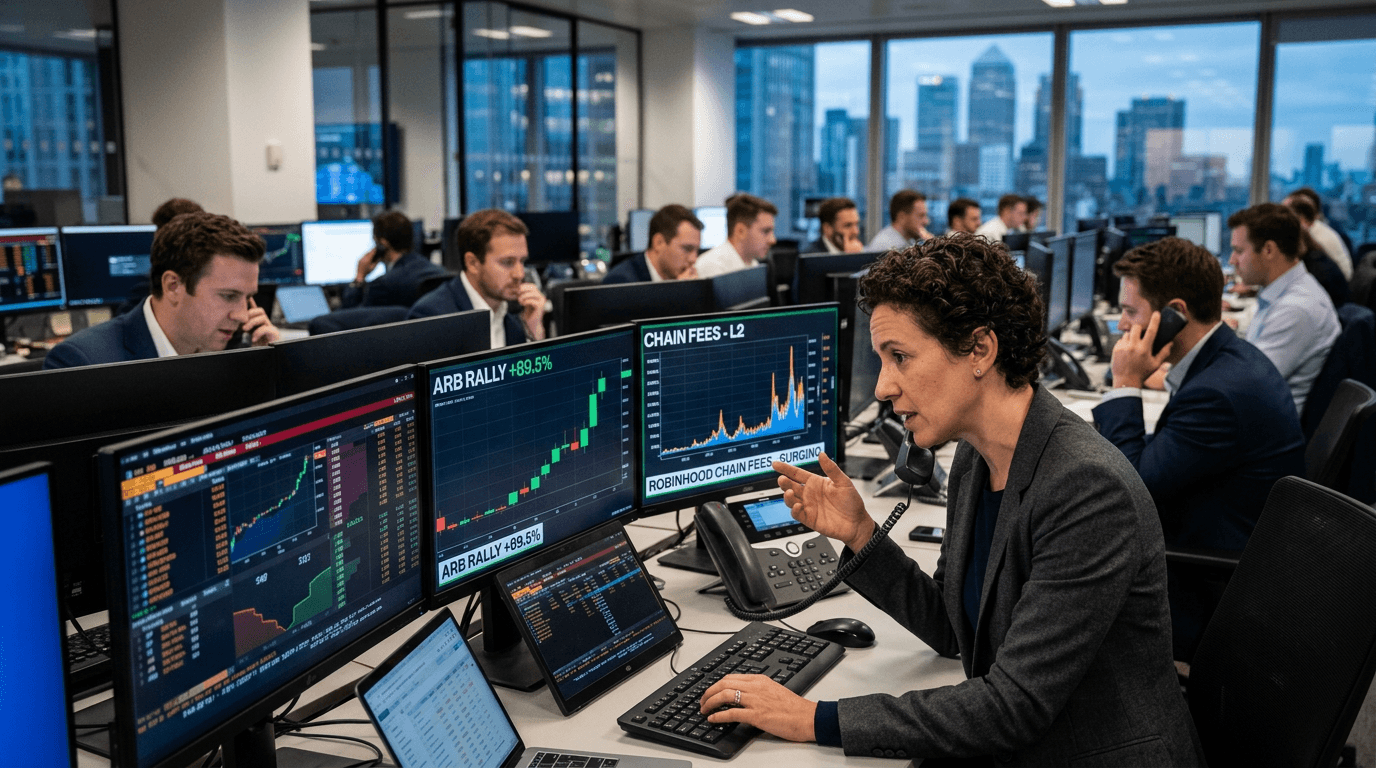
Arbitrum’s ARB token has staged one of the most eye-catching recoveries in the layer-2 space, rallying roughly 90%–96% off its recent record lows as activity and fee generation on Robinhood Chain explode higher.[3][4][9][13][14][15] For traders, this move is less about pure speculation and more about a concrete shift in on-chain revenues and how those cash flows are being repriced in the market.[1][3][9][13]
UNDERSTANDING THE ARBITRUM–ROBINHOOD CHAIN LINK
Robinhood Chain is an Ethereum layer-2 network built using Arbitrum’s Orbit stack, meaning it leverages Arbitrum technology for scalability while maintaining a distinct brand and user base.[1][3] As trading and DeFi activity on Robinhood’s blockchain accelerated, daily fees reportedly surged toward the $4.45 million mark, putting the chain among the most lucrative new L2s by fee income.[1][3][9][13]
A key part of the current narrative is revenue sharing from Robinhood Chain back into the Arbitrum ecosystem.[1][3] Market commentary and analytics suggest that roughly 10% of Robinhood Chain’s net revenue is directed toward Arbitrum’s DAO or broader ecosystem, creating a tangible link between Robinhood’s growth and ARB’s fundamental value.[1][3] That connection has turned ARB from a purely governance token into a quasi-revenue asset in the eyes of many traders.[1][3][4]
The timing of the surge also matters. ARB had been stuck in a depressed range around its lows near the $0.07–$0.08 area for much of the summer, with sentiment deeply negative and liquidity thin.[3][4][7][14] The combination of visible revenue inflows from Robinhood Chain and a technical breakout from this base gave traders a clear catalyst to reprice the token higher.[3][4][7]
Why Fees And On-chain Revenue Matter
In the current market environment, traders are increasingly focused on “real yield” and protocol revenues rather than purely narrative-driven tokens.[1][4][8] Layer-2 networks that can show growing user activity, strong fee generation, and credible paths to distributing value to token holders tend to attract capital faster when risk appetite returns.[1][3][4][9]
Arbitrum fits squarely into this trend. Reports show its ecosystem income for the first half of the year in the multi-million dollar range, with high gross margins driven by low operating costs relative to fee revenue.[4] The Robinhood Chain contribution adds a new, fast-growing income stream on top of Arbitrum’s existing base of DeFi, gaming, and infrastructure protocols.[1][3][4]
For traders, the crucial point is that fee growth can justify higher valuations even in a sideways macro environment.[1][4][8] When daily fees spike into the millions, and a portion of that revenue is earmarked for the DAO, the implied cash flow profile of the token improves, which can support a sustained repricing rather than a purely speculative pump.[1][3][4]
This is why the current rally has been accompanied by expectations that ARB could extend toward the $0.15 area if fee momentum and revenue-sharing visibility persist.[4][7][9][14] Price targets in this zone reflect not only technical resistance but also updated assumptions about what multiple the market is willing to pay on Arbitrum’s growing L2 income.[4][7][9]
Derivatives Positioning And Layer-2 Rotation
As spot prices broke out, derivatives markets quickly followed. Futures volume in ARB has jumped sharply, with some data showing 24-hour volume up more than 700% and open interest climbing over 60% as traders piled into leverage.[7][9][13] Funding rates have flipped positive, indicating that long positions are now paying shorts to maintain exposure.[7][9][13]
This shift in derivatives positioning reflects a broader sector rotation. High-beta tokens tied to layer-2 ecosystems and on-chain revenues have become preferred vehicles for traders seeking amplified exposure to a crypto rebound.[1][3][8] As Robinhood Chain’s metrics improved, ARB was reclassified by many as a “revenue-backed L2 trade” rather than just another altcoin.[1][3][4]
The knock-on effects extend beyond Arbitrum. Other L2 tokens and infrastructure plays have seen renewed interest as traders scan for similar fee-growth stories that might be mispriced.[1][8][9] In some cases, this has created a mini “L2 season,” where capital flows into networks showing rising transaction counts, fee revenues, and sustainable economic models.[1][4][8]
For derivatives traders, this environment demands careful risk management. Rapid increases in open interest, thin order books at higher prices, and crowded long positioning can turn a fundamentally driven rally into a volatile, liquidation-prone trade.[7][9][13] Monitoring funding rates, skew, and order book depth becomes essential when trading ARB directionally.
What Traders Should Watch Next
Several indicators will determine whether ARB’s ~90% rally evolves into a durable trend or fades back into its prior range.[3][4][7][14] First, traders should track Robinhood Chain’s daily active users, transaction counts, and fee revenue to see if the $4.45 million level was a spike or the start of a sustained plateau.[1][3][9][13]
Second, the mechanics and transparency of the revenue-sharing arrangement with Arbitrum’s ecosystem are critical.[1][3] Clear on-chain flows, DAO reporting, and governance decisions on how to deploy these funds—whether for grants, buybacks, or ecosystem incentives—will influence how confidently the market can model ARB’s long-term value.[1][4]
Third, watch derivatives metrics such as open interest, funding, and options implied volatility. If open interest continues to climb while funding normalizes, it may signal a healthier mix of long and short positioning, reducing the risk of a sharp unwind.[7][9][13] Conversely, extremely positive funding and one-sided longs could precede a shakeout, even within a bullish fundamental backdrop.[7][9][13]
Finally, broader macro and crypto sector flows still matter. Arbitrum’s rally has benefited from pockets of risk-on sentiment in altcoins and renewed interest in sectoral narratives like L2 scalability and real-world asset tokenization.[1][4][8] Should macro conditions deteriorate or risk appetite fade, even revenue-backed tokens can experience meaningful drawdowns.[1][8]
Conclusion
Arbitrum’s latest surge showcases how quickly sentiment can flip when a clear revenue story emerges around a previously depressed asset.[3][4][7][9] Robinhood Chain’s rapid growth, multimillion-dollar daily fees, and revenue sharing into the Arbitrum ecosystem have provided the fundamental backbone for ARB’s ~90% rebound from its lows.[1][3][4][9][13]
For traders, the key takeaway is that on-chain cash flows are increasingly driving altcoin repricing, especially in the layer-2 space.[1][4][8] Understanding how fee revenues connect to token economics, monitoring derivatives positioning, and tracking sector rotations into high-beta L2 names can turn headlines into actionable trade ideas rather than noise.[1][3][4][7][9]
As ARB eyes the $0.15 region, the sustainability of Robinhood Chain’s activity and the clarity of Arbitrum’s revenue distribution will determine whether this move becomes a new baseline or a short-lived spike.[1][3][4][7][9][14] In a market where fundamentals and flows are finally converging, traders who can read both sides of the story will be best positioned to navigate the next phase of L2 evolution.